
April 30th Dr Ada Grabowska-Zhang and Dr Joanna Bagniewska – Connecting nature and connecting with nature – tools, motivations and capacity
Society is experiencing an increased disconnection from nature, which not only impacts the environment, its restoration and conservation, but also human well-being. Here we present several projects through which we give people the tools and motivations to connect with nature, and capacity to restore it in their local community. From designing bird nestboxes made of fungus, through investigating biodiversity on school grounds, to verifying the didactic potential of bird ID apps, we will cover topics that combine education, biodiversity monitoring and nature recovery.
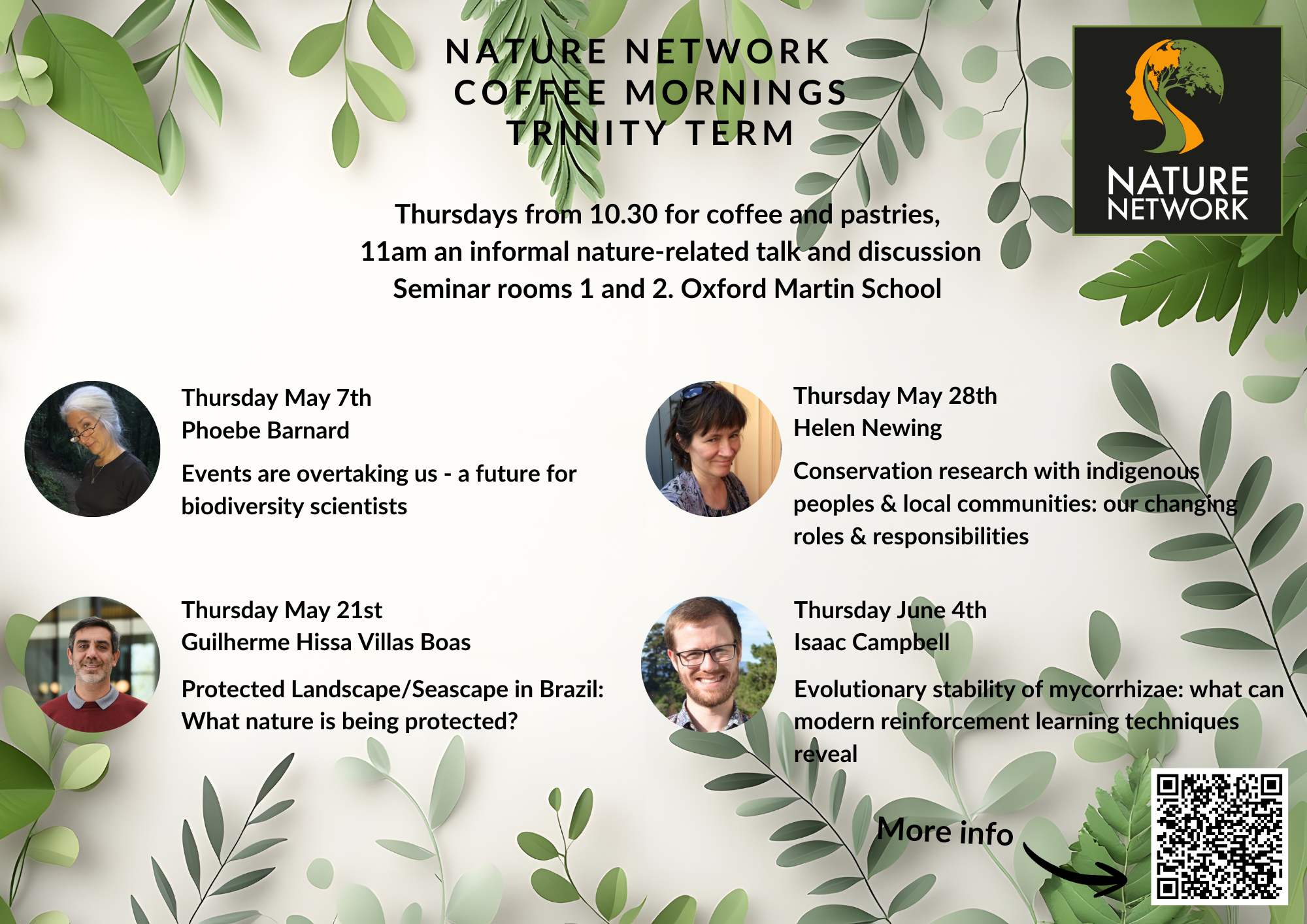
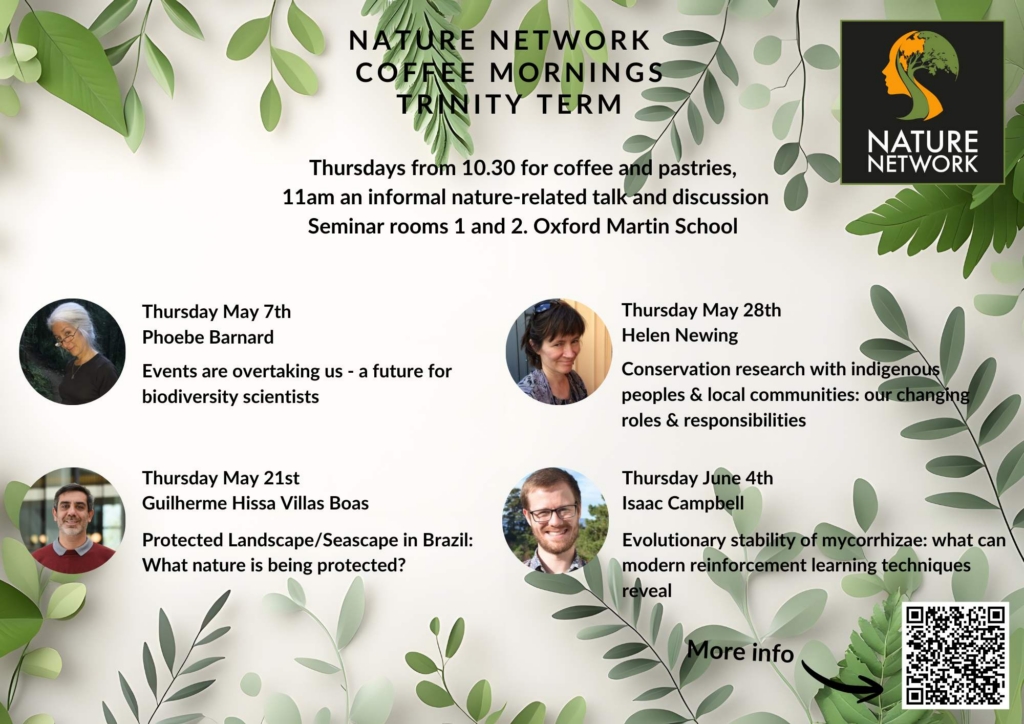
May 7th Phoebe Barnard: Events are overtaking us – a future for biodiversity scientists
Veteran biodiversity and climate scientist Phoebe Barnard has decided to go straight for the jugular of our civilizational crises, realizing that an already Sisyphean task of Nature protection and recovery is becoming an almost vertical climb in the systems we are trapped in. She’ll talk informally about her and her teams’ work towards a civilization based on Earth repair, climate repair and societal reconnection.
21st May. Guilherme Hissa Villas Boas: Protected Landscape/Seascape in Brazil: What nature is being protected?
Protected Landscapes/Seascapes is an IUCN protected area category widely used in Brazil, aimed at protecting biodiversity, controlling land use, and promoting sustainable development. Although it accounts for more than half of Brazil’s protected areas and is home to 5% of the national population, this category remains misunderstood and even rejected by some environmentalist sectors. In this case study, I seek to present an overview of the 40-year history of these protected areas and their environmental and social impacts on the landscape.
May 28th. Helen Newing: Conservation research with indigenous peoples and local communities: our changing roles and responsibilities
The 2022 Kunming-Montreal Global Biodiversity Framework specifies that conservation should be rights-based, and that it should be be based on traditional knowledge as well as scientific evidence. In this talk I will present some of our experiences in ICCS of working with indigenous communities from a rights-based approach and ask: how are our roles and responsibilities changing?
June 4th. Isaac Campbell. Evolutionary stability of mycorrhizae: what can modern reinforcement learning techniques reveal
Mycorrhizal symbioses between plants and fungi are well-established, yet the factors moderating outcomes of these relationships remain unclear. Grounded in physiological processes and organismal morphology, we use a bioenergetics framework to investigate why plants and fungi trade, and exactly how much should they trade, given their need to acquire and utilise limited resources in an uncertain environment. We focus on phosphorus and carbon use, how these vary between plant functional types, and how this impacts symbiotic outcomes