
22nd Jan – Brigid Hains and Richard Fisher
Science communication that makes sense.
In this session, two experienced editors from the digital magazine Aeon will share advice and insights on how to develop, pitch and write long-form science essays for a general, global audience. Aeon’s mission is to explore and communicate knowledge that helps us make sense of ourselves and the world. The magazine works with leading thinkers in science, philosophy, psychology, society and culture to publish well-written, thought-provoking ideas for a general readership – at length, and in depth.
Find out how it works in a behind-the scenes talk and Q&A with Aeon’s editorial director and co-founder Brigid Hains, and science editor Richard Fisher, an honorary professor in science communication at UCL.
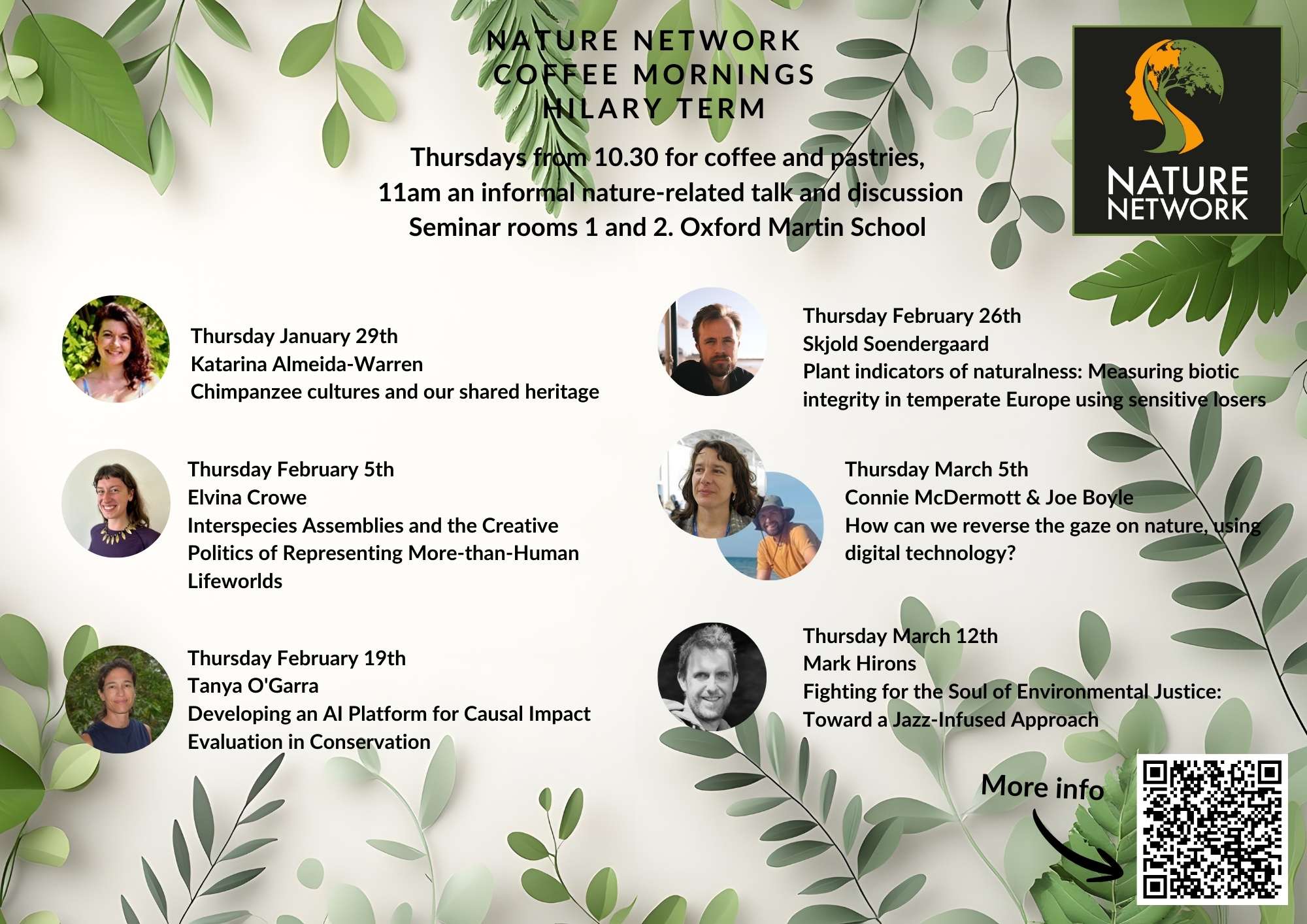
29th Jan – Katarina Almeida-Warren
Chimpanzee cultures and our shared heritage.
Chimpanzee populations across Africa exhibit remarkable cultural diversity, with distinct tool-use traditions and behaviours that are passed down through generations. Studying these cultural traditions through an archaeological lens is providing critical insights into our own evolutionary origins by revealing the behavioural, cognitive and cultural foundations we share with our closest living relatives. Yet, today, chimpanzee populations face not only biological extinction but also the loss of cultural knowledge, critical to their survival and resilience in a changing world. Recognising our shared primate cultural heritage and reframing culture as integral to nature offers a pathway toward understanding ourselves as part of nature’s complexity, not apart from it—a perspective essential for addressing the intertwined crises facing both human and non-human worlds.
5th Feb Elvina Crowe
Interspecies Assemblies and the Creative Politics of Representing More-than-Human Lifeworlds.
Interspecies assemblies are collective practices that seek to include more-than-human voices in deliberative processes where, through imaginative role-play, human participants embody nonhuman beings and speak from their perspectives. Revived in activist traditions, these practices have a strong history of animating nonhuman voices in public consciousness, making them valuable socio-political tools for ecological advocacy. Current literature is dispersed across disciplines, so here I present a synthesis of existing work and case studies, situating interspecies assemblies historically and examining their contemporary manifestations. Building on decolonial, feminist, and multispecies understandings of representation in deliberative democracy, the paper highlights the value of arts-based and embodied participation, as storytelling cultivates empathy and shapes more affective and effective forms of ecological governance.
12th Feb – NO MEETING THIS WEEK
19th Feb Tanya O’Garra
Developing an AI Platform for Causal Impact Evaluation in Conservation
Despite annual conservation investments exceeding $100 billion, global biodiversity continues to decline. A fundamental problem is the lack of credible causal evidence about what works in conservation, and why. This lack of causal evidence weakens both science and policy, diverting scarce resources toward well-intentioned but often ineffective interventions. Here Tanya will introduce an early-stage idea for a platform that integrates AI methods with causal inference, and AI-derived environmental and biodiversity metrics to evaluate conservation interventions, with the goal of sparking conversation about how AI could meaningfully strengthen evidence-based policy and investment decisions in conservation.
26th Feb Skjold Soendergaard
Plant indicators of naturalness: Measuring biotic integrity in temperate Europe using sensitive losers
The first step to halting species loss is identifying habitat with the highest conservation value. Plants seem like good candidates as indicators for such places, but are all plants equal in this regard? And what happens when our very definition of “natural” is biased? I will discuss how the closed-canopy theory—the dominant paradigm for natural vegetation in temperate Europe—complicates our ability to link conservation value with evolutionary baselines. If we assume dense forest is the only natural state, we risk misinterpreting the ecological history of open habitats. Finally, I will look beyond specific indicators to introduce a broader restoration evaluation metric, where measuring biotic intactness is just one component of a successful recovery strategy.
5th March Connie McDermott & Joe Boyle
An interactive ‘drop in’ session focussing on the Reverse Gaze. How can we reverse the gaze on nature, using digital technology?
How nature is seen determines how it is governed. The “Reverse Gaze” (a new Leverhulme Centre for Nature Recovery research stream) asks: How can we transform technology to expand our gaze on nature, to ‘see’ and account for a wider range of place-based knowledges, perspectives and actions on nature recovery?
Is it time for a new Nature Technology X? – An OS Mt. Olympus?
The recent explosion of nature technologies – from AI to remote sensing, drones, eDNA, and sensors of every description – has vastly expanded what we can ‘see’ and digitized, from outer space to the microcosm, without need for contact with the people and places being surveyed. This has made tremendous contributions to scientific understanding. But it has also narrowed our focus, and hence our vision, of who and what ‘counts’ towards knowledge, and towards global targets like Net Zero or 30×30.
What do you think? Do you have ideas of whether and how technologies could be democratized? What actions for nature are currently not being recognized? How we can ‘count’ what is currently unseen and unquantified?
We’re here to learn about your research, the technologies you use, and whether a reversed gaze would be relevant or useful to your work. To keep things festive, we’ll have delicious food and wine to support an open forum for frank discussion. Like it? Don’t? Tell us what you think and how your own work sits within this.
Where and When: the Oxford Martin School, 11-1, 5/3 (After Nature Network Coffee).
Agenda
Introduce the reverse gaze concept and research team
Discuss through prompt questions
Design a reversed gaze study + repurposed tech to answer it
Lunch included. Drop ins welcome.
12th March Mark Hirons
Fighting for the Soul of Environmental Justice: Toward a Jazz-Infused Approach
This talk reflects on the disjuncture between the increasingly widespread uptake of ideas related to environmental justice on the one hand, and an acceleration of authoritarianism, polarisation and contestations around the environmental agenda on the other. Drawing on Cornel West’s jazz-soaked philosophy, it advances a jazz-infused approach to environmental justice that, through the blues, swing, and improvisation, calls us to think of environmental justice as a collective practice of listening, shared rhythm, and creative action amid uncertainty and difference.