Biodiversity coffee seminars Alexandre Cha usson An introduction to systematic reviews
ORGANIZER;CN="Nature Admin":MAILTO:letsrecord@gmail.com URL;VALUE=URI:https://nature.ox.ac.uk/events/event/biodiversity-seminar-an- introduction-to-systematic-reviews/ END:VEVENT BEGIN:VEVENT UID:20260112T1002Z-1768212150.42-EO-8586-1@127.0.0.1 STATUS:CONFIRMED DTSTAMP:20260412T145451Z CREATED:20200929T090543Z LAST-MODIFIED:20210428T082436Z DTSTART;TZID=Europe/London:20200611T100000 DTEND;TZID=Europe/London:20200611T110000 SUMMARY: Legal Challenges and Possibilities for Future Nature-based Solutio ns DESCRIPTION: Biodiversity coffee seminars Annie Welden Legal Challenges and Possibilities for Future Nature-based Solutions X-ALT-DESC;FMTTYPE=text/html:Biodiversity coffee seminars Annie Welden Legal Challenges and Possibilities for Future Nature-based Solutions
ORGANIZER;CN="Nature Admin":MAILTO:letsrecord@gmail.com URL;VALUE=URI:https://nature.ox.ac.uk/events/event/biodiversity-coffee-semi nars-legal-challenges-and-possibilities-for-future-nature-based-solutions/ END:VEVENT BEGIN:VEVENT UID:20260112T1002Z-1768212150.43-EO-8871-1@127.0.0.1 STATUS:CONFIRMED DTSTAMP:20260412T145451Z CREATED:20210308T094808Z LAST-MODIFIED:20210428T082806Z DTSTART;TZID=Europe/London:20200611T100000 DTEND;TZID=Europe/London:20200611T110000 SUMMARY: An Introduction to Systems thinking DESCRIPTION: Biodiversity coffee seminars: Pam Berry – An Introduction to S ystems thinking X-ALT-DESC;FMTTYPE=text/html:Biodiversity coffee seminars: Pam Berry - An Introduction to Systems thinking
ORGANIZER;CN="Nature Admin":MAILTO:letsrecord@gmail.com URL;VALUE=URI:https://nature.ox.ac.uk/events/event/an-introduction-to-syste ms-thinking/ END:VEVENT BEGIN:VEVENT UID:20260112T1002Z-1768212150.43-EO-8588-1@127.0.0.1 STATUS:CONFIRMED DTSTAMP:20260412T145451Z CREATED:20200929T093111Z LAST-MODIFIED:20210428T082547Z DTSTART;TZID=Europe/London:20200701T103000 DTEND;TZID=Europe/London:20200701T113000 SUMMARY: Where not to plant trees DESCRIPTION: Biodiversity coffee seminars Dr Nicola Stevens. Where not to p lant trees. X-ALT-DESC;FMTTYPE=text/html:Biodiversity coffee seminars Dr Nicola Ste vens. Where not to plant trees.
ORGANIZER;CN="Nature Admin":MAILTO:letsrecord@gmail.com URL;VALUE=URI:https://nature.ox.ac.uk/events/event/biodiversity-seminars-wh ere-not-to-plant-trees/ END:VEVENT BEGIN:VEVENT UID:20260112T1002Z-1768212150.44-EO-8590-1@127.0.0.1 STATUS:CONFIRMED DTSTAMP:20260412T145451Z CREATED:20200929T100533Z LAST-MODIFIED:20210428T082724Z DTSTART;TZID=Europe/London:20200715T113000 DTEND;TZID=Europe/London:20200715T123000 SUMMARY: Mothers of Nature Photography Documentary DESCRIPTION: A revolutionary conservation project in Sri Lanka is empowerin g women in coastal communities (many of whom are widows from civil war or t sunami) to run their own businesses while actively protecting & replanting the island nations mangrove forests. This project focuses on their personal stories and the challenges in Sri Lanka that threaten the remaining […] X-ALT-DESC;FMTTYPE=text/html:A revolutionary conservation project in Sr i Lanka is empowering women in coastal communities (many of whom are widows from civil war or tsunami) to run their own businesses while actively prot ecting & replanting the island nations mangrove forests. This project focus es on their personal stories and the challenges in Sri Lanka that threaten the remaining forest & conservation efforts.
More infor mation about the project.
Scott's website photograph y website.
ORGANIZER;CN="Nature Admin":MAILTO:letsrecord@gmail.com URL;VALUE=URI:https://nature.ox.ac.uk/events/event/biodiversity-seminar-mot hers-of-nature-photography-documentary/ END:VEVENT BEGIN:VEVENT UID:20260112T1002Z-1768212150.45-EO-8622-1@127.0.0.1 STATUS:CONFIRMED DTSTAMP:20260412T145451Z CREATED:20201020T132719Z LAST-MODIFIED:20210506T082210Z DTSTART;TZID=Europe/London:20201020T093000 DTEND;TZID=Europe/London:20201020T103000 SUMMARY: Radish-lead ecosystem restoration strategies informed by ecologica l\, forestry and agricultural expertise. DESCRIPTION: An exploration of other sources of inspiration and operational insight into the recovery of ecosystems in Britain and elsewhere. An openi ng presentation to a wider debate. Speaker Jonathan William Spencer MBE\, F RSA\, FIBiol is a professional ecologist and former Head of Environment for Forestry England with wide professional interests in the history and ecolo gy of […] X-ALT-DESC;FMTTYPE=text/html:An exploration of other sources of inspira tion and operational insight into the recovery of ecosystems in Britain and elsewhere. An opening presentation to a wider debate.
Hollywood Storytelling Workshop and how to apply these ideas to your practice.
ORGANIZER;CN="Nature Admin":MAILTO:letsrecord@gmail.com URL;VALUE=URI:https://nature.ox.ac.uk/events/event/hollywood-storytelling-w orkshop/ END:VEVENT BEGIN:VEVENT UID:20260112T1002Z-1768212150.46-EO-8653-1@127.0.0.1 STATUS:CONFIRMED DTSTAMP:20260412T145451Z CREATED:20201022T154551Z LAST-MODIFIED:20210506T082801Z DTSTART;TZID=Europe/London:20201028T100000 DTEND;TZID=Europe/London:20201028T110000 SUMMARY: Farm Clusters for Delivery of Ecosystem Services: Lessons Learnt. DESCRIPTION: Farm clusters are a powerful means of mobilising change on far mland across the country. But all farms and all farmers are different. What lessons can be drawn from working closely with landowners across the chalk landscapes of Hampshire? Speaker Alison Field FRSA\, FICFor is a professio nal forester and former Regional Director for the Forestry Commission […] X-ALT-DESC;FMTTYPE=text/html:Farm clusters are a powerful means of mobi lising change on farmland across the country. But all farms and all farmers are different. What lessons can be drawn from working closely with landown ers across the chalk landscapes of Hampshire?
Alison Field FRSA\, FICFor is a professional forester and former Regional Director for the Forestry Commission South East England\, with long experience in b roadleaved forestry and adding value to forest products. Amongst her other accomplishments Alison now acts as Farm Facilitator for the Winchester to T est Farm Cluster\, an area covering some 35\,000 acres. Alison is also a Co uncil Member of the Institute of Chartered Foresters and a Trustee of the N ational Forest.
LOCATION:Online GEO:0.000000;0.000000 ORGANIZER;CN="Nature Admin":MAILTO:letsrecord@gmail.com URL;VALUE=URI:https://nature.ox.ac.uk/events/event/farm-clusters-for-delive ry-of-ecosystem-services-lessons-learnt/ END:VEVENT BEGIN:VEVENT UID:20260112T1002Z-1768212150.47-EO-8875-1@127.0.0.1 STATUS:CONFIRMED DTSTAMP:20260412T145451Z CREATED:20210308T095601Z LAST-MODIFIED:20210308T095657Z DTSTART;TZID=Europe/London:20201125T100000 DTEND;TZID=Europe/London:20201125T110000 SUMMARY: Opportunities for biodiversity enhancement on the University estat e DESCRIPTION: The University wants to understand the opportunities for biodi versity enhancement on the University estate\, to help develop the new Sust ainability Strategy. During an internship with the Estates department I ass essed the existing value for biodiversity on the estate and the different s trategies that could be used to enhance biodiversity. Emily is a a PhD stud ent […] X-ALT-DESC;FMTTYPE=text/html:The University wants to understand the opp ortunities for biodiversity enhancement on the University estate\, to help develop the new Sustainability Strategy. During an internship with the Esta tes department I assessed the existing value for biodiversity on the estate and the different strategies that could be used to enhance biodiversity.
Emily is a a PhD student in the Plant Sciences department\, conducting research looking at reforestation and its impact on ecosystem function and biodiversity.
ORGANIZER;CN="Nature Admin":MAILTO:letsrecord@gmail.com URL;VALUE=URI:https://nature.ox.ac.uk/events/event/opportunities-for-biodiv ersity-enhancement-on-the-university-estate/ END:VEVENT BEGIN:VEVENT UID:20260112T1002Z-1768212150.48-EO-8877-1@127.0.0.1 STATUS:CONFIRMED DTSTAMP:20260412T145451Z CREATED:20210308T095928Z LAST-MODIFIED:20210308T095928Z DTSTART;TZID=Europe/London:20201204T100000 DTEND;TZID=Europe/London:20201204T110000 SUMMARY: GB Lessons learnt from REDD+ for NBS and NDCs DESCRIPTION: Danae Maniatis and Kimberly Todd discus the results of their r ecent report on lessons learnt from REDD+ for NBS and NDCs X-ALT-DESC;FMTTYPE=text/html:Danae Maniatis and Kimberly Todd discus th e results of their recent report on lessons learnt from REDD+ for NBS and N DCs
ORGANIZER;CN="Nature Admin":MAILTO:letsrecord@gmail.com URL;VALUE=URI:https://nature.ox.ac.uk/events/event/gb-lessons-learnt-from-r edd-for-nbs-and-ndcs/ END:VEVENT BEGIN:VEVENT UID:20260112T1002Z-1768212150.48-EO-8879-1@127.0.0.1 STATUS:CONFIRMED DTSTAMP:20260412T145451Z CREATED:20210308T100156Z LAST-MODIFIED:20210406T122219Z DTSTART;TZID=Europe/London:20201207T100000 DTEND;TZID=Europe/London:20201207T110000 SUMMARY: University of Oxford’s sustainability strategy DESCRIPTION: The University of Oxford’s Environmental sustainability strate gy and Biodiversity net gain. Harriet Waters\, Head of Environmental Sustai nability\, University of Oxford will present the biodiversity net gain aspe cts of the University’s Environmental sustainability strategy. Oxford Unive rsity is setting a target to achieve net zero carbon and biodiversity net g ain by 2035 to address the global challenges […] X-ALT-DESC;FMTTYPE=text/html:The University of Oxford's Environmental s ustainability strategy and Biodiversity net gain. Harriet Waters\, Head of Environmental Sustainability\, University of Oxford will present the biodiv ersity net gain aspects of the University’s Environmental sustainability st rategy. Oxford University is setting a target to achieve net zero carbon an d biodiversity net gain by 2035 to address the global challenges of climate change and biodiversity loss in our organisation.
ORGANIZER;CN="Nature Admin":MAILTO:letsrecord@gmail.com URL;VALUE=URI:https://nature.ox.ac.uk/events/event/university-of-oxfords-su stainability-strategy/ END:VEVENT BEGIN:VEVENT UID:20260112T1002Z-1768212150.49-EO-8881-1@127.0.0.1 STATUS:CONFIRMED DTSTAMP:20260412T145451Z CREATED:20210308T100600Z LAST-MODIFIED:20210428T082847Z DTSTART;TZID=Europe/London:20210127T103000 DTEND;TZID=Europe/London:20210127T113000 SUMMARY: Biodiversity Network Annual Keynote Lecture: How to heal biodivers ity and feed the world DESCRIPTION: Bending the curve on biodiversity. Michael Obersteiner\, Direc tor of the Environmental Change Institute X-ALT-DESC;FMTTYPE=text/html:Bending the curve on biodiversity. Michael Obersteiner\, Director of the Environmental Change Institute
ORGANIZER;CN="Nature Admin":MAILTO:letsrecord@gmail.com URL;VALUE=URI:https://nature.ox.ac.uk/events/event/biodiversity-network-ann ual-keynote-lecture-how-to-heal-biodiversity-and-feed-the-world/ END:VEVENT BEGIN:VEVENT UID:20260112T1002Z-1768212150.5-EO-8955-1@127.0.0.1 STATUS:CONFIRMED DTSTAMP:20260412T145451Z CREATED:20210423T090302Z LAST-MODIFIED:20210423T090500Z DTSTART;TZID=Europe/London:20210310T100000 DTEND;TZID=Europe/London:20210310T110000 SUMMARY: Biodiversity Coffee Seminar series in conjunction with the Arts\, Biodiversity & Climate network DESCRIPTION: This seminar is part of a new series organised by the Art\, Bi odiversity and Climate network. This lecture follows the journey of a plant hunter and illustrator who has painted his way around the globe\, depictin g the world’s weirdest and wildest rare plants\, from the driest deserts of the Middle East to the misty mountains […] X-ALT-DESC;FMTTYPE=text/html:This seminar is part of a new series organ ised by the Art\, Biodiversity and Climate network. This lecture follows the jou rney of a plant hunter and illustrator who has painted his way around the g lobe\, depicting the world’s weirdest and wildest rare plants\, from the dr iest deserts of the Middle East to the misty mountains of tropical Borneo. The plant kingdom is replete with intriguing forms and structures which hav e long inspired botanical illustrators. In fact although we live in a digit al era\, illustration has always been important in preserving knowledge abo ut plants\, and is still important today. Chris will recount the challenges of his adventures\, and how he has sought to conjure up these botanical cu riosities on canvas.
ORGANIZER;CN="Nature Admin":MAILTO:letsrecord@gmail.com URL;VALUE=URI:https://nature.ox.ac.uk/events/event/biodiversity-coffee-semi nar-series-in-conjunction-with-the-arts-biodiversity-climate-network/ END:VEVENT BEGIN:VEVENT UID:20260112T1002Z-1768212150.5-EO-8958-1@127.0.0.1 STATUS:CONFIRMED DTSTAMP:20260412T145451Z CREATED:20210423T090751Z LAST-MODIFIED:20210423T090751Z DTSTART;TZID=Europe/London:20210405T103000 DTEND;TZID=Europe/London:20210405T113000 SUMMARY: Biodiversity Network coffee with Margaux Steyaert\, coral reefs in the Chagos Archipelago DESCRIPTION: Biodiversity Network coffee series with Margaux Steyaert\, cor al reefs in the Chagos Archipelago. Margaux Steyaert will discussed her DPh il project in the Chagos Archipelago MPA\, on benthic diversity across cora l reefs using artificial reef structures\, genetics and photo analysis. X-ALT-DESC;FMTTYPE=text/html:Biodiversity Network coffee series with Ma rgaux Steyaert\, coral reefs in the Chagos Archipelago. Margaux Steyaert wi ll discussed her DPhil project in the Chagos Archipelago MPA\, on benthic d iversity across coral reefs using artificial reef structures\, genetics and photo analysis.
ORGANIZER;CN="Nature Admin":MAILTO:letsrecord@gmail.com URL;VALUE=URI:https://nature.ox.ac.uk/events/event/biodiversity-network-cof fee-with-margaux-steyaert-coral-reefs-in-the-chagos-archipelago/ END:VEVENT BEGIN:VEVENT UID:20260112T1002Z-1768212150.51-EO-8951-1@127.0.0.1 STATUS:CONFIRMED DTSTAMP:20260412T145451Z CREATED:20210423T084834Z LAST-MODIFIED:20210423T085510Z DTSTART;TZID=Europe/London:20210408T100000 DTEND;TZID=Europe/London:20210408T110000 SUMMARY: Biodiversity coffee seminar. Evelyne Chavent Coral Gardeners DESCRIPTION: Evelyne is Head of reef restoration and science for Coral Gard eners\, and NGO established in April 2017\, in Mo’orea\, French Polynesia b y Titouan Berniclot and his surfer and fishermen friends. By seeing the deg radation of coral reefs in recent years\, we decided to take action. Young and motivated\, we launched a crowdfunding campaign in 2017 […] X-ALT-DESC;FMTTYPE=text/html:Evelyne is Head of reef restoration and sc ience for Coral Gardeners\, and N GO established in April 2017\, in Mo'orea\, French Polynesia by Titouan Ber niclot and his surfer and fishermen friends. By seeing the degradation of c oral reefs in recent years\, we decided to take action. Young and motivated \, we launched a crowdfunding campaign in 2017 to start the project.
We consider that 75{4136d53bac2007e4117f1d8828c187063ea0a85f13bd7ca9434591c 56c4e6ea2} of the world’s coral reefs suffer threats from pollution\, overf ishing and human activities or global warming. Coral reefs coverage has alr eady declined by 30-50{4136d53bac2007e4117f1d8828c187063ea0a85f13bd7ca94345 91c56c4e6ea2} since the 1980s (M.Gaskill). Without proper action\, all cora l reefs are at risk of disappearing by the end of the century with disastro us consequences for marine life.
Coral Gardeners was created to save the coral reefs of Mo’orea\, French Polynesia and the world.We are raising awareness locally and around the world of the disappearance of coral reefs\ , we are restoring damaged areas of the reef and we work with scientists to improve our coral restoration techniques. We switched from "coral of oppor tunity" to "Super corals'' technique. Since 2017\, we have planted more tha n 15000 corals back on the reef and reached out to millions of people aroun d the world\, but we won't stop there. We plan to plant a million corals in 30 different places around the world in 5 years and for that we will need the help of many people!
ORGANIZER;CN="Nature Admin":MAILTO:letsrecord@gmail.com URL;VALUE=URI:https://nature.ox.ac.uk/events/event/biodiversity-coffee-semi nar-evelyne-chavent-coral-gardeners/ END:VEVENT BEGIN:VEVENT UID:20260112T1002Z-1768212150.52-EO-8953-1@127.0.0.1 STATUS:CONFIRMED DTSTAMP:20260412T145451Z CREATED:20210423T085722Z LAST-MODIFIED:20210423T085722Z DTSTART;TZID=Europe/London:20210409T100000 DTEND;TZID=Europe/London:20210409T110000 SUMMARY: Using mobile games to drive pro environmental behaviour The case o f the Kakapo Diogo Veríssimo DESCRIPTION: Diogo Veríssimo\, PhD. Research Fellow\, University of Oxford will be speaking to us about the role of mobile game apps in driving suppor t for nature conservation. Mobile games have never been more popular. But m ost of these games have as their main goal to generate revenue. What if we could harness the power of games […] X-ALT-DESC;FMTTYPE=text/html:Diogo Veríssimo\, PhD. Research Fellow\, U niversity of Oxford will be speaking to us about the role of mobile game ap ps in driving support for nature conservation. Mobile games have never been more popular. But most of these games have as their main goal to generate revenue. What if we could harness the power of games for something more mea ningful? I have been working with On The EDGE Conservation (OTEC) to launch ‘Kakapo Run’\, only around 200 kakapos remain in New Zealand today – invas ive mammalian predators\, such as the stoat\, have wiped out this Criticall y Endangered species on the mainland. In the game\, players must get the ka kapo to safety to Sanctuary Island. Predators like rats and stoats are one of the many threats faced by the kakapo. But does the game make a differenc e? We a randomized controlled trial to investigate. In this talk I will pre senting our results and talk about the role of mobile game apps in driving support for nature conservation.
ORGANIZER;CN="Nature Admin":MAILTO:letsrecord@gmail.com URL;VALUE=URI:https://nature.ox.ac.uk/events/event/using-mobile-games-to-dr ive-pro-environmental-behaviour-the-case-of-the-kakapo-diogo-verissimo/ END:VEVENT BEGIN:VEVENT UID:20260112T1002Z-1768212150.53-EO-9020-1@127.0.0.1 STATUS:CONFIRMED DTSTAMP:20260412T145451Z CREATED:20210505T153126Z LAST-MODIFIED:20210506T085527Z DTSTART;TZID=Europe/London:20210505T100000 DTEND;TZID=Europe/London:20210505T110000 SUMMARY: Concrete or critters? Housing and optimal land-use DESCRIPTION: Do we need one and a half million houses between Oxford and Ca mbridge? Have residents agreed to the industrialisation of our rural home? How will nature fare with its restoration dependent on offsetting money fro m developers? How are we doing\, with our democracy\, our natural world\, a nd our housing crisis? Dr Sue Roberts\, Green Party […] X-ALT-DESC;FMTTYPE=text/html:Do we need one and a half million houses b etween Oxford and Cambridge? Have residents agreed to the industrialisation of our rural home? How will nature fare with its restoration dependent on offsetting money from developers? How are we doing\, with our democracy\, o ur natural world\, and our housing crisis?
Dr Sue Roberts\, Green Par ty Councillor at South Oxfordshire District\, and founder and chair of Bioa bundance Community Interest Company\, will let you into some little-known s ecrets of how the financialisation of housing allows development to gobble up our land.
Sue is an alumnus of Wolfson College Oxford. She studied Sociality in Rabbits for her doctorate in the 1980s. She is proud that Wol fson is not one of the Oxford University colleges exploiting our land for p rofit.
In 2012\, Sue founded Ecomorph Ltd\, a Green Deal Advisory Com pany which has fallen the way of many home-ecofitting companies\, and close d in 2019. Ecofitting is complex\, bespoke and incredibly expensive. In the UK we have 27 million homes\, and rising\, which need attention. She becam e despondent at the absurdity of us building more non-zero-carbon homes\, a nd switched attention to opposing the greed of unneeded development. She is fearful that land-use changes will further deplete our natural world\, and set up Bioabundance last year. Bioabundance is taking legal action against the South Oxfordshire development plan.
ORGANIZER;CN="Nature Admin":MAILTO:letsrecord@gmail.com URL;VALUE=URI:https://nature.ox.ac.uk/events/event/concrete-or-critters-hou sing-and-optimal-land-use/ END:VEVENT BEGIN:VEVENT UID:20260112T1002Z-1768212150.53-EO-9064-1@127.0.0.1 STATUS:CONFIRMED DTSTAMP:20260412T145451Z CREATED:20210519T174533Z LAST-MODIFIED:20210519T174533Z DTSTART;TZID=Europe/London:20210507T150000 DTEND;TZID=Europe/London:20210519T163000 SUMMARY: Launch of Oxford’s Environmental Sustainability Strategy and ONE a nnual lecture DESCRIPTION: On the 7th of May\, we had the opportunity to listen to a seri es of inspiring talks at the launch of Oxford’s Environmental Sustainabilit y Strategy and the annual ONE lecture. The opening addresses were delivered by Harriet Waters\, Head of Environmental Sustainability\, and Professor L ouise Richardson\, Vice-Chancellor of the University. The event took place at […] X-ALT-DESC;FMTTYPE=text/html:
On the 7th of May\, we had the opportunity to listen to a series of inspiring talks at the launch of Oxford’s Environ mental Sustainability Strategy and the annual ONE lecture.
The openin g addresses were delivered by Harriet Waters\, Head of Environmental Sustai nability\, and Professor Louise Richardson\, Vice-Chancellor of the Univers ity.
The event took place at a time when the world is still very much in the process of trying to get to grips with the impact of the COVID-19 p andemic. While the necessity of responding to the climate crisis has garner ed increasing recognition\, the events of the past eighteen months have fur ther reinforced its urgency. The need for international agreement and actio n is therefore clear.
Globally\, the academic community has been at t he forefront of the sustainability agenda\, leading research on topics rang ing from climate science to food security. Oxford Networks for the Environm ent contributes to tackling the most pressing challenges of our time by bri nging together research across the University and making it accessible to s takeholders in government\, businesses and communities. The five networks ( biodiversity\, climate\, energy\, food and water) organise several events e ach year\, bringing together renowned specialists to openly discuss and deb ate these pressing global challenges.
The University itself has a rol e to play in responding to climate change and biodiversity loss locally. Dr David Prout\, Pro-Vice-Chancellor for planning and resources\, introduced the new\, ambitious Environmental Sustainability Strategy. One of the main features is the establishment of an Environmental Sustainability Fund that will make up to £200 million available to be invested in the strategy over the next 15 years. Oxford Net Zero is among the first initiatives to receiv e a grant. The vision and action plan of the research initiative were intro duced by Professor Sam Frankhauser\, Oxford Net Zero’s Research Director.
During the event we heard from Oxford University's students\, research ers\, and staff\, who shared their perspectives on the new Environmental Su stainability Strategy. Chaired by Kaya Axelsson\, Net Zero Policy Engagemen t Fellow at the Smith School of Enterprise and the Environment\, the group highlighted that the question is not whether we need to achieve net zero ca rbon and net biodiversity gain\, but how. One thing is clear\, everyone wil l have a role to play\, whether to do with water or climate\, within philos ophy or economics\, as students or staff\, by campaigning or doing research .
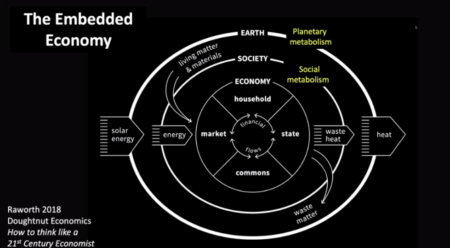
The keynote lecture was delivered by Professor Yadvinder Malhi\, Pr ogramme Leader in Ecosystem Research at the Environmental Change Institute. Earth is a living system with a planetary scale metabolism that cycles car bon\, oxygen\, nitrogen\, and many other elements necessary for life. Under standing how disturbances in the natural cycle propagate through the Earth system and feedback on climate is a major research challenge. In his insigh tful talk\, Prof Malhi demonstrated the scale of human impact on this metab olism. To mitigate these impacts\, he emphasised the need to respond by lim iting the growth of the ‘social metabolism’ and work to decouple it from th e planetary metabolism.
The second panel discussion was chaired by Fi ona Harvey\, Environmental Correspondent for the Guardian. The participants - academics and representatives of businesses and NGOs - agreed that addre ssing the complexity of the current situation will require more interdiscip linary work within academia\, as well as closer collaboration among researc hers\, policymakers and citizens.
If you would like to learn more\, f ollow the links below and keep an eye out for more articles in the future.< /p>
You can find the University’s Environmental Sustainability Strategy < a href="https://sustainability.admin.ox.ac.uk/environmental-sustainability- strategy">here
ORGANIZER;CN="Nature Admin":MAILTO:letsrecord@gmail.com URL;VALUE=URI:https://nature.ox.ac.uk/events/event/launch-of-oxfords-enviro nmental-sustainability-strategy-and-one-annual-lecture/ END:VEVENT BEGIN:VEVENT UID:20260112T1002Z-1768212150.54-EO-9165-1@127.0.0.1 STATUS:CONFIRMED DTSTAMP:20260412T145451Z CREATED:20210601T144737Z LAST-MODIFIED:20210611T123032Z DTSTART;TZID=Europe/London:20210507T160000 DTEND;TZID=Europe/London:20210601T170000 SUMMARY: ONE Annual Event Keynote Lecture by Prof. Yadvinder Malhi DESCRIPTION: Ordinarily\, the Oxford Networks for the Environment (ONE) inv ite an external speaker to give the keynote lecture at their annual event. But\, because this year’s occasion was also the launch of Oxford University ’s ambitious sustainability strategy\, the organisers felt that a highly di stinguished internal speaker could act as a symbolic bridge between the uni versity and […] X-ALT-DESC;FMTTYPE=text/html:Ordinarily\, the Oxford Networks for the E nvironment (ONE) invite an external speaker to give the keynote lecture at their annual event. But\, because this year’s occasion was also the launch of Oxford University’s ambitious sustainability strategy\, the organisers f elt that a highly distinguished internal speaker could act as a symbolic br idge between the university and the wider world.
As the ONE Chair\, J im Hall\, noted in his introduction\, Oxford’s Prof. Yadvinder Malhi’s repu tation is truly global. Professor of Ecosystem Science at the School of Geo graphy and the Environment\, he is world-famous for his research on tropica l forest ecosystems and has ongoing projects on four continents. He is a Fe llow of the Royal Society as well as a recipient of the CBE.
And yet\ , despite all this\, he is also currently working on ecosystem research and conservation in our own backyard\, across the Oxfordshire county. If the k ey theme for this year’s event was connecting the local\, national\, and th e global\, then Yadvinder was the perfect main dish\, delivered to the orga nisers on a silver platter.
Weight Watching: The Global Socia l Metabolism
After some initial comments on the growing real isation of how ‘large’ humanity is becoming\, and the paradigm shift this i s entailing\, Yadvinder introduced the graph above. He proposes a handy way of thinking about the blue line there: Metabolism. Those of us who have st ruggled to gain or lose weight will likely cite our metabolisms as a key re ason. When applied to sustainability though\, metabolism becomes a useful i ndicator of the strain we place on the planet’s biosphere.
Each biolo gical being\, the plant kingdom included\, has a metabolism roughly defined as all the energy flowing through it that enables it to function. When we estimate every living organism’s combined metabolism on Earth we get the bi ological metabolism of the biosphere. 150 terawatts is the total for all li fe on land\, with terawatts representing a unit of energy flow per second.< /p>
In comparison to this combined figure for all of life on land\, the t otal metabolism of humanity has long been just a small fraction. But\, as y ou well know\, over the past century and a half our numbers have skyrockete d. Obviously\, the energy in our bodies (our biological metabolism) is negl igible\, making the problem our social metabolism. That is\, the energy flo wing through our infrastructure\, transport systems\, industrial machinery\ , communications networks\, electrical appliances— you get the point.
While it may seem modest to some that humanity’s total metabolism in 2010 was estimated by Yadvinder as being 17{4136d53bac2007e4117f1d8828c187063ea0 a85f13bd7ca9434591c56c4e6ea2} of the terrestrial biosphere’s\, I’d like to remind you that we’re only one of millions of species of organism living on land. That roughly 7 billion people i.e.\, nearly every single person aliv e\, could fit shoulder-to-shoulder in the city of Los Angeles alone. I thin k it’s something that we need regular reminders of: The world\, and hence t he biosphere\, is so vast it’s scarcely comprehensible…
And yet\, we are becoming ‘larger’.
Yadvinder calculated that\, by 2050\, if we fo llow the mid-range UN Development Program (UNDP) scenario\, that our total social metabolism will be roughly one third of that 150 TW figure for all o f life on land. And worse yet\, if every human being were to have the same social metabolism as the average\, contemporary Chinese citizen\, that numb er would rise to 40{4136d53bac2007e4117f1d8828c187063ea0a85f13bd7ca9434591c 56c4e6ea2}. I won’t even tell you what a ‘Global US’ scenario entails.
< p>...I lied: 120{4136d53bac2007e4117f1d8828c187063ea0a85f13bd7ca9434 591c56c4e6ea2}.
Our Embeddedness: A National Perspective
There are two ways to approach the issue: quality and quantity. By decreasing the quantity of our metabolism through more eff icient energy use\, saving of food\, water\, and electricity\, and consumin g less\, we do the planet and ourselves a vital service. In parallel though \, we also need to improve the quality of our metabolism by making it more circular and “decoupling” it from the planetary metabolism. For instance th rough renewables and recycling. While we can never fully decouple our metab olism from the planet’s\, there is much room for improvement.
And thi s improvement is necessary exactly because we are embedded in the wider bio sphere. Here Yadvinder cites his colleague Kate Raworth\, invoking her noti on of doughnut economics which rightly flips traditional economics on its h ead. Society and the environment are not mere externalities to an economic model that determines how we should relate to the world. Rather\, the econo my is embedded within society which is embedded within the environment.
Local actions have national consequences which have global side-effects. As such\, Yadvinder took some time to reflect on some national figures and trends. Here we learned that the UK’s social metabolism is roughly equal ( 91{4136d53bac2007e4117f1d8828c187063ea0a85f13bd7ca9434591c56c4e6ea2}) of it s biosphere’s metabolism. The explanation for this lies largely in the fact that the UK ‘imports’ over half its metabolism from the rest of the world. It’s a potent reminder of the interconnectedness of our world today and th e impact of ‘minor’ everyday decisions. An avocado eaten here contributes t o the destruction of a forest over there—a problem festering terribly in Me xico.

We also learned that for all their problems\, cities are the settlements with the lowest per-capita metabolism. That is\ , each city-dweller contributes less to humanity’s social metabolism than t heir counterpart in the countryside.
Perhaps the most significant con sequence of our embeddedness is that we cannot focus only on achieving net zero emissions. Though this is one of the two vital pillars to the sustaina ble revolution\, we also need to address our impact on the biosphere and on biodiversity. In Yadvinder’s words: “Addressing climate change must not in volve increasing pressure on the biosphere (e.g. BECCS\, biofuels) or hinde r restoration of the depleted biosphere.” Cleaner energy and nature-based s olutions must be negotiated on equal footing.
Appropriately\, he then also shared exciting news of the launch of the Oxford Martin School’s Prog ramme in Biodiversity and Society.
A Local(-cum-Global ) Solution
To kick off the final section we learned a bit ab out HERO: Healthy Ecosystem Restoration in Oxfordshire. In this local proje ct\, which is a part of the new Martin School programme mentioned above\, Y advinder and his colleagues are “trying to develop this local county and en vironment as a case study where we can look at a number of these challenges around biosphere\, sustainability\, nature recovery\, and see how we can d eliver on the ground\, and also provide lessons that can be applied nationa lly or internationally.”
In doing so they are bridging that ghastly c hasm between theory and practice\, applying academic insights to practical issues around agriculture\, land restoration\, and ecosystems conservation to facilitate climate resilience and adaptation. Put simply\, they are deve loping a community of practice that aims to be part of the local foundation to a global matrix of sustainable solutions.
Yadvinder then reflecte d on the numerous key international meetings being held that are focusing b oth on climate change and biodiversity. He hopes that they will help set a suitable agenda for the next decade and relayed his optimism by stating: “I think previously\, until the last few years\, biodiversity has often been seen as ‘nice to have’ when we think about global sustainability\, and I th ink now we realise that it’s both fundamental and critical to the challenge of a sustainable future.”
He closed off by giving us an earnest remi nder that Oxford University is particularly well-placed to be at the forefr ont of events and thinking on how to achieve local\, national\, and global sustainability goals. That the field can take inspiration from Oxford’s med ical contributions both historically and currently in our fight against the current pandemic.
ORGANIZER;CN="Nature Admin":MAILTO:letsrecord@gmail.com URL;VALUE=URI:https://nature.ox.ac.uk/events/event/one-annual-event-keynote -lecture-by-prof-yadvinder-malhi/ ATTACH;FMTTYPE=image/png:https://nature.ox.ac.uk/wp-content/uploads/2021/06/seminar.png END:VEVENT BEGIN:VEVENT UID:20260112T1002Z-1768212150.55-EO-9014-1@127.0.0.1 STATUS:CONFIRMED DTSTAMP:20260412T145451Z CREATED:20210505T151652Z LAST-MODIFIED:20210506T163756Z DTSTART;TZID=Europe/London:20210519T100000 DTEND;TZID=Europe/London:20210519T110000 SUMMARY: Engaging with local and national biodiversity policy DESCRIPTION: Recent years have seen a significant step-change in attention to biodiversity as a political priority for governments worldwide. This yea r is due to culminate in the agreement of the United Nations Post-2020 Glob al Biodiversity Framework\, and domestically\, the UK Environment Bill will rewrite post-Brexit rules on everything from agriculture to pollution for many years to […] X-ALT-DESC;FMTTYPE=text/html:
Recent years have seen a significant step- change in attention to biodiversity as a political priority for governments worldwide. This year is due to culminate in the agreement of the United Na tions Post-2020 Global Biodiversity Framework\, and domestically\, the UK E nvironment Bill will rewrite post-Brexit rules on everything from agricultu re to pollution for many years to come. Considering these developments: Wha t is the role of academic research in informing and scrutinising policy tra jectories? How can academics from different disciplines and career stages m ore effectively engage with policymakers? With many interconnected social\, economic\, and technological dimensions to account for\, what even is poli cy for biodiversity? And\, where do we want it to go in future?
Biodi versity is directly and indirectly impacted by local and national policy. I n this seminar\, we will discuss the nature of policy for biodiversity in t he UK\, from the role of the Department for Environment\, Food and Rural Af fairs to the work of local councils in developing local planning and develo pment policies. In doing so\, we will consider the strategies academic rese archers might take to engage with policy at local and national scales. We w ill ask: How can relationships be forged with civil servants\, parliament a nd politicians? How can research evidence help decision makers respond to s ocietal concerns? Through discussions with academics experienced in policy engagement\, we will discuss successes and challenges of policy engagement and identify practical skills for those interested in developing their own policy engagement strategy within the UK.
Supported by the Oxford Policy En gagement Network (OPEN) and the Biodiversity Network.
For enquiries \ , please contact Dr. Jasper Montana: jasper.montana@ouce.ox.ac.uk
ORGANIZER;CN="Nature Admin":MAILTO:letsrecord@gmail.com URL;VALUE=URI:https://nature.ox.ac.uk/events/event/engaging-with-local-and- national-biodiversity-policy/ END:VEVENT BEGIN:VEVENT UID:20260112T1002Z-1768212150.56-EO-9059-1@127.0.0.1 STATUS:CONFIRMED DTSTAMP:20260412T145451Z CREATED:20210517T114622Z LAST-MODIFIED:20210517T114622Z DTSTART;TZID=Europe/London:20210519T160000 DTEND;TZID=Europe/London:20210519T173000 SUMMARY: Webinar: Bolsonaro and Brazil’s climate and Covid-19 crises DESCRIPTION: Brazil is going through extremely concerning crises that need more of the world’s attention. In 2020\, the country registered the highest level of deforestation of the Amazon in 12 years. The spike in deforestati on is related to the Brazilian government and allies’ efforts to legalize t he private occupation of public land and\, consequently\, the illegal defor estation of […] X-ALT-DESC;FMTTYPE=text/html:Brazil is going through extremely concerni ng crises that need more of the world’s attention.
In 2020\, the coun try registered the highest level of de forestation of the Amazon in 12 years. The spike in deforestation is re lated to the Brazilian government and allies’ efforts to legalize the priva te occupation of public land and\, consequently\, the illegal deforestation of the Amazon. Also\, it is the result of the dismantling of environmental policies\, of traditional people’s rights and of the drastic reduction or freezing of funds for the protection of the forests and local communities i n the last years\, worsened by the persecution of environmental activists a nd Indigenous leaders more recent ly.
The country is now also a global threat due to Covid-19\, whi ch represents the worst healthcare breakdown in Brazil’s history. Covid-19 has been responsible for over 400\,000 deaths\, the world's second-highest death toll from the pandemic - sadly including celebrated Amazon-based photographer Lilo Clareto\, to whom we w ill pay homage at the event.
In order to discuss how Brazilians have been deeply affected by this catastrophic moment and responding to it\, we are organising a webinar with prominent Brazilian civil society representat ives: an indigenous leader\, an environmentalist\, a journalist and a scien tist.
The event will also be an opportunity to connect Braz ilian national voices with the reflections and work of environmental organi sations and writers in the UK\, ahead of COP26\, which will take place late r this year.
Live interpretation into English and Portuguese will be available.
This event is hosted by Global Canopy\, Ox ford Centre for Tropical Forests\, School of Geography and the Environment\, and Oxford Biodiversity Netw ork.
Speakers
Adriana Ramos\, Policy and Law Coordinator of Instituto Socioambiental (ISA) and membe r of the coordination committee of the Climate Ob servatory\, a Brazilian coalition of nearly 60 civil society organizati ons.
Douglas Belchior\, History professor\, founder of Uneafro Brasil\, and member of Brazil’s Black Coalition for Rights\, a political network that brings tog ether over 150 organizations and collectives of the black movement\, leadin g the emergency campaign There Are Hu ngry People\, to raise funds against the rise of hunger\, misery and vi olence during Covid-19.
Eliane Brum\, writer\, journalist\, and docum entary filmmaker\, with over forty journalism prizes and honors\, who is a columnist for El País an d collaborates with The Guardian and The New York Times. Eliane also publis hed in English ‘The Collector of Leftover Souls - Dispatches From Brazil’ ( Granta) and ‘One Two’ (Amazon Crossing).
Erika Berenguer\, Senior Res earch Associate at The Environmental Change Insti tute of the University of Oxford and member of the Sustainable Amazon Network\, composed of researchers of mo re than 30 institutions in Brazil and abroad\, created to apply scientific evidence as a way to strengthen sustainability in the Amazon region.
Jay Griffiths\, British award-winning writer\, author of ‘Wild\, an Elemental Journey’\, ‘Kith: The Riddle of the Childscape’ and ‘Why Rebel’\, also a regular contributor to the environment page of The Guardian.
Niki Ma rdas\, Executive Director of Global Canopy.
Sonia Guajajara\, Brazilian indigenous leader\, coordinat or of Brazil’s Articulation of Indigenous Peoples< /a> (APIB).
The event will be mediated by the Global Environment Edit or of The Guardian\, Jona than Watts.
REGISTER NOW
ORGANIZER;CN="Nature Admin":MAILTO:letsrecord@gmail.com URL;VALUE=URI:https://nature.ox.ac.uk/events/event/webinar-bolsonaro-and-br azils-climate-and-covid-19-crises/ END:VEVENT BEGIN:VEVENT UID:20260112T1002Z-1768212150.57-EO-9018-1@127.0.0.1 STATUS:CONFIRMED DTSTAMP:20260412T145451Z CREATED:20210505T152238Z LAST-MODIFIED:20210519T112847Z DTSTART;TZID=Europe/London:20210526T100000 DTEND;TZID=Europe/London:20210526T110000 SUMMARY: Engaging with international biodiversity policy DESCRIPTION: Policymaking for biodiversity is an international affair. From the conferences of the United Nations to local offices of Non-Governmental Organisations across the world\, there are a diverse range of entry points for engaging with policy. So\, what are the major international arenas for biodiversity-related policies? What is the role of Global Environmental As sessments such as […] X-ALT-DESC;FMTTYPE=text/html:Policymaking for biodiversity is an intern ational affair. From the conferences of the United Nations to local offices of Non-Governmental Organisations across the world\, there are a diverse r ange of entry points for engaging with policy. So\, what are the major inte rnational arenas for biodiversity-related policies? What is the role of Glo bal Environmental Assessments such as IPBES and international NGOs as media tors between academia and policy-making? How might an academic think about building international policy engagement into their research agenda? In thi s seminar featuring contributions from academics active in informing and su pporting international biodiversity policy\, we will discuss the opportunit ies and challenges of thinking about policy engagement at the international level.
Supported by the Oxford Policy Engagement Network (OPEN) and the Biodiversity Network.
ORGANIZER;CN="Nature Admin":MAILTO:letsrecord@gmail.com URL;VALUE=URI:https://nature.ox.ac.uk/events/event/engaging-with-internatio nal-biodiversity-policy/ END:VEVENT BEGIN:VEVENT UID:20260112T1002Z-1768212150.58-EO-9019-1@127.0.0.1 STATUS:CONFIRMED DTSTAMP:20260412T145451Z CREATED:20210505T152606Z LAST-MODIFIED:20210506T163124Z DTSTART;TZID=Europe/London:20210602T100000 DTEND;TZID=Europe/London:20210602T110000 SUMMARY: The future of policy engagement for biodiversity DESCRIPTION: When it comes to informing and scrutinizing policy for biodive rsity\, are we doing enough? In the third seminar of this series\, we intro duce and respond to critical provocations on the possible future pathways f or policy engagement for biodiversity. This will include discussions of: th e way different kinds of academic work\, from the social sciences and […] X-ALT-DESC;FMTTYPE=text/html:When it comes to informing and scrutinizin g policy for biodiversity\, are we doing enough? In the third seminar of th is series\, we introduce and respond to critical provocations on the possib le future pathways for policy engagement for biodiversity. This will includ e discussions of: the way different kinds of academic work\, from the socia l sciences and humanities to conservation and ecosystem science\, can be ef fectively supported in policy engagement\; and the responsibilities\, chall enges and ethics of engaging with policy\, business\, and other stakeholder s in a multi- and trans-national context. While there are unlikely to be ea sy answers\, these discussions will catalyze thinking about individual and collective roadmaps for future policy engagement efforts. On the eve of neg otiations in the Convention on Biological Diversity\, this will be an oppor tunity to think critically about how collaborating across disciplines can h elp navigate the inevitable political\, social\, and environmental dimensio ns of policy for biodiversity.
The vast majority of extractive and produc tive activities undergo planning and application processes and are subject to regulation. Despite this\, habitat loss and degradation are still the pr imary causes of global biodiversity decline\, accelerating green house gas emissions and other environmental impacts. Part of the reason is that ecolo gical data and biodiversity objectives are insufficiently considered in the se planning processes\, while at the same time conservation and restoration planning\, especially in the scientific domain\, seldom account for other objectives\, e.g. food production\, timber extraction\, job creation. It is therefore not a surprise that these conservation plans often remain academ ic exercises and do not get implemented. Piero will present a few approache s and real-world examples of multi-criteria spatial planning that are aimed at jointly achieving multiple\, typically competing\, targets\, and discus s their advantages and disadvantages in terms of driving forward the scienc e and practice of spatial planning for biodiversity conservation. He will a lso present two projects at the catchment level and the continental level w hich IIASA is leading\, that aim to integrate habitat conservation and rest oration\, sustainable water use\, agriculture and forestry within a single planning framework\, that can be applied by planning authorities at local t o national scale to plan and evaluate applications for extractive and produ ctive activities and conservation interventions.
Piero Visconti is th e Biodiversity\, Ecology\, and Conservation (BEC) Research Group Leader at IIASA. Visconti holds a doctoral degree in Conservation Planning from James Cook University\, Australia. After his PhD\, Visconti held postdoctoral po sitions at the University of Rome\, the Microsoft Research Cambridge Comput ational Ecology Group\, and the United Nations Environment Programme World Conservation Monitoring Centre (UNEP-WCMC). Prior to joining IIASA\, Viscon ti was a joint Research Fellow at University College London’s Centre for Bi odiversity and Environment Research (UCL-CBER) and the Zoological Society o f London’s Institute of Zoology (ZSL-IoZ)\, where he worked on normative sc enarios for biodiversity and integrated spatial planning for biodiversity c onservation\, restoration\, and food production. At IIASA\, BEC’s as well a s Visconti’s own research span a broad set of topics within applied ecology and conservation. BEC research combines methods from systems analyses\, gl obal change biology\, conservation biogeography\, spatial planning for biod iversity conservation\, and restoration\, to answer scientific questions an d provide policy support.
Alongside his research and supervision acti vities\, Visconti engages at the science-policy interface\, for instance\, through his past role of coordinating lead author of the Intergovernmental Science-Policy Platform on Biodiversity and Ecosystem Services (IPBES) Regi onal Assessment of status\, trends\, and future scenarios of biodiversity a nd ecosystem services for Europe and Central Asia.
ORGANIZER;CN="Nature Admin":MAILTO:letsrecord@gmail.com URL;VALUE=URI:https://nature.ox.ac.uk/events/event/integrated-spatial-plann ing-for-multi-functional-landscapes/ END:VEVENT BEGIN:VEVENT UID:20260112T1002Z-1768212150.59-EO-9069-1@127.0.0.1 STATUS:CONFIRMED DTSTAMP:20260412T145451Z CREATED:20210526T091921Z LAST-MODIFIED:20210526T091921Z DTSTART;TZID=Europe/London:20210630T100000 DTEND;TZID=Europe/London:20210630T130000 SUMMARY: The Policy Engagement for Biodiversity: Synthesis Workshop DESCRIPTION: Recent years have seen a significant step-change in attention to biodiversity as a political priority for governments worldwide. With the United Nations Post-2020 Global Biodiversity Framework and the UK Environm ent Bill on the horizon\, this workshop will synthesise discussions from th ree recent seminars of the Biodiversity Network and background reviews on p olicy engagement for biodiversity […] X-ALT-DESC;FMTTYPE=text/html:Recent years have seen a significant step- change in attention to biodiversity as a political priority for governments worldwide. With the United Nations Post-2020 Global Biodiversity Framework and the UK Environment Bill on the horizon\, this workshop will synthesise discussions from three recent seminars of the Biodiversity Network and bac kground reviews on policy engagement for biodiversity at Oxford.
The small three-hour workshop for interested Oxford academics and students will focus on the production of one or more blog posts\, exploring questions su ch as: What is the role of academic research in informing and scrutinising policy trajectories? How can academics from different disciplines and caree r stages more effectively engage with policymakers? With many interconnecte d social\, economic\, and technological dimensions to account for\, what ev en is policy for biodiversity? And\, where do we want it to go in future?
Booking deadline: 25th June 2021.
Contact jasper.montana@ouce.ox .ac.uk for further information.
ORGANIZER;CN="Nature Admin":MAILTO:letsrecord@gmail.com URL;VALUE=URI:https://nature.ox.ac.uk/events/event/the-policy-engagement-fo r-biodiversity-synthesis-workshop/ END:VEVENT BEGIN:VEVENT UID:20260112T1002Z-1768212150.6-EO-9278-1@127.0.0.1 STATUS:CONFIRMED DTSTAMP:20260412T145451Z CREATED:20210923T101431Z LAST-MODIFIED:20210923T101508Z DTSTART;TZID=Europe/London:20210929T100000 DTEND;TZID=Europe/London:20210929T110000 SUMMARY: Biodiversity Network Coffee Series DESCRIPTION: Welcome back to the new series of Biodiversity Coffee Seminars ! Today we’ll be hearing from colleagues at the Natural History Museum. The NHM is developing a Biodiversity Indicators Portal that will aid policymak ers\, evidence builders and scientific advisors to make better biodiversity decisions using robust scientific data developed by the NHM. The portal wi ll highlight […] X-ALT-DESC;FMTTYPE=text/html:Welcome back to the new series of Biodiver
sity Coffee Seminars!
Today we'll be hearing from colleagues at the Na
tural History Museum.
The NHM is developing a Biodiversity Indicators Portal that will aid policymakers\, evidence builders and scientific advis ors to make better biodiversity decisions using robust scientific data deve loped by the NHM.
The portal will highlight biodiversity change and t he impact of the factors that drive it. The hope is that this tool will ena ble decision makers to conserve and preserve biodiversity\, working to bend the curve of biodiversity loss. It will tell the story of what’s happened in the past\, the state of the present and predict the impact of future dec isions.
The first version\, planned to go live in September\, will co ntain data from the NHM's Biodiversity Intactness Index. The Biodiversity I ntactness Index estimates how much biodiversity is left in an area\, helpin g us understand current and future biodiversity declines.
We'll also be outlining our talks for next term and will briefly mention our new HERO programme\, there will also be time for you to tell the network about any opportunities for collaborating and events you have coming up.
Register to recieve your link here
ORGANIZER;CN="Nature Admin":MAILTO:letsrecord@gmail.com URL;VALUE=URI:https://nature.ox.ac.uk/events/event/biodiversity-network-cof fee-series/ ATTACH;FMTTYPE=image/png:https://nature.ox.ac.uk/wp-content/uploads/2021/09/BDN.png END:VEVENT BEGIN:VEVENT UID:20260112T1002Z-1768212150.61-EO-9285-1@127.0.0.1 STATUS:CONFIRMED DTSTAMP:20260412T145451Z CREATED:20210930T094332Z LAST-MODIFIED:20210930T094332Z DTSTART;TZID=Europe/London:20210930T110000 DTEND;TZID=Europe/London:20210930T120000 SUMMARY: The Natural History Museum portal workshop DESCRIPTION: The Natural History Museum has built the first version of an o nline tool that aims to make it easy for policymakers and researchers to fi nd\, understand and explore data on one of our biodiversity indicators – th e Biodiversity Intactness Index (BII). In this workshop we hope to learn yo ur thoughts on what has been built […] X-ALT-DESC;FMTTYPE=text/html:The Natural History Museum has built the f irst version of an online tool that aims to make it easy for policymakers a nd researchers to find\, understand and explore data on one of our biodiver sity indicators – the Biodiversity Intactness Index (BII).
In this wo rkshop we hope to learn your thoughts on what has been built so far\, what works and what could be improved. Both Museum scientists who have developed the BII and the product team who built the online tool will be present to answer and ask questions. A link to the tool will be shared in advance.
The number of people attending the workshop will be limited.
Regis tration will close on Tuesday 5th October at 17:00\, we will contact you to confirm your place on the workshop on Wednesday 6th October and to provide a link to join.
ORGANIZER;CN="Nature Admin":MAILTO:letsrecord@gmail.com URL;VALUE=URI:https://nature.ox.ac.uk/events/event/the-natural-history-muse um-portal-workshop/ END:VEVENT BEGIN:VEVENT UID:20260112T1002Z-1768212150.61-EO-9282-1@127.0.0.1 STATUS:CONFIRMED DTSTAMP:20260412T145451Z CREATED:20210923T102956Z LAST-MODIFIED:20210923T102956Z DTSTART;TZID=Europe/London:20211015T160000 DTEND;TZID=Europe/London:20211015T173000 SUMMARY: The trouble with nature DESCRIPTION: The fabric of life on Earth is unravelling\, and this decade w ill be crucial in exacerbating this trajectory or bending it. Professor San dra Diaz will explore three major factors that have contributed to the pres ent situation: the multidimensional nature of biodiversity\, teleconnected socio-economic drivers\, and the prevalent social narratives linking humans with the rest of […] X-ALT-DESC;FMTTYPE=text/html:The fabric of life on Earth is unravelling \, and this decade will be crucial in exacerbating this trajectory or bendi ng it. Professor Sandra Diaz will explore three major factors that have con tributed to the present situation: the multidimensional nature of biodivers ity\, teleconnected socio-economic drivers\, and the prevalent social narra tives linking humans with the rest of life on Earth. She will also discuss how they can be harnessed in the quest for better futures.
Sandra Día z is interested in plant functional traits and general patterns of function al specialization\, their effects on ecosystem properties and their interac tions with global change drivers. She constructed the first global quantita tive picture of essential functional diversity of vascular plants – the glo bal spectrum of plant form and function – providing a backdrop for evolutio nary\, ecological and biogeochemical modelling studies and co-founded the w orld’s first and largest communal dataset of plant traits TRY. She has adva nced theory and practical implementation of the concept of functional diver sity and its effects on ecosystem properties and benefits. She combines her plant ecology studies with interdisciplinary work on how different societi es value and reconfigure biological communities and ecosystems.
Sandr a’s permanent position is as Professor of Ecology at Córdoba National Unive rsity\, and as senior member of the National Research Council of Argentina. She founded Núcleo DiverSus on Diversity and Sustainability. She co-chaire d the Global Assessment of the Intergovernmental Platform on Biodiversity a nd Ecosystem Services (IPBES) and spearheaded the pluralistic conceptual fr amework IPBES Assessments\, including the notion of nature’s contributions to people. In 2019 she was elected Foreign Member of the Royal Society.
ORGANIZER;CN="Nature Admin":MAILTO:letsrecord@gmail.com URL;VALUE=URI:https://nature.ox.ac.uk/events/event/the-trouble-with-nature/ END:VEVENT BEGIN:VEVENT UID:20260112T1002Z-1768212150.62-EO-9287-1@127.0.0.1 STATUS:CONFIRMED DTSTAMP:20260412T145451Z CREATED:20211004T132420Z LAST-MODIFIED:20211004T132452Z DTSTART;TZID=Europe/London:20211020T100000 DTEND;TZID=Europe/London:20211020T110000 SUMMARY: How can academics help tomorrow’s voters and today’s journalists e ngage with biodiversity? DESCRIPTION: Schools are always keen to have academics come and talk to the ir students\, but if you get the call\, what do you talk about and how do y ou pitch it? We keep hearing that today’s teenagers are out of touch with n ature\, so how can you convey your very detailed biodiversity research proj ect to an […] X-ALT-DESC;FMTTYPE=text/html:Schools are always keen to have academics come and talk to their students\, but if you get the call\, what do you tal k about and how do you pitch it? We keep hearing that today’s teenagers are out of touch with nature\, so how can you convey your very detailed biodiv ersity research project to an audience with very little prior knowledge? I’ d argue that you don’t. Step away from your research and become an advocate for learning about the natural world. Tell them your back story – what got you hooked on nature? What path did you go down to get where you are? What fun do you have when doing your research? What have you found out that is new and why is it important? What are your hopes for your and their futures ? Don’t show more than one graph\, kick out the jargon\, put up some photos of you in wellies\, up a tree\, with a beastie\, with other researchers. E ntice them into your world.
In this session I will invite a couple of teachers and students to give you some advice on what they want to hear\, and give you the opportunity to pitch a story. Come with one photo\, or an object\, a passion\, a fear\, or a funny story\, and give them a tantalisin g glimpse into your world.
Or just come and enjoy.
Session led by Kim Polgreen
ORGANIZER;CN="Nature Admin":MAILTO:letsrecord@gmail.com URL;VALUE=URI:https://nature.ox.ac.uk/events/event/how-can-academics-help-t omorrows-voters-and-todays-journalists-engage-with-biodiversity/ END:VEVENT BEGIN:VEVENT UID:20260112T1002Z-1768212150.63-EO-9289-1@127.0.0.1 STATUS:CONFIRMED DTSTAMP:20260412T145451Z CREATED:20211004T133319Z LAST-MODIFIED:20211027T154541Z DTSTART;TZID=Europe/London:20211027T220000 DTEND;TZID=Europe/London:20211027T230000 SUMMARY: What will be the impact of the (proposed) new GCSE in Natural Hist ory and how can academics help? DESCRIPTION: Author & journalist Mary Colwell has pushed for a GCSE in Natu ral History for 10 years. Now It looks as if it’s going to happen\, & hopef ully teaching will start in September 2023. Mary will be joining us to expl ore the potential of this GCSE\, & how it will be challenge to our siloed e ducation […] X-ALT-DESC;FMTTYPE=text/html:Author & journalist Mary Colwell has pushe
d for a GCSE in Natural History for 10 years. Now It looks as if it's going
to happen\, & hopefully teaching will start in September 2023.
Mary w
ill be joining us to explore the potential of this GCSE\, & how it will be
challenge to our siloed education system because it draws on natural scienc
es\, history\, anthropology\, economics & much more. This could be a game c
hanger for education and for the understanding of biodiversity by tomorrow’
s voters.
Can your research be distilled into a resource that will fi nd a niche in a GCSE Natural History classroom in 2023? Join us to discuss this and other ways to get involved.
About Mary:
Mary is an author\, producer and campaigner for nature. Her articles have
appeared in the Guardian\, BBC Wildlife Magazine\, The Tablet\, Country Li
fe and many other publications. She has made documentaries for the BBC Natu
ral History Unit in both TV and radio\, and has published three books: John
Muir – the Scotsman Who Saved America’s Wild Places in 2014 (Lion Hudson)\
, Curlew Moon in April 2018 (William Collins) and Beak Tooth and Claw (Will
iam Collins) due in April 2021.
In 2009 she won a Sony Radio Academy G
old award and in October 2017 she was awarded the Dilys Breese Medal by the
BTO for outstanding science communication\, the David Bellamy Award in 201
8 from the Gamekeepers Association for her conservation work on Curlews and
\, in 2019\, the WWT Marsh Award for Conservation.
Colwell is a noted spokesperson for environmentalism in the United Kingdom and has written ar ticles on the subject the main newspapers. She was listed at number 27 in B BC Wildlife Magazine's Top 50 Most Influential Conservationists in the UK\, and has received various awards for her work on promoting environmentalism .
Colwell was one of three recipients of the 2019 Marsh Award from th e Wildfowl & Wetlands Trust for her activism around the Curlew including en gaging political support from Downing Street (who called the Curlew\, "the panda of UK conservation")\, and promoting April 21 as World Curlew Day.
Colwell has campaigned with politician Caroline Lucas to have Natural H istory included as a GCSE exam on the national curriculum\, and in May 2020 \, she told The Daily Telegraph it would be taught in schools by 2022. In O ctober 2020\, a final proposal was submitted to the Department for Educatio n.
ORGANIZER;CN="Nature Admin":MAILTO:letsrecord@gmail.com URL;VALUE=URI:https://nature.ox.ac.uk/events/event/what-will-be-the-impact- of-the-proposed-new-gcse-in-natural-history-and-how-can-academics-help/ ATTACH;FMTTYPE=image/jpeg:https://nature.ox.ac.uk/wp-content/uploads/2021/10/Copy-of-Biodiversity-network-seminar-27.10-e1634744565497.jpg END:VEVENT BEGIN:VEVENT UID:20260112T1002Z-1768212150.64-EO-9295-1@127.0.0.1 STATUS:CONFIRMED DTSTAMP:20260412T145451Z CREATED:20211008T093533Z LAST-MODIFIED:20211008T095829Z DTSTART;TZID=Europe/London:20211028T080000 DTEND;TZID=Europe/London:20211028T183000 SUMMARY: What would it take to make the world’s universities ‘nature positi ve’? DESCRIPTION: Co-hosted by the UN Environment Programme and the University of Oxford\, this session will consider the need for nature-positive univer sities. An exploration of the university experience in implementing environ mental sustainability strategies and work on biodiversity will be followed by a discussion between vice-chancellors from around the world on how they can progress this important […] X-ALT-DESC;FMTTYPE=text/html:
Co-hosted by the UN Environment Pr ogramme and the University of Oxford\, this session will consider the need for nature-positive universities. An exploration of the university experien ce in implementing environmental sustainability strategies and work on biod iversity will be followed by a discussion between vice-chancellors from aro und the world on how they can progress this important agenda.
Part of the 'HOW CAN UNIVERSITIES ACCELERATE THE GLOBAL TRANSITION TO NET ZE RO?' event taking place from 8-18:30 om October 28th
ORGANIZER;CN="Nature Admin":MAILTO:letsrecord@gmail.com URL;VALUE=URI:https://nature.ox.ac.uk/events/event/what-would-it-take-to-ma ke-the-worlds-universities-nature-positive/ END:VEVENT BEGIN:VEVENT UID:20260112T1002Z-1768212150.64-EO-9342-1@127.0.0.1 STATUS:CONFIRMED DTSTAMP:20260412T145451Z CREATED:20211103T163324Z LAST-MODIFIED:20211117T152046Z DTSTART;TZID=Europe/London:20211117T100000 DTEND;TZID=Europe/London:20211117T233000 SUMMARY: Anne-Caroline Prévôt : Environmental psychology DESCRIPTION: The research Anne-Caroline Prévot is pursuing with her colleag ues and students aims at understanding the interrelationships between exper iences of nature\, biodiversity conservation and social bonds. She investig ates how experiences of nature and associated behaviours interact with the dynamics of biodiversity and its conservation\, in particular through the m obilisation of new social bonds. Her current research […] X-ALT-DESC;FMTTYPE=text/html:The research Anne-Caroline Prévot is pursu ing with her colleagues and students aims at understanding the interrelatio nships between experiences of nature\, biodiversity conservation and social bonds. She investigates how experiences of nature and associated behaviour s interact with the dynamics of biodiversity and its conservation\, in part icular through the mobilisation of new social bonds.
Her current rese arch projects focus on the co-construction of new narratives of the future\ , through fiction and science fiction.
Anne-Caroline Prévot will pres ent her latest book: “La nature à l’oeil nu” (“Nature with the naked eye”)< /p>
Alongside her research activities\, Anne-Caroline Prévot is intereste d in sharing her reflections and results beyond academic circles\, through books\, conferences\, and presentations for the general public.
Anne- Caroline is Research Director with CNRS\; she specialises in environmental psychology and has published extensively on perceptions of nature and biodi versity conservation.
This seminar is the first event we are holding in collaboration with the Maison Française d'Oxford\, aiming to strengthen Franco-British research collaborations for the Biodiversity Network. Please join us to welcome our French collaborators.
This seminar will be th e first in-person seminar of the year\, however\, we will also be live-stre aming it for those unable to attend in person. Join us for coffee\, a crois sant and interesting conversations.
ORGANIZER;CN="Nature Admin":MAILTO:letsrecord@gmail.com URL;VALUE=URI:https://nature.ox.ac.uk/events/event/anne-caroline-prevot-env ironmental-psychology/ ATTACH;FMTTYPE=image/jpeg:https://nature.ox.ac.uk/wp-content/uploads/2021/11/TE15-portrait.jpg END:VEVENT BEGIN:VEVENT UID:20260112T1002Z-1768212150.65-EO-9345-1@127.0.0.1 STATUS:CONFIRMED DTSTAMP:20260412T145451Z CREATED:20211103T165454Z LAST-MODIFIED:20211130T093410Z DTSTART;TZID=Europe/London:20211129T160000 DTEND;TZID=Europe/London:20211129T170000 SUMMARY: Jerome Chave : Forest ecology and ecology of communities DESCRIPTION: Forests are an essential component of the climate challenge. S trategies to expand their area and carbon storage capacity are referred to as natural climate solutions. Yet whether reforestation is natural and whet her these actions can have an impact on climate remains open. The success o f these strategies dependent on a precise definition of terms and […] X-ALT-DESC;FMTTYPE=text/html:Forests are an essential component of the climate challenge. Strategies to expand their area and carbon storage capac ity are referred to as natural climate solutions. Yet whether reforestation is natural and whether these actions can have an impact on climate remains open. The success of these strategies dependent on a precise definition of terms and the ability to monitor nationally determined contributions in a transparent and effective manner.
I will address three related themes :
First\, better historical information about forests in the period p
receding the remote sensing era is essential for knowledge and also for env
ironmental justice.
Second\, the definition of forest cover is famousl
y ambiguous\, and objective definitions are now emerging\, based on high-re
solution imagery\, but not without ethical challenges.
Third\, forest
is more than a layer of leaves and technology to measure forest biomass fro
m space will be discussed.
Together these themes suggest the possibili
ty of establishing a global monitoring system for forest biomass\, and I wi
ll conclude by emphasizing the crucial need for ground data for the validat
ion of these future forest observatories.
Jérôme Chave studies the fun
ctioning of tropical forests\, including the ecology of tree communities an
d the contribution of tropical forests to the carbon cycle. His current res
earch interests include biodiversity science\, ecosystem modelling\, and pl
ant biogeography in the Amazon.
He is the director of the “Evolution and Biological Diversity” laboratory in Toulouse. He is the scientific and technical manager of the Laboratory of Excellence CEBA- “Centre for the stu dy of the Amazonian Biodiversity”\, and scientific director of the Station de Recherche en Écologie des Nouragues (French Guyana).
This event wi ll be held at
Maison Française d'Oxford
2-10 Norham Road
Ox
ford
OX2 6SE
UK
However\, it will also be streamed live.
We are putting together a seminar series in collaboration with the Mais on Française d’Oxford\, aiming to strengthen Franco-British research collab orations for the Biodiversity Network. Please join us to welcome our French collaborators.
LOCATION:School of Geography and Environment Lecture theatre GEO:51.758549;-1.253182 ORGANIZER;CN="Nature Admin":MAILTO:letsrecord@gmail.com URL;VALUE=URI:https://nature.ox.ac.uk/events/event/jerome-chave-forest-ecol ogy-and-ecology-of-communities/ ATTACH;FMTTYPE=image/png:https://nature.ox.ac.uk/wp-content/uploads/2021/11/Jerome_Chave.png END:VEVENT BEGIN:VEVENT UID:20260112T1002Z-1768212150.66-EO-9386-1@127.0.0.1 STATUS:CONFIRMED DTSTAMP:20260412T145451Z CREATED:20220121T144802Z LAST-MODIFIED:20220121T145619Z DTSTART;TZID=Europe/London:20220126T100000 DTEND;TZID=Europe/London:20220126T110000 SUMMARY: HESTIA: A harmonized way to represent\, share\, and analyse agri-e nvironmental data DESCRIPTION: Abstract: Enabling farmers and food processors to measure thei r environmental impacts and productivity and communicate this information u p supply chains\, while also providing researchers with greater access to c onsistent producer-specific data\, would support improvements in agricultur al productivity and sustainability. In this seminar\, I will present a cons istent and unambiguous format to represent agri-environmental data describi ng […] X-ALT-DESC;FMTTYPE=text/html:Abstract: Enabling farmer s and food processors to measure their environmental impacts and productivi ty and communicate this information up supply chains\, while also providing researchers with greater access to consistent producer-specific data\, wou ld support improvements in agricultural productivity and sustainability. In this seminar\, I will present a consistent and unambiguous format to repre sent agri-environmental data describing specific farms and food supply chai ns. Using test datasets\, our format can represent data describing diverse producers and preserve high levels of detail from the original sources. I w ill also describe a software toolkit that automatically validates\, augment s\, and calculates environmental impact indicators from these data. Finally \, I will present an open-access data platform (https://hestia.earth) which currently stores data from over 250 public sources in this format. To demo nstrate the platform\, we will use a survey of 935 maize-pigeon pea farms t o demonstrate the process. This work creates a new resource for researchers and builds part of the digital foundations for more sustainable food suppl y chains.
Register in advance here< /p> ORGANIZER;CN="Nature Admin":MAILTO:letsrecord@gmail.com URL;VALUE=URI:https://nature.ox.ac.uk/events/event/hestia-a-harmonized-way- to-represent-share-and-analyse-agri-environmental-data/ END:VEVENT BEGIN:VEVENT UID:20260112T1002Z-1768212150.66-EO-9369-1@127.0.0.1 STATUS:CONFIRMED DTSTAMP:20260412T145451Z CREATED:20211216T164043Z LAST-MODIFIED:20220217T104436Z DTSTART;TZID=Europe/London:20220216T100000 DTEND;TZID=Europe/London:20220216T110000 SUMMARY: Capacities for knowledge co-production in transdisciplinary teams. DESCRIPTION: The drivers of environment and development challenges are comp lex and cross-cutting in nature\, requiring the collaboration of different disciplines and sectors\, often across geographies\, to understand and addr ess them. However\, the increasing disciplinary specialization has led to a corresponding fragmentation of knowledge. Approaches are needed deliver ta ilored knowledge for policy and practice. However\, there is […] X-ALT-DESC;FMTTYPE=text/html:
The drivers of environment and development challenges are complex and cross-cutting in nature\, requiring the collabo ration of different disciplines and sectors\, often across geographies\, to understand and address them. However\, the increasing disciplinary special ization has led to a corresponding fragmentation of knowledge. Approaches a re needed deliver tailored knowledge for policy and practice. However\, the re is a lack of institutional memory\, driven by lack of reporting\, around how to effectively produce such knowledge for impact in the context of div erse research partnerships. Understanding this is key to increase the effec tiveness of research funds and deliver impact in both practice and policy.< /p>
Alexandre will present research from the Sentinel research partnershi p on capacities for knowledge production in interdisciplinary and transdisc iplinary teams. The research partnership brings together academic and devel opment organizations across the UK\, Zambia\, Ethiopia\, and Ghana to produ ce research on impacts\, risks\, and trade-offs between the social\, econom ic and environmental dimensions of agricultural development pathways to inf orm policy in Ghana\, Zambia\, and Ethiopia. Learning lessons will focus on individual competencies\, and research team characteristics and processes\ , including internal communication.
ORGANIZER;CN="Nature Admin":MAILTO:letsrecord@gmail.com URL;VALUE=URI:https://nature.ox.ac.uk/events/event/9369/ END:VEVENT BEGIN:VEVENT UID:20260112T1002Z-1768212150.67-EO-9393-1@127.0.0.1 STATUS:CONFIRMED DTSTAMP:20260412T145451Z CREATED:20220217T101608Z LAST-MODIFIED:20220217T103830Z DTSTART;TZID=Europe/London:20220217T100000 DTEND;TZID=Europe/London:20220217T110000 SUMMARY: The archaeology of land use and agrobiodiversity: recent work from western Asia and Europe DESCRIPTION: In this talk I survey recent bioarchaeological methods and cas e studies in the investigation of past land use and biodiversity. Recent wo rk on early farming in western Asia and Europe is revealing its remarkably biodiversity\, including a form of wheat (Timopheev’s wheat\, Triticum timo pheevii group) that has since largely disappeared. As well as rediscovering such […] X-ALT-DESC;FMTTYPE=text/html:In this talk I survey recent bioarchaeolog ical methods and case studies in the investigation of past land use and bio diversity. Recent work on early farming in western Asia and Europe is revea ling its remarkably biodiversity\, including a form of wheat (Timopheev’s w heat\, Triticum timopheevii group) that has since largely disappeared.
< p>As well as rediscovering such ‘lost crops’\, bioarchaeology also offers m eans of characterising land use patterns over long time periods.In t his context I present recent work on the ‘Feeding Anglo-Saxon England’ ERC project in the School of Archaeology\, which situates historic patterns of early medieval land use – including in Oxfordshire – in a longue durée patt ern of expansive\, low-input arable farming.
Amy Bogaard is P rofessor of Neolithic and Bronze Age Archaeology. Her academic interests ce ntre on the nature of early farming practices in Europe and western Asia an d their social implications for Neolithic and Bronze Age societies. Method ologically\, her research is oriented towards archaeobotany – the analysis of macroscopic plant remains (seeds\, fruits etc.) from archaeological depo sits – and the use of present-day observations of farming practice and crop -growing conditions for the construction of reliable archaeological inferen ces.
Current research projects include archaeobotanical investigation s at Neolithic-Bronze Age sites in Turkey\, Greece and central Europe. Her publications include Neolithic Farming in Central Europe (Routledge\, 2004 ) and Plant Use and Crop Husbandry in an Early Neolithic Village: Vaihingen an der Enz\, Baden-Württemberg (Habelt\, 2012).
ORGANIZER;CN="Nature Admin":MAILTO:letsrecord@gmail.com URL;VALUE=URI:https://nature.ox.ac.uk/events/event/the-archaeology-of-land- use-and-agrobiodiversity-recent-work-from-western-asia-and-europe/ END:VEVENT BEGIN:VEVENT UID:20260112T1002Z-1768212150.68-EO-9390-1@127.0.0.1 STATUS:CONFIRMED DTSTAMP:20260412T145451Z CREATED:20220128T125632Z LAST-MODIFIED:20220326T205007Z DTSTART;TZID=Europe/London:20220504T160000 DTEND;TZID=Europe/London:20220504T170000 SUMMARY: Conservation in the Climate Emergency. DESCRIPTION: Over 13\,000 scientists have declared that the Earth faces a c limate emergency\, and an emergency is an urgent situation requiring us to refocus on the task at hand\, yet much of conservation proceeds unchanged. In this talk Dr Charlie Gardner makes the case that climate change is\, or soon will\, be the greatest threat to […] X-ALT-DESC;FMTTYPE=text/html:Over 13\,000 scientists have declared that the Earth faces a climate emergency\, and an emergency is an urgent situat ion requiring us to refocus on the task at hand\, yet much of conservation proceeds unchanged. In this talk Dr Charlie Gardner makes the case that clim ate change is\, or soon will\, be the greatest threat to biodiversity\, and consequently that conservation will be unable to meet its goal of maintain ing biodiversity unless the climate threat is addressed. Therefore\, the fi eld must reconsider its objectives and philosophies\, re-examine its theori es of change\, and refocus its strategies.
Dr Charlie Gardner is a co nservationist and activist with a particular interest in the intersection o f the climate and ecological crises. He is an Associate Senior Lecturer at the Durrell Institute of Conservation and Ecology (University of Kent)\, an d spokesperson with Scientist Reb ellion and Scientists for Extinction Rebellion.
LOCATION:Main Lecture Theatre GEO:51.759076;-1.252735 ORGANIZER;CN="Nature Admin":MAILTO:letsrecord@gmail.com URL;VALUE=URI:https://nature.ox.ac.uk/events/event/conservation-in-the-clim ate-emergency/ END:VEVENT BEGIN:VEVENT UID:20260112T1002Z-1768212150.69-EO-9513-1@127.0.0.1 STATUS:CONFIRMED DTSTAMP:20260412T145451Z CREATED:20220606T184115Z LAST-MODIFIED:20220606T184115Z DTSTART;TZID=Europe/London:20220511T160000 DTEND;TZID=Europe/London:20220511T170000 SUMMARY: Coral reef spatial resilience: geo-ecological perspectives of coas tal risks DESCRIPTION: Spatial resilience is crucial in worldwide coastal theatres fa cing sea-level rise\, stormy wave / rainfall intensification\, biodiversity erosion and human densification. Sound adaptation requires informed manage ment fueled by spatially-explicit observations\, hindcast and forecast mode ls. A living\, “thick and wide” coastal interface\, hosting structurally- a nd functionally-rich complexity\, has the great potential to absorb coastal risks. We […] X-ALT-DESC;FMTTYPE=text/html:Spatial resilience is crucial in worldwide coastal theatres facing sea-level rise\, stormy wave / rainfall intensific ation\, biodiversity erosion and human densification. Sound adaptation requ ires informed management fueled by spatially-explicit observations\, hindca st and forecast models. A living\, "thick and wide" coastal interface\, hos ting structurally- and functionally-rich complexity\, has the great potenti al to absorb coastal risks. We will establish how to render the spatial com plexity of temperate and tropical coasts through cutting-edge remote sensin g. The dynamics of the spatial resilience will be modelled and simulated ac ross those study areas. The adaptive capacity and connectivity of the coast al systems will be discussed in light of hazards and assets' exposure and v ulnerability. Perspectives will finally be integrated into a nexus of scien tific prospects and artistic percepts / affects.
An toine COLLIN is an Associate Professor at the École Pratique des Hautes Étu des (EPHE) within Université PSL (France). Founder of the Coastal GeoEcolog ical Lab (Dinard\, Brittany)\, he is a geospatial ecologist interested in i nteractions between coastal socio-ecosystems and their environment. Antoine 's experiences in University of Quebec\, CRIOBE in French Polynesia and Tok yo Tech strenghtened his fondness to combine anthropocenic concepts and met hods from benthic and wetland ecology\, geomorphology\, oceano-climatology\ , environmental socio-economy\, remote sensing\, as well as applied mathema tics\, statistics\, complexity and art-science.
ORGANIZER;CN="Nature Admin":MAILTO:letsrecord@gmail.com URL;VALUE=URI:https://nature.ox.ac.uk/events/event/coral-reef-spatial-resil ience-geo-ecological-perspectives-of-coastal-risks/ END:VEVENT BEGIN:VEVENT UID:20260112T1002Z-1768212150.69-EO-9497-1@127.0.0.1 STATUS:CONFIRMED DTSTAMP:20260412T145451Z CREATED:20220513T094633Z LAST-MODIFIED:20220513T094633Z DTSTART;VALUE=DATE:20220705 DTEND;VALUE=DATE:20220708 SUMMARY: Nature-based Solutions Conference DESCRIPTION: Please join us for the Nature-based Solutions Conference 2022\ , where we will bring together leading researchers from the social and natu ral sciences\, engineering and economics with policymakers\, civil society actors and business leaders to discuss the potential of Nature-based Soluti ons (NbS) to meet societal goals in a warming world. We will draw together the current […] X-ALT-DESC;FMTTYPE=text/html:Please join us for the Nature-based Soluti ons Conference 2022\, where we will bring together leading researchers from the social and natural sciences\, engineering and economics with policymak ers\, civil society actors and business leaders to discuss the potential of Nature-based Solutions (NbS) to meet societal goals in a warming world. We will draw together the current state of the interdisciplinary evidence for the socioeconomic and ecological effectiveness of NbS\, and explore the so cial\, technical\, ethical\, ecological\, governance and financial challeng es around scaling them up. As well as highlighting avenues for further rese arch\, we will aim to generate guidelines on the design and implementation of NbS targeting decision-makers in business and government. Outcomes will be synthesised in policy briefs\, a special issue\, and made available to a wide audience through a creative outreach campaign.
ORGANIZER;CN="Nature Admin":MAILTO:letsrecord@gmail.com URL;VALUE=URI:https://nature.ox.ac.uk/events/event/nature-based-solutions-c onference/ END:VEVENT BEGIN:VEVENT UID:20260112T1002Z-1768212150.7-EO-9547-1@127.0.0.1 STATUS:CONFIRMED DTSTAMP:20260412T145451Z CREATED:20221013T144046Z LAST-MODIFIED:20221017T170410Z DTSTART;TZID=Europe/London:20221014T161500 DTEND;TZID=Europe/London:20221014T173000 SUMMARY: Nathalie Pettorelli: Conservation under rapid climatic changes: th e case for rewilding DESCRIPTION: Climate change is happening fast\, driving some ecosystems wel l beyond their limits. Conservation policy commonly aims to restore habitat s to historical benchmarks or modern likely equivalents. However\, as clima te changes and species redistribute themselves in response to it\, this may in some circumstances no longer be an option. Rewilding is a novel and rap idly developing […] X-ALT-DESC;FMTTYPE=text/html:Climate change is happening fast\, driving some ecosystems well beyond their limits. Conservation policy commonly aim s to restore habitats to historical benchmarks or modern likely equivalents . However\, as climate changes and species redistribute themselves in respo nse to it\, this may in some circumstances no longer be an option. Rewildin g is a novel and rapidly developing concept in ecosystem management\, which could provide a flexible framework for tackling the biodiversity crisis an d enhancing ecological resilience. This talk will discuss the pros and cons of rewilding as a way to managing future-proofed ecosystems\, highlighting the potential ecological and socio-economic risks and benefits\, and explo ring the current barriers to implementation.
Nathalie Pettorelli is a senior scientist at the Zoological Society of London. She heads the Enviro nmental Monitoring and Conservation Modelling (EMCM) team\, which is intere sted in developing tools and methodologies supporting the sustainable manag ement of natural resources.
Nathalie has published over 200 scientifi c contributions on biodiversity monitoring\, climate change ecology\, and t he use of satellite remote sensing to support wildlife management and conse rvation. She is the Editor in Chief of Remote Sensing in Ecology and Conser vation\, a senior editor for Journal of Applied Ecology\, and the co-chair of the IUCN rewilding group.
This in-person event is followed by a dr inks reception and everyone is welcome\, you may also register to attend th e virtual lecture
Place Suite. School of Geography and the Environmen t\, Oxford\, South Parks Road\, Oxford\,
The Leverhulme Centre for Na ture Recovery and the Biodiversity Network are pleased to support this even t.
ORGANIZER;CN="Nature Admin":MAILTO:letsrecord@gmail.com URL;VALUE=URI:https://nature.ox.ac.uk/events/event/nathalie-pettorelli-cons ervation-under-rapid-climatic-changes-the-case-for-rewilding/ END:VEVENT BEGIN:VEVENT UID:20260112T1002Z-1768212150.71-EO-9549-1@127.0.0.1 STATUS:CONFIRMED DTSTAMP:20260412T145451Z CREATED:20221013T144945Z LAST-MODIFIED:20221111T115206Z DTSTART;TZID=Europe/London:20221104T161500 DTEND;TZID=Europe/London:20221104T173000 SUMMARY: Results based payments and REDD+ safeguards: Challenges for demons trating and verifying the social and environmental integrity of Verified Em ission Reductions at jurisdictional scale DESCRIPTION: Billions of dollars of results-based financing for reducing em issions from deforestation and degradation (REDD+) at jurisdictional and pr oject scales are expected to be delivered over the next 5 years through vol untary carbon markets or results-based payments (RBP) schemes such as the W orld Bank’s Forest Carbon Partnership Facility (FCPF) Carbon Fund ($700m co mmitted to 15 countries)\, […] X-ALT-DESC;FMTTYPE=text/html:Billions of dollars of results-based finan cing for reducing emissions from deforestation and degradation (REDD+) at j urisdictional and project scales are expected to be delivered over the next 5 years through voluntary carbon markets or results-based payments (RBP) s chemes such as the World Bank’s Forest Carbon Partnership Facility (FCPF) C arbon Fund ($700m committed to 15 countries)\, the Green Climate Fund’s (GC F) REDD+ Results-based Payments Pilot Programme ($500m already transferred to GCF Accredited Entities for 8 countries)\, and Lowering Emissions by Acc elerating Forest finance (LEAF) Coalition ($1bn pledged\, 5 signed Letters of Intent\, and 30 applicants to date).
However\, jurisdictions face challenges on multiple fronts in order to access market and non-market resu lts-based finance for REDD+. One key challenge is being to demonstrate conf ormance with REDD safeguard requirements. For over a decade we have worked to identify and address the challenges faced by jurisdictions in conforming with REDD safeguards and also with standard bodies\, funds and donors on t he challenges of verifying conformance.
Speaker biography:
Daniela is the founder and director of CLP. She serves as an ad
visor to numerous governments\, climate funds\, private companies and found
ations on climate change law\, policymaking and implementation. She is also
a renowned international expert on environmental social and governance (ES
G) safeguards.
Since 2013 she has supported 21 national and subnation al governments to meet obligations under environmental and human rights con ventions\, in particular\, under the UN Framework on Convention on Climate Change (UNFCCC). She has led the design and adoption of environmental\, cli mate change and overall sustainable development programmes/projects (e.g. C limate Change Acts\, National Adaptation Plans\, REDD-plus strategies\, Cli mate Finance Strategies\, etc.)\, in countries around the world\, including in Small Island Developing States. At the multilateral level\, Daniela has provided ground-breaking strategic policy analysis and design support to m ultilateral funds and organizations in the context of enhanced climate acti on to meet the objectives of the Paris Agreement and in acknowledgement of the complex climate financing landscape.
Prior to CLP\, Daniela has h eld a variety of roles in UN system\, CSOs\, and law firms. She holds an MS c in Environmental Change and Management from the University of Oxford.
This in-person event is followed by a drinks reception and everyone is w elcome
Please select your ticket above to register to attend in-perso n. OR to register to attend virtually
ORGANIZER;CN="Nature Admin":MAILTO:letsrecord@gmail.com URL;VALUE=URI:https://nature.ox.ac.uk/events/event/results-based-payments-a nd-redd-safeguards-challenges-for-demonstrating-and-verifying-the-social-an d-environmental-integrity-of-verified-emission-reductions-at-jurisdictional -scale/ END:VEVENT BEGIN:VEVENT UID:20260112T1002Z-1768212150.72-EO-9552-1@127.0.0.1 STATUS:CONFIRMED DTSTAMP:20260412T145451Z CREATED:20221017T125249Z LAST-MODIFIED:20221111T120154Z DTSTART;TZID=Europe/London:20221111T161500 DTEND;TZID=Europe/London:20221111T173000 SUMMARY: Natural England. Nature recovery in England: why\, what and how. DESCRIPTION: During recent years the discourse in efforts to protect the na tural world have moved from conservation and into a frame more characterise d by Nature recovery. This talk will consider why this has been the case an d look at the policy mix which might deliver against some of the official n ew goals adopted by the UK […] X-ALT-DESC;FMTTYPE=text/html:
During recent years the discourse in effor ts to protect the natural world have moved from conservation and into a fra me more characterised by Nature recovery.
This talk will consider why this has been the case and look at the policy mix which might deliver agai nst some of the official new goals adopted by the UK Government\, for examp le to ensure 30 per cent of the country managed for Nature by 2030 and the England goal to halt species decline by 2030.
The possible pathways t o meeting such goals will be discussed\, including in relation to the gover nment’s plans for economic growth.
Speaker bio:
Tony Juniper CBE is Chair of the official nature conservation agency Natur
al England. Before taking up this role in April 2019 he was the Executive D
irector for Advocacy and Campaigns at WWF-UK\, a Fellow with the University
of Cambridge Institute for Sustainability Leadership and President of the
Wildlife Trusts. Until January 2018 he was an independent sustainability an
d environment advisor\, including as Special Advisor with The Prince of Wal
es's International Sustainability Unit.
Juniper speaks and writes wid ely on conservation and sustainability themes and is the author of many boo ks\, including the multi-award winning bestseller ‘What has Nature ever don e for us?’ published in 2013. Tony began his career as an ornithologist\, w orking with Birdlife International. From 1990 he worked at Friends of the E arth\, initially leading the campaign for the tropical rainforests\, and fr om 2003–2008 was the organisation's executive director. From 2000–2008 was Vice Chair of Friends of the Earth International.
He was the first re cipient of the Charles and Miriam Rothschild medal (2009) and was awarded h onorary Doctor of Science degrees from the Universities of Bristol and Plym outh (2013). The Ladybird guide to climate change\, co-authored with HRH Th e Prince of Wales and Emily Shuckburgh\, was published in January 2017. In 2017 he was appointed a Commander of the British Empire (CBE).
This i n-person event is followed by a drinks reception and everyone is welcome
ORGANIZER;CN="Nature Admin":MAILTO:letsrecord@gmail.com URL;VALUE=URI:https://nature.ox.ac.uk/events/event/natural-england-nature-r ecovery-in-england-why-what-and-how/ END:VEVENT BEGIN:VEVENT UID:20260112T1002Z-1768212150.72-EO-9554-1@127.0.0.1 STATUS:CONFIRMED DTSTAMP:20260412T145451Z CREATED:20221013T145738Z LAST-MODIFIED:20221125T142917Z DTSTART;TZID=Europe/London:20221118T161500 DTEND;TZID=Europe/London:20221118T173000 SUMMARY: Prescribing nature for human health. DESCRIPTION: The past few decades have been a large global increase in the incidence of non- communicable diseases (NCDs)\, including cardiovascular\, respiratory\, and mental illnesses. These conditions now account for more than 50% of annual deaths worldwide (WHO 2021: https://www.who.int/news-roo m/fact-sheets/detail/noncommunicable-diseases ). Alongside the rise in thes e NCDs\, there has also been a large emerging scientific evidence-base to d emonstrate […] X-ALT-DESC;FMTTYPE=text/html:
The past few decades have been a large glo bal increase in the incidence of non- communicable diseases (NCDs)\, includ ing cardiovascular\, respiratory\, and mental illnesses. These conditions n ow account for more than 50% of annual deaths worldwide (WHO 2021: https:// www.who.int/news-room/fact-sheets/detail/noncommunicable-diseases ).
Alongside the rise in these NCDs\, there has also been a large emerging sci entific evidence-base to demonstrate that communities and individuals who l ive or work closer to green spaces in cities\, tend to have much lower inci dences of these diseases\, even when considering other socio-economic and c ultural factors. To understand why this is the case\, what kinds of nature are needed\, and the length and type of interaction\, has led to a whole ne w research field focused on examining which interactions with our senses (s ight\, smell\, sound\, and touch) lead to positive health outcomes and why.
This talk will present an overview of some of these studies\, examin ing evidence for the interactions with nature that bring about hormonal res ponses and changes to nervous and immune systems that induce physiological and psychological calming\, pain relief\, alleviation of tiredness\, and re gulation of natural killer cell activity (which play a major role in the ho st-rejection of virally infected cells and cancer tumours). It will then go on to ask if we are now at a point where we can actually start to prescrib e a dose of nature as a treatment\, and if so\, what aspect of nature\, at what dosage\, and how should it be administered? Finally\, it will discuss the few examples where the efficacy of prescribing nature compared to more traditional biochemical-based drugs has been examined and ask what is the f uture scope of nature-based medicine?
Speaker biography:
Kathy Willis CBE is Professor of Biodiversity in the department o
f Biology and the Principal of St Edmund Hall\, University of Oxford. She i
s also a Crossbench Peer in the House of Lords. Previous roles include Dire
ctor of Science at the Royal Botanic Gardens\, Kew\, and a member of the UK
Government’s Natural Capital Committee. Her research falls into two catego
ries. First\, she aims to understand how plant biodiversity responds\, over
time and space\, from years to millions of years and from local to global
scales\, to climate change and other environmental drivers. Second\, she re
searches the flow and extent of critical ecosystem services that we obtain
from plant biodiversity\, such as the drawn-down of atmospheric CO2\, flood
risk protection\, clean water\, soil erosion protection\, and habitats imp
ortant for enhancing physical and mental well-being. She heads the Oxford L
ong-term Ecology group in the department of Biology and is also a founding
member of the OSE spinout company NatCap Research.
This in-person eve nt is followed by a drinks reception and everyone is welcome
Please s elect your ticket above to register to attend in-person or virtually.
ORGANIZER;CN="Nature Admin":MAILTO:letsrecord@gmail.com URL;VALUE=URI:https://nature.ox.ac.uk/events/event/prescribing-nature-for-h uman-health/ END:VEVENT BEGIN:VEVENT UID:20260112T1002Z-1768212150.73-EO-9556-1@127.0.0.1 STATUS:CONFIRMED DTSTAMP:20260412T145451Z CREATED:20221013T150039Z LAST-MODIFIED:20221128T182019Z DTSTART;TZID=Europe/London:20221125T161500 DTEND;TZID=Europe/London:20221125T173000 SUMMARY: Changes in the Great Plains as indicated by insect ecological resp onses DESCRIPTION: The biota of the Great Plains of North America face numerous c hallenges. These include massive habitat conversion to row crop agriculture \, loss of large native vertebrates\, and altered biogeochemistry. The rami fications of changes in nutrient cycles include climate change\, a result o f increased atmospheric carbon dioxide\, and the redistribution of many of the elements essential […] X-ALT-DESC;FMTTYPE=text/html:
The biota of the Great Plains of North Ame rica face numerous challenges. These include massive habitat conversion to row crop agriculture\, loss of large native vertebrates\, and altered bioge ochemistry. The ramifications of changes in nutrient cycles include climate change\, a result of increased atmospheric carbon dioxide\, and the redist ribution of many of the elements essential for life such as nitrogen and so dium. These changes are particularly noticeable for animals with short life spans\, such as insects\, and ecosystems with high turnover of plant tissu e\, such as grasslands. We use insect community responses to examine the im plications of ongoing changes in the Great Plains.
Speaker bi
ography:
Ellen Welti is a Research Ecologist with the Smithso
nian Institute’s Great Plain Science Program based in the shortgrass prairi
es of Montana\, USA. She has a PhD in Biology from Kansas State University
(2017) and had two postdoc positions at the University of Oklahoma and at S
enckenberg Research Institute and Natural History Museum. Her work uses a c
ombination of lab experiments\, field experiments\, and long-term observati
onal data to examine the consequences of global change for grassland insect
s.
This in-person event is followed by a drinks reception and everyon e is welcome
Please select your ticket above to register to attend in -person or virtually
ORGANIZER;CN="Nature Admin":MAILTO:letsrecord@gmail.com URL;VALUE=URI:https://nature.ox.ac.uk/events/event/changes-in-the-great-pla ins-as-indicated-by-insect-ecological-responses/ END:VEVENT BEGIN:VEVENT UID:20260112T1002Z-1768212150.74-EO-9562-1@127.0.0.1 STATUS:CONFIRMED DTSTAMP:20260412T145451Z CREATED:20221019T140845Z LAST-MODIFIED:20221019T140910Z DTSTART;TZID=Europe/London:20221128T050000 DTEND;TZID=Europe/London:20221128T181500 SUMMARY: Cities in Nature: Transforming Singapore into a City in Nature. DESCRIPTION: The talk will a) showcase some cities that have incorporated b iodiversity conservation successfully\, b) share how the National Parks Boa rd of Singapore (NParks) implements its City in Nature vision and c) illust rate how NParks identifies problems\, crafts specific problem statements\, works with the scientific community to design research projects that seek n ature-based solutions\, interprets the […] X-ALT-DESC;FMTTYPE=text/html:
The talk will a) showcase some cities that have incorporated biodiversity conservation successfully\, b) share how th e National Parks Board of Singapore (NParks) implements its City in Nature vision and c) illustrate how NParks identifies problems\, crafts specific p roblem statements\, works with the scientific community to design research projects that seek nature-based solutions\, interprets the data\, translate s the results to policies\, operationalises the recommendations on the grou nd and devises evaluation and monitoring programmes – all in one government agency collaborating in an interdisciplinary manner and comprehensively wi th multi-governmental agencies\, academic community\, and the public (NGOs\ , citizen scientists\, etc.).
Speaker bio
Dr. L
ena Chan is the Senior Director of the International Biodiversity Conservat
ion Division\, National Parks Board (NParks) of Singapore. Some initiatives
that Dr. Chan has worked on include the development and updating of the Si
ngapore Index on Cities’ Biodiversity\, drafting of NParks’ Nature Conserva
tion Masterplan\, and supervising the Pulau Tekong Coastal Protection and M
angrove Enhancement project\, etc.
Dr. Chan’s current official duties
cover being the National Focal Point for the Convention on Biological Dive
rsity\, a Governing Board member of the ASEAN Centre for Biodiversity\, Co-
Chair of the ICLEI City with Nature Knowledge & Research Hub\, a member of
the Biophilic Cities Network’s Advisory Board\, etc. She has published scie
ntific papers on ecology\, parasitology and women and the environment\, and
chapters in books on conservation biology. She co-edited supplements
of the Gardens’ Bulletin Singapore that were dedicated to a biodiversity su
rvey of the Central Nature Reserve published in 1997 and a comprehensive bi
odiversity survey of the Bukit Timah Nature Reserve published in 2019.
In 2020\, writer and campaigner Guy Shrubs ole moved from London to Devon. As he explored the wooded valleys\, rivers and tors of Dartmoor\, Guy discovered a spectacular habitat that he had nev er encountered before: temperate rainforest. Entranced\, he would spend the coming months investigating the history\, ecology and distribution of rain forests across England\, Wales and Scotland. Britain\, Guy discovered\, was once a rainforest nation.
In this talk Guy recounts a story of a uni que habitat that has been so ravaged\, most people today don’t realise it e xists. Temperate rainforest may once have covered up to one-fifth of Britai n and played host to a dazzling variety of luminous life-forms\, inspiring Celtic druids\, Welsh wizards\, Romantic poets\, and Arthur Conan Doyle’s m ost loved creations.
Though only fragments now remain\, they form a r are and internationally important habitat\, home to lush ferns and beardy l ichens\, pine martens and pied flycatchers. But why are even environmentali sts unaware of their existence? And how have we managed to so comprehensive ly excise them from our cultural memory?
For more info and to learn m ore about Guy's book 'Lost Rainforests of Britain'\, please visit: https://lostrainforestsofbritain.or g/
ORGANIZER;CN="Nature Admin":MAILTO:letsrecord@gmail.com URL;VALUE=URI:https://nature.ox.ac.uk/events/event/the-lost-rainforests-of- britain/ END:VEVENT BEGIN:VEVENT UID:20260112T1002Z-1768212150.75-EO-9560-1@127.0.0.1 STATUS:CONFIRMED DTSTAMP:20260412T145451Z CREATED:20221013T150748Z LAST-MODIFIED:20221205T163420Z DTSTART;TZID=Europe/London:20221209T161500 DTEND;TZID=Europe/London:20221209T173000 SUMMARY: Introduced megafauna and the biological reality of nativeness. DESCRIPTION: Biotic nativeness is a cornerstone concept in conservation bio logy and in many fields in ecology. The importance of biotic concept is pre mised on the notion that long term coevolutionary history is necessary for ecosystem functioning and for species coexistence. However\, it remains unk nown whether long-term\, community-wide coevolution happens\, and if it doe s\, at what temporal […] X-ALT-DESC;FMTTYPE=text/html:
Biotic nativeness is a cornerstone concept in conservation biology and in many fields in ecology. The importance of b iotic concept is premised on the notion that long term coevolutionary histo ry is necessary for ecosystem functioning and for species coexistence. Howe ver\, it remains unknown whether long-term\, community-wide coevolution hap pens\, and if it does\, at what temporal scales. I will share results from a global meta-analysis of over 400 studies testing if and how biotic native ness shapes the effects of large herbivores on the environment. I will then share work which explores how broadening our curiosity towards introduced organisms can shift macroecological understandings of biodiversity change\, reveal overlooked ecological processes\, and provide new opportunities to conserve a wild future.
Speaker biography
Erick
Lundgren’s research primarily focuses on novel ecosystems\, or communities
composed of both introduced and native species. These systems provide oppo
rtunities to test how communities assemble and how to understand global pat
terns of biodiversity change. Novel ecosystems are emblematic of our changi
ng world and present paradoxes that do not fit neatly into our understandin
gs of how ecosystems work or of how biodiversity is changing. Erick’s resea
rch concerns these paradoxes and the ecological insights they reveal at bot
h global and local scales. Most of his research focuses on introduced large
herbivores. By studying introduced large herbivores\, in particular feral
equids\, as wildlife\, Erick has found remarkable ecological processes conc
ealed by notions of ‘naturalness’. He is currently a postdoctoral researche
r with Dr. Jens-Christian Svenning at Aarhus University in Denmark.
T his talk is followed by refreshments\, everyone is welcome.
Please se lect your ticket above to register to attend in-person\, or virtually
ORGANIZER;CN="Nature Admin":MAILTO:letsrecord@gmail.com URL;VALUE=URI:https://nature.ox.ac.uk/events/event/introduced-megafauna-and -the-biological-reality-of-nativeness/ END:VEVENT BEGIN:VEVENT UID:20260112T1002Z-1768212150.76-EO-9625-1@127.0.0.1 STATUS:CONFIRMED DTSTAMP:20260412T145451Z CREATED:20230110T194208Z LAST-MODIFIED:20230119T132625Z DTSTART;TZID=Europe/London:20230120T161500 DTEND;TZID=Europe/London:20230120T180000 SUMMARY: The role of the carbon sink in recovering degraded and secondary f orest across the tropics DESCRIPTION: Abstract: Tropical forests play a key role in climate change m itigation. Recovering\, degraded and secondary forests are becoming more do minant in tropical landscapes and yet large uncertainties exist regarding t heir carbon sink and storage. Starting in the Brazilian Amazon\, this talk will explore how a variety of satellite datasets can be used to improve the […] X-ALT-DESC;FMTTYPE=text/html:Abstract:
Tropical forests play a key
role in climate change mitigation. Recovering\, degraded and secondary for
ests are becoming more dominant in tropical landscapes and yet large uncert
ainties exist regarding their carbon sink and storage. Starting in the Braz
ilian Amazon\, this talk will explore how a variety of satellite datasets c
an be used to improve the spatial representation of the carbon sink in reco
vering forests. By combining satellite-based datasets of secondary forest a
ge and aboveground carbon\, this talk will explain how the carbon accumulat
ion can be modelled according to different environmental variables and dist
urbances. These disturbances were found to drive spatially distinct regrowt
h patterns\, with repeated anthropogenic disturbances reducing regrowth by
up to 55%. Expanding this approach across the major tropical regions\, the
second half of the talk will introduce the regional carbon recovery in degr
aded and secondary forests across the Amazon\, Central Africa\, and Borneo.
Between 1984 and 2018 recovering forests offset a quarter of carbon emissi
ons from tropical forest loss\, indicating the mitigation potential of prot
ecting them\, alongside old-growth forest conservation.
Biogr aphy:
Viola successfully defended her PhD in December at the Universi ty of Bristol. Her PhD research focused on using satellite data to improve the understanding of the carbon emissions and removals in human-modified fo rests across the tropics\, with a particular focus on Brazil and the Brazil ian Amazon. The main motivation of the research was to understand the clima te change mitigation potential of these forests. These themes will also be the focus of her talk. She is now a Research Associate at the University of Exeter and will soon move on to the German Research Centre for Geoscience in Potsdam.
LOCATION:Main Lecture Theatre GEO:51.759076;-1.252735 ORGANIZER;CN="Nature Admin":MAILTO:letsrecord@gmail.com URL;VALUE=URI:https://nature.ox.ac.uk/events/event/the-carbon-sink-in-recov ering-degraded-and-secondary-forest-across-the-tropics/ END:VEVENT BEGIN:VEVENT UID:20260112T1002Z-1768212150.76-EO-9627-1@127.0.0.1 STATUS:CONFIRMED DTSTAMP:20260412T145451Z CREATED:20230112T165817Z LAST-MODIFIED:20230131T115616Z DTSTART;TZID=Europe/London:20230127T161500 DTEND;TZID=Europe/London:20230127T171500 SUMMARY: Nature Positive: fact or fiction? DESCRIPTION: Abstract: Biodiversity loss is one of the great global challen ges of our time. If we are ever to address and ultimately reverse biodivers ity loss\, we must face the difficult truth that amongst its most substanti al drivers are consumption and trade. As such\, to arrest declines in biodi versity\, we may all have to change the way […] X-ALT-DESC;FMTTYPE=text/html:Abstract:
Biodiversity loss is one of
the great global challenges of our time. If we are ever to address and ult
imately reverse biodiversity loss\, we must face the difficult truth that a
mongst its most substantial drivers are consumption and trade. As such\, to
arrest declines in biodiversity\, we may all have to change the way we liv
e and do business.
The idea of ‘Nature Positive’ builds on decades of scientific work and hard-fought environmental policy gains\, and suggests that we can: (a) quantify the direct and indirect impacts of organisations on biodiversity\; (b) substantially reduce those impacts\; and\, (c) revers e them\, to the extent that we begin to see global biodiversity recovery. I t is a great narrative – but is it fundamentally a fiction\, or do the fact s suggest it might actually be possible? In this talk\, I will explore this question empirically\, from the perspective of working right on the bounda ry between academia and industry.
Biography:
I am an ecologist\,
conservation scientist and practitioner: currently Associate Professor in
Climate Change Biology at the University of Oxford\, and Director of Wild B
usiness Ltd. I have a BSc in Physics\, MSc in Environmental Technology\, an
d PhD in Conservation Biology from Imperial College London – spending much
of the latter on expeditions to the former Aral Sea (Uzbekistan).
Sub sequently\, I worked as a researcher at the University of Copenhagen (Denma rk) and Durrell Institute of Conservation and Ecology (UK). Alongside my sc ientific work\, I have since 2012 delivered international research-based bi odiversity consultancy (through Wild Business Ltd) to various private and p ublic sector actors. My research and consultancy aims to explore whether an d how net positive biodiversity outcomes and climate change mitigation can be achieved alongside economic development activities.
This e vent is both inperson and online. There will be a drinks reception after th e event and everyone is welcome
ORGANIZER;CN="Nature Admin":MAILTO:letsrecord@gmail.com URL;VALUE=URI:https://nature.ox.ac.uk/events/event/nature-positive-fact-or- fiction/ END:VEVENT BEGIN:VEVENT UID:20260112T1002Z-1768212150.77-EO-9630-1@127.0.0.1 STATUS:CONFIRMED DTSTAMP:20260412T145451Z CREATED:20230113T105200Z LAST-MODIFIED:20230206T140157Z DTSTART;TZID=Europe/London:20230203T161500 DTEND;TZID=Europe/London:20230203T171500 SUMMARY: The Wildlife Trusts’ action for nature and climate: priorities and challenges. DESCRIPTION: Abstract: Kathryn Brown will talk about the 2030 Strategy for the Wildlife Trusts\, which focusses on action for nature and climate to ac hieve three goals by 2030: nature in recovery\, people taking meaningful ac tion\, and nature playing a role in addressing global challenges including climate change. She will highlight some of the most innovative nature-based […] X-ALT-DESC;FMTTYPE=text/html:Abstract:
Kathryn B rown will talk about the 2030 Strategy for the Wildlife Trusts\, which focu sses on action for nature and climate to achieve three goals by 2030: natur e in recovery\, people taking meaningful action\, and nature playing a role in addressing global challenges including climate change. She will highlig ht some of the most innovative nature-based solutions projects happening ac ross the Trusts\, who collectively are one of the UK’s top ten landholders. Kathryn will also reflect on the biggest evidence challenges for The Wildl ife Trusts to monitor and evaluate progress and achieve their goals.
Biography:
Kathryn Brown is Director for Cli mate Change and Evidence at The Wildlife Trusts. She has worked for 20 year s in a range of climate change roles including as Head of Adaptation at the Climate Change Committee and in a range of policy and evidence roles in mi tigation and adaptation at Defra. Kathryn has worked on every UK climate ch ange risk assessment\, leading the most recent third assessment in 2021. Sh e was awarded an OBE for services to climate change research in 2022.
Tis event will be followed by a drinks reception and everyone is welcome.< /p>
This event will be inperson as well as on-line
ORGANIZER;CN="Nature Admin":MAILTO:letsrecord@gmail.com URL;VALUE=URI:https://nature.ox.ac.uk/events/event/the-wildlife-trusts-acti on-for-nature-and-climate-priorities-and-challenges/ END:VEVENT BEGIN:VEVENT UID:20260112T1002Z-1768212150.77-EO-9633-1@127.0.0.1 STATUS:CONFIRMED DTSTAMP:20260412T145451Z CREATED:20230127T173020Z LAST-MODIFIED:20230210T162024Z DTSTART;TZID=Europe/London:20230210T161500 DTEND;TZID=Europe/London:20230210T180000 SUMMARY: Belowground plant-fungal interactions in forests DESCRIPTION: Soil fungi play a major role in shaping forest ecosystems: the roots of trees interact with a myriad of fungi and the trees’ ability to c ope with environmental change can be mediated by these interactions. In thi s talk\, Sofia Gomes will illustrate how fungal community structure changes during forest development\, and she will discuss the […] X-ALT-DESC;FMTTYPE=text/html:Soil fungi play a major role in shaping fo rest ecosystems: the roots of trees interact with a myriad of fungi and the trees’ ability to cope with environmental change can be mediated by these interactions. In this talk\, Sofia Gomes will illustrate how fungal communi ty structure changes during forest development\, and she will discuss the p otential of root-associated fungi in the protection of trees against drough t. Vincent Merckx will focus on a specific guild of root-associated fungi – mycorrhizal fungi – and how forest understory plants potentially use the a bility of these fungi to link different plants to gain carbon.
Vincent Merckx is a senior researcher at Naturalis Bio diversity Center\, where he leads the Understanding Evolution research grou p. He is also an Associate Professor at the University of Amsterdam. He obt ained his PhD at the University of Leuven in Belgium\, and before coming to the Netherlands\, he was a postdoc at the University of California in Berk eley. His research focuses on the interactions between plants and mycorrhiz al fungi.
ORGANIZER;CN="Nature Admin":MAILTO:letsrecord@gmail.com URL;VALUE=URI:https://nature.ox.ac.uk/events/event/belowground-plant-fungal -interactions-in-forests/ END:VEVENT BEGIN:VEVENT UID:20260112T1002Z-1768212150.78-EO-9663-1@127.0.0.1 STATUS:CONFIRMED DTSTAMP:20260412T145451Z CREATED:20230208T143101Z LAST-MODIFIED:20230221T100442Z DTSTART;TZID=Europe/London:20230217T130000 DTEND;TZID=Europe/London:20230217T143000 SUMMARY: Monetary valuation of nature: pragmatic conservation or unhelpful commodification? DESCRIPTION: The valuation of nature and ecosystem services in monetary uni ts plays a central role in many forms of environmental governance\, includi ng in carbon and biodiversity markets and offsetting schemes which are incr easingly under scrutiny. The idea of using monetary units to value nature h as precipitated significant debate\, with proponents contending that it rep resents a pragmatic […] X-ALT-DESC;FMTTYPE=text/html:The valuation of nature and ecosystem serv ices in monetary units plays a central role in many forms of environmental governance\, including in carbon and biodiversity markets and offsetting sc hemes which are increasingly under scrutiny. The idea of using monetary uni ts to value nature has precipitated significant debate\, with proponents co ntending that it represents a pragmatic and realist approach to accounting for the environment in decision-making processes\, unlocking substantial fu nding for conservation\, while others argue that it can lead to a commodifi cation of nature that ultimately proves inequitable and ineffective in addr essing environmental challenges. In the spirit of developing a constructive dialogue on the issue\, Kate Raworth will moderate a discussion between tw o ecological economists\, Robert Costanza and Erik Gomez-Baggethun\, who wi ll explore the debates and tensions associated with using monetary units to value nature and ecosystem services and role such valuations play in conte mporary environmental governance.
Kate Raworth
Kate Raworth is an economist focused on making economics fit for the 21st century. Her best-selling book Doughnut Economics: seven ways to think like a 21st century economist has been translated into 20 languages. She is co- founder of Doughnut Economics Action Lab\, working with cities\, business\, communities\, governments and educators to turn Doughnut Economics from a radical idea into transformative action. She teaches at Oxford University’s Environmental Change Institute and is Professor of Practice at Amsterdam U niversity of Applied Sciences.
Robert Costanza
Robert (PhD\, FASSA\, FRSA) is a professor of Ecological Economics at the
Institute for Global Prosperity\, University College London and an Adjunct
Professor at the College of Business and Economics\, University of Tasmania
. He is also a Senior Fellow at the Stockholm Resilience Centre\, an Honora
ry Professor at the Australian National University\, an Affiliate Fellow at
the Gund Institute at the University of Vermont\, and a deTao Master of Ec
ological Economics at the deTao Masters Academy in Shanghai\, an Overseas E
xpert in the Chinese Academy of Sciences (CAS) and an Ambassador of the Wel
lbeing Economy Alliance (WEAll). He is co-founder and past-president of the
International Society for Ecological Economics\, and founding editor of Ec
ological Economics. He is founding editor-in-chief of Solutions and editor
in chief of The Anthropocene Review. Professor Costanza’s transdisciplinary
research integrates the study of humans and the rest of nature to address
research\, policy and management issues at multiple time and space scales\,
from small watersheds to the global system.
His areas of expertise in
clude: ecological economics\, ecosystem services\, landscape ecology\, inte
grated ecological and socioeconomic modelling\, energy and material flow an
alysis\, environmental policy\, social traps and addictions\, incentive str
uctures and institutions. He is the author or co-author of over 600 scienti
fic papers and 30 books.
Erik Gomez-Baggethun
E
rik is a Professor of Environmental Governance at the Norwegian University
of Life Sciences\, a Senior Visiting Researcher at the University of Oxford
\, and a senior scientific advisor at the Norwegian Institute for Nature Re
search. He has taught courses and modules in ecological economics at the Un
iversity of Oxford\, the University of Cambridge and other universities in
Europe and Latin America. His research covers diverse topics in ecological
economics and sustainability science\, with a focus on the links between ec
osystems and human well-being\, environmental values\, and post-growth econ
omics\, topics on which he has produced >150 scientific publications. Since
2017\, Erik has featured on Clarivate’s list of the world’s most highly ci
ted researchers in the field of economics and finance. He is president elec
t of the International Society for Ecological Economics (ISEE) and is a lea
d author of the reports The Economics of Ecosystem Services and Biodiversit
y (TEEB) and of the Global Values Assessment of the Intergovernmental Scien
ce-Policy Platform on Biodiversity & Ecosystem Services (IPBES).
Our global society is hopelessly addicted to a particular vision of the world and a future that has become both unsus tainable and undesirable.
Robert will speak about his new book\, Addi cted to Growth\, which frames our current predicament as a societal addicti on to a ‘growth at all costs’ economic paradigm. While economic growth has produced many benefits\, its side effects are now producing existential pro blems that are rapidly getting worse. Robert will consider lessons from wha t works at the individual level to overcome addictions and applies them to a societal scale. Costanza recognises that the first step to recovery is re cognising the addiction and that it is leading to disaster\; however\, simp ly pointing out the dire consequences of our societal addiction is only the first step and can be counterproductive by itself in motivating change. Th e key next step is creating a truly shared vision of the kind of world we a ll want\, and the book explores creative ways to implement this societal th erapy. The final step is using that shared vision to motivate the changes n eeded to achieve it\, including adaptive transformations of our economic sy stems\, property rights regimes\, and governance institutions.
This l ecture will be both in person and online. It is followed by a drinks recept ion and everyone is welcome.
Biography
Robert Costanza (PhD\, FASSA\, FRSA) is a professor of Ecological Economic s at the Institute for Global Prosperity\, University College London and an Adjunct Professor at the College of Business and Economics\, University of Tasmania. He is also a Senior Fellow at the Stockholm Resilience Centre\, an Honorary Professor at the Australian National University\, an Affiliate Fellow at the Gund Institute at the University of Vermont\, and a deTao Ma ster of Ecological Economics at the deTao Masters Academy in Shanghai\, an Overseas Expert in the Chinese Academy of Sciences (CAS) and an Ambassador of the Wellbeing Economy Alliance (WEAll). He is co-founder and past-presid ent of the International Society for Ecological Economics\, and founding ed itor of Ecological Economics. He is founding editor-in-chief of Solutions and editor in chief of The Anthropocene Review. Professor Costanza’s trans disciplinary research integrates the study of humans and the rest of nature to address research\, policy and management issues at multiple time and sp ace scales\, from small watersheds to the global system. His areas of exper tise include: ecological economics\, ecosystem services\, landscape ecology \, integrated ecological and socioeconomic modelling\, energy and material flow analysis\, environmental policy\, social traps and addictions\, incent ive structures and institutions. He is the author or co-author of over 600 scientific papers and 30 books. His work has been cited more than 140\,000 times in Google Scholar with an h-index of 139. More than 360 interviews a nd reports on his work have appeared in various popular media and he has wr itten over 75 articles for the popular press.
ORGANIZER;CN="Nature Admin":MAILTO:letsrecord@gmail.com URL;VALUE=URI:https://nature.ox.ac.uk/events/event/9634/ END:VEVENT BEGIN:VEVENT UID:20260112T1002Z-1768212150.8-EO-9665-1@127.0.0.1 STATUS:CONFIRMED DTSTAMP:20260412T145451Z CREATED:20230208T163214Z LAST-MODIFIED:20230222T134911Z DTSTART;TZID=Europe/London:20230223T130000 DTEND;TZID=Europe/London:20230223T140000 SUMMARY: Culture clashes in conservation DESCRIPTION: Who is conservation for and what does successful conservation look like? Protecting animals\, developing rural economies\, conserving bio diversity\, or reducing conflict between people and wildlife? Explore these questions with the Wildlife Conservation Research Unit and learn about the intricacies of conservation. This event is part of the Green Action Week X-ALT-DESC;FMTTYPE=text/html:
Who is conservation for and what does succ essful conservation look like? Protecting animals\, developing rural econom ies\, conserving biodiversity\, or reducing conflict between people and wil dlife?
Explore these questions with the Wildlife Conservation Researc h Unit and learn about the intricacies of conservation.
This event is part of the Green Action Week
LOCATION:Oxford Martin School GEO:51.754679;-1.254219 ORGANIZER;CN="Nature Admin":MAILTO:letsrecord@gmail.com URL;VALUE=URI:https://nature.ox.ac.uk/events/event/culture-clashes-in-conse rvation-whose-voices-get-heard/ END:VEVENT BEGIN:VEVENT UID:20260112T1002Z-1768212150.8-EO-9636-1@127.0.0.1 STATUS:CONFIRMED DTSTAMP:20260412T145451Z CREATED:20230113T121522Z LAST-MODIFIED:20230302T094234Z DTSTART;TZID=Europe/London:20230224T161500 DTEND;TZID=Europe/London:20230224T171500 SUMMARY: Rewilding DESCRIPTION: Charlie is the inspiration behind Knepp Wildland\, a 3\,500 ac re estate in West Sussex and the largest rewilding project in lowland Brita in. Switching to ‘process-led’ conservation\, using free-roaming herds of g razing animals\, Knepp is now a hotspot for numerous endangered species lik e turtle-doves\, nightingales and purple emperor butterflies and has become a leading light in […] X-ALT-DESC;FMTTYPE=text/html:Charlie is the inspiration behind Knepp Wi ldland\, a 3\,500 acre estate in West Sussex and the largest rewilding proj ect in lowland Britain. Switching to ‘process-led’ conservation\, using fre e-roaming herds of grazing animals\, Knepp is now a hotspot for numerous en dangered species like turtle-doves\, nightingales and purple emperor butter flies and has become a leading light in the conservation movement.
Th is lecture is both in person and online. A drinks reception will be held af terwards and everyone is welcome.
ORGANIZER;CN="Nature Admin":MAILTO:letsrecord@gmail.com URL;VALUE=URI:https://nature.ox.ac.uk/events/event/9636/ END:VEVENT BEGIN:VEVENT UID:20260112T1002Z-1768212150.81-EO-9667-1@127.0.0.1 STATUS:CONFIRMED DTSTAMP:20260412T145451Z CREATED:20230214T161806Z LAST-MODIFIED:20230316T112611Z DTSTART;TZID=Europe/London:20230306T160000 DTEND;TZID=Europe/London:20230306T173000 SUMMARY: Phantom credits: why rainforests offsets are not working. DESCRIPTION: In January\, a joint investigation by the Guardian\, Die Zeit and Source Material found that the forest carbon offsets approved by the wo rld’s leading certifier and used by major corporations for climate claims a re largely worthless. Patrick Greenfield\, one of the reporters on the inve stigation\, will detail the story of their investigation and discuss its [… ] X-ALT-DESC;FMTTYPE=text/html:In January\, a joint investigation by the Guardian\, Die Zeit and Source Material found that the forest carbon offset s approved by the world’s leading certifier and used by major corporations for climate claims are largely worthless.
Patrick Greenfield\, one of the reporters on the investigation\, will detail the story of their invest igation and discuss its wider implications for conservation and corporate n et-zero claims.
Patrick Greenfield is a reporter for the Guar dian and the Observer. He writes about biodiversity loss and the climate cr isis.
LOCATION:School of Geography and Environment Lecture theatre GEO:51.758549;-1.253182 ORGANIZER;CN="Nature Admin":MAILTO:letsrecord@gmail.com URL;VALUE=URI:https://nature.ox.ac.uk/events/event/phantom-credits-why-rain forests-offsets-are-not-working/ END:VEVENT BEGIN:VEVENT UID:20260112T1002Z-1768212150.82-EO-9642-1@127.0.0.1 STATUS:CONFIRMED DTSTAMP:20260412T145451Z CREATED:20230118T095738Z LAST-MODIFIED:20230315T153925Z DTSTART;TZID=Europe/London:20230310T163000 DTEND;TZID=Europe/London:20230310T173000 SUMMARY: The search for a healthy environment. DESCRIPTION: It has long been recognised that the environments in which we live have an enormous influence on our physical and mental health. Equally\ , it has become clear to all in recent years that human activities can have profoundly damaging impacts of natural ecosystems and the biodiversity the y support. With the medical sciences tending to focus […] X-ALT-DESC;FMTTYPE=text/html:It has long been recognised that the envir onments in which we live have an enormous influence on our physical and men tal health. Equally\, it has become clear to all in recent years that human activities can have profoundly damaging impacts of natural ecosystems and the biodiversity they support.
With the medical sciences tending to f ocus principally on the diagnosis and treatment of disease\, and environmen tal sciences concentrating on elucidating the workings of natural ecosystem s and wildlife\, the question arises\, “Who is equipped to provide an integ rated understanding of how to mitigate environmental threats to humans at t he same time as capturing the opportunities offered by nature to foster hea lth and wellbeing?”
This lecture will briefly review past and present efforts to understand the intimate interconnections between the environmen t\, human health and wellbeing. Well known and emerging risks will be consi dered along with the health benefits of living in different kinds of sustai nable ecosystems. Ways of addressing the “wicked problems” we face using tr ansdisciplinary approaches will be also explored\, together with the value of horizon scanning in informing policy actions.
Biography
Michael Depledge is Emeritus Professor of Environment and Huma n Health at the University of Exeter Medical School\, Devon\, UK. He is als o an Honorary Professor of Public Policy at University College\, London and a Visiting Professor at Chiba University Medical School\, Tokyo\, Japan. H e was formerly a Commissioner of the Royal Commission on Environmental Poll ution and Chief Scientific Advisor of the UK Government’s Environment Agenc y. Depledge has conducted both medical and ecotoxicological research in Eur ope\, Asia\, South and Central America\, Australia and New Zealand resultin g in more than 400 publications in the peer reviewed international literatu re. His work has addressed diverse topics within the sphere of environment and human health\, ranging from oceans and human health\, to the detection of chemical pollution and its effects\, climate change impacts\, pharmaceut icals in the environment as well as pioneering studies on the use of natura l environments to foster improvements in human health and wellbeing. Depled ge is an advisor on environment and health issues to various governments\, the World Health Organisation\, the United Nations Environment Programme\, the European Environment Agency as well as many other organisations. He is currently the Chief Scientific Advisor of the Eden Project (www.edenproject .com). He is also a member of the Advisory Board for the Mediterranean Inst itute for Environmental Transition\, University of Aix Marseille\, France. He was made a Commander of the Order of the British Empire (CBE) by Queen E lizabeth II in 2017 for services to environment and human health sciences.< /p>
ORGANIZER;CN="Nature Admin":MAILTO:letsrecord@gmail.com URL;VALUE=URI:https://nature.ox.ac.uk/events/event/the-search-for-a-healthy -environment/ END:VEVENT BEGIN:VEVENT UID:20260112T1002Z-1768212150.83-EO-9638-1@127.0.0.1 STATUS:CONFIRMED DTSTAMP:20260412T145451Z CREATED:20230224T101324Z LAST-MODIFIED:20230321T122744Z DTSTART;TZID=Europe/London:20230317T161500 DTEND;TZID=Europe/London:20230317T173000 SUMMARY: The new Global Biodiversity Framework: the good\, the bad and the narratives DESCRIPTION: In December 2022\, the parties to the Convention on Biological Diversity enshrined the Kunming-Montreal Global Biodiversity Framework (GB F). This policy instrument will structure all the global intergovernmental action on biodiversity during the next ten years. It is thus bound to have massive influence on what will be done (or not) in this field. I will […] X-ALT-DESC;FMTTYPE=text/html:
In December 2022\, the parties to the Conv ention on Biological Diversity enshrined the Kunming-Montreal Global Biodiv ersity Framework (GBF). This policy instrument will structure all the globa l intergovernmental action on biodiversity during the next ten years. It is thus bound to have massive influence on what will be done (or not) in this field. I will discuss how the GBF has incorporated the scientific evidence \, whether it means a step forward with respect to its predecessor (the Aic hi Targets)\, and some constraints and opportunities posed by it. I will al so discuss how different social narratives about nature and people came int o play during the construction of the GBF.
Sandra Díaz is Professor o f Ecology at Córdoba National University\, senior member of the National Re search Council of Argentina and Visiting Professor at the School of Geograp hy and the Environment\, Oxford University. She is interested in plant func tional traits and syndromes\, their effects on ecosystem properties and the ir interactions with global change drivers. She constructed the first globa l quantitative picture of essential functional diversity of vascular plants –the global spectrum of plant form and function. She has advanced theory a nd practical implementation of the concept of functional diversity and its effects on ecosystem properties and benefits. She combines her ecology stud ies with interdisciplinary work on how different societies value and reconf igure nature. She founded Núcleo DiverSus on Diversity and Sustainability\, and co-founded the Global Communal Plant Trait Initiative TRY. She co-chai red the Global Assessment of the Intergovernmental Platform on Biodiversity and Ecosystem Services\, and coordinated scientific contributions to the C BD Global Biodiversity Framework. She is a member of the Academies of Scien ces of Argentina\, USA\, France\, Norway\, Latin America and the Developing World\, and Foreign Fellow of the Royal Society and member of the American Philosophical Society. Her awards include the Margalef Prize in Ecology (2 017)\, the Gunnerus Award in Sustainability Science (2019)\, the Kew Intern ational Medal (2020) and the BBVA Frontiers of Knowledge in Ecology and Con servation Award (2021).
The event will be followed by a drinks recept ion and everyone is welcome
ORGANIZER;CN="Nature Admin":MAILTO:letsrecord@gmail.com URL;VALUE=URI:https://nature.ox.ac.uk/events/event/the-new-global-biodivers ity-framework-the-good-the-bad-and-the-narratives/ END:VEVENT BEGIN:VEVENT UID:20260112T1002Z-1768212150.83-EO-9733-1@127.0.0.1 STATUS:CONFIRMED DTSTAMP:20260412T145451Z CREATED:20230424T103525Z LAST-MODIFIED:20230426T152608Z DTSTART;TZID=Europe/London:20230505T161500 DTEND;TZID=Europe/London:20230505T171500 SUMMARY: The Art of Plant Conservation DESCRIPTION: In this talk\, join Chris will take us on some of his hair-rai sing\, global adventures over clifftops\, up erupting volcanoes\, through t yphoons in search of plants. X-ALT-DESC;FMTTYPE=text/html:Chris Thorogood is a botanist and artist w ho has travelled the world in pursuit of plants. In this talk\, Chris will take us on some of his hair-raising\, global adventures over clifftops\, up erupting volcanoes\, through typhoons\, and out into the very heart of the world’s vast\, green wilderness\, all for the love of plants. Chris will t alk about his conservation work around the world\, and share how he recreat es his botanical encounters in paint.
Chris Thorogood is the Deputy D irector and Head of Science at Oxford Botanic Garden and Arboretum. Chris’s research focusses on plant evolution\, biodiversity and biomimetics. He is an ambassador for public engagement with plant sciences and regular broadc aster. Chris is a wildlife artist and botanical illustrator\, and an intern ational best-selling author of specialist field guides and popular titles i ncluding ‘Weird Plants’ and ‘Chasing Plants’.
This talk will be follo wed by a drinks reception and everyone is welcome.
Reg ister to join on line here
Register to jo in in person here
ORGANIZER;CN="Nature Admin":MAILTO:letsrecord@gmail.com URL;VALUE=URI:https://nature.ox.ac.uk/events/event/9733/ END:VEVENT BEGIN:VEVENT UID:20260112T1002Z-1768212150.84-EO-9668-1@127.0.0.1 STATUS:CONFIRMED DTSTAMP:20260412T145451Z CREATED:20230208T165634Z LAST-MODIFIED:20230502T152421Z DTSTART;TZID=Europe/London:20230509T120000 DTEND;TZID=Europe/London:20230509T133000 SUMMARY: Can Biodiversity Net Gain help us reach England’s biodiversity goa ls? DESCRIPTION: At the end of 2023 new legislation will be enacted making it m andatory for nearly every new development in England to leave nature in a b etter state than before (so it achieves a mandatory “Biodiversity Net Gain” (BNG)). But will it work? The devil is in the detail. In this panel sessio n\, join a range […] X-ALT-DESC;FMTTYPE=text/html:At the end of 2023 new legislation will be enacted making it mandatory for nearly every new development in England to leave nature in a better state than before (so it achieves a mandatory “Bi odiversity Net Gain” (BNG)). But will it work? The devil is in the detail. In this panel session\, join a range of Oxford’s leading BNG experts for an introduction into this important new piece of legislation affecting Englan d’s natural environment\, the role it has the potential to play in helping England achieve its overarching biodiversity goals\, and the things to look out for that will affect its effectiveness going forwards.
The panel will include:
Sophus zu Ermgassen\, Ecological Economist\, Universit y of Oxford
Prue Addison\, Conservation Strategy Director\, Berks\, B ucks\, & Oxon Wildlife Trust
Natalie Duffus\, researcher\, University of Oxford
Joseph Bull\, Associate Professor in Climate Change Biolog y\, University of Oxford
Ben Taylor\, Chief Executive\, Trust for Oxf ordshire's Environment
Register to attend in person here
ORGANIZER;CN="Nature Admin":MAILTO:letsrecord@gmail.com URL;VALUE=URI:https://nature.ox.ac.uk/events/event/can-biodiversity-net-gai n-help-us-reach-englands-biodiversity-goals/ END:VEVENT BEGIN:VEVENT UID:20260112T1002Z-1768212150.84-EO-9730-1@127.0.0.1 STATUS:CONFIRMED DTSTAMP:20260412T145451Z CREATED:20230421T155734Z LAST-MODIFIED:20230421T160320Z DTSTART;TZID=Europe/London:20230512T161500 DTEND;TZID=Europe/London:20230512T171500 SUMMARY: What is good about “nature”: locating value in the nonhuman world DESCRIPTION: There is a long list of things people value about the natural world: diversity\, complexity\, integrity\, naturalness\, wildness\, native species\, and of the sentient and even non-sentient individuals that make up an ecosystem. Often\, these values conflict. How are we to proceed? This talk will suggest that the set of commonly held values is inflated\, […] X-ALT-DESC;FMTTYPE=text/html:
There is a long list of things people valu e about the natural world: diversity\, complexity\, integrity\, naturalness \, wildness\, native species\, and of the sentient and even non-sentient in dividuals that make up an ecosystem. Often\, these values conflict. How are we to proceed? This talk will suggest that the set of commonly held values is inflated\, that some are false values and that others are proxies for m ore fundamental values. Some values have been "scienceized\," given a sense of objective reality by being commonly used in environmental science and e nvironmental policy. Nevertheless\, even when the set of values has been ho ned to its core\, we are left with multiple values that cannot be measured using a single metric. The talk will conclude by exploring how to move forw ard using a pluralist approach.
There will be a drinks reception and a book signing after the talk and everyone is welcome.
Biography:
Emma Marris writes about the environment and other topics for National G eographic\, Wired\, the New York Times and the Atlantic\, among others. Her book on ethical relationships between humans and animals\, Wild Souls\, fi rst appeared in July 2021.
Register to attend in perso n here
Register to attend online here
ORGANIZER;CN="Nature Admin":MAILTO:letsrecord@gmail.com URL;VALUE=URI:https://nature.ox.ac.uk/events/event/what-is-good-about-natur e-locating-value-in-the-nonhuman-world/ END:VEVENT BEGIN:VEVENT UID:20260112T1002Z-1768212150.85-EO-9736-1@127.0.0.1 STATUS:CONFIRMED DTSTAMP:20260412T145451Z CREATED:20230424T142256Z LAST-MODIFIED:20230523T102303Z DTSTART;TZID=Europe/London:20230519T161500 DTEND;TZID=Europe/London:20230519T171500 SUMMARY: The Jewel Box: How moths illuminate nature’s hidden rules. DESCRIPTION: In THE JEWEL BOX\, Tim reflects on what he has learned in the last thirty years of work as a scientist studying ecosystems and demonstrat es how the contents of one small box can illuminate the workings of all nat ure. X-ALT-DESC;FMTTYPE=text/html:Every morning\, ecologist Tim Blackburn is inspired by the diversity contained within the moth trap he runs on the ro of of his London flat. Beautiful\, ineffably mysterious organisms\, these m oths offer a glimpse into a larger order\, one that extends beyond individu al species\, beyond lepidoptera or insects\, and into a hidden landscape. J ust as Michael Faraday's iron filings arrange themselves to articulate a ma gnetic field that would otherwise be invisible\, Tim shows us that when we pay proper attention to these tiny animals\, their relationships with one a nother\, and their connections to the wider web of life\, a greater truth a bout the world gradually emerges into focus. In THE JEWEL BOX\, Tim reflect s on what he has learned in the last thirty years of work as a scientist st udying ecosystems and demonstrates how the contents of one small box can il luminate the workings of all nature.
Biography: Tim Blackburn is Prof essor of Invasion Biology at University College London. Previously\, he was the Director of the Institute of Zoology\, the research arm of the Zoologi cal Society of London\, where he still has a research affiliation. He has b een awarded Honorary Professorships at the Universities of Adelaide\, Birmi ngham\, and Oxford\, and has been named an Honorary Research Associate at t he Centre of Excellence in Invasion Biology\, Stellenbosch.
This even t will be followed by a book signing and drinks reception\, everyone is wel come.
LOCATION:School of Geography and the Envionment - Atmosphere room GEO:51.758549;-1.253182 ORGANIZER;CN="Nature Admin":MAILTO:letsrecord@gmail.com URL;VALUE=URI:https://nature.ox.ac.uk/events/event/the-jewel-box-how-moths- illuminate-natures-hidden-rules/ END:VEVENT BEGIN:VEVENT UID:20260112T1002Z-1768212150.86-EO-9741-1@127.0.0.1 STATUS:CONFIRMED DTSTAMP:20260412T145451Z CREATED:20230424T151930Z LAST-MODIFIED:20230511T175443Z DTSTART;TZID=Europe/London:20230526T161500 DTEND;TZID=Europe/London:20230526T171500 SUMMARY: Climate change and nature recovery: from global thinking to local action DESCRIPTION: The links between the climate and nature crises are clear. Cli mate shapes patterns of biodiversity at all scales from global to local\; e cosystems are key to the global carbon cycle and often mediate the impacts of climate change on people. The latest IPCC reports show how the impacts o f climate change on ecosystems and biodiversity […] X-ALT-DESC;FMTTYPE=text/html:The links between the climate and nature c rises are clear. Climate shapes patterns of biodiversity at all scales from global to local\; ecosystems are key to the global carbon cycle and often mediate the impacts of climate change on people. The latest IPCC reports sh ow how the impacts of climate change on ecosystems and biodiversity are now being reported around the world\; they also show that habitat degradation and fragmentation increases vulnerability of both people and nature to clim ate change. It is possible to adapt to climate change and to build resilien ce\, but there are limits to this which would become increasingly apparent at higher levels of global warming. Nature-based Solutions\, which provide benefits for people and biodiversity are an essential element of climate ch ange mitigation and adaptation. It is however essential that they are plann ed and delivered in ways that are scientifically robust\, draw on local kno wledge and are equitable and inclusive. Mike will give an overview of the g lobal issues based on his experience as an IPCC Coordinating Lead Author an d present research that he is leading at Natural England\, to test the effe ctiveness of Nature-based Solutions for climate change in practice and to l earn how to implement then to deliver their full potential.
< strong>Biography
Mike Morecroft is an ecologist at the gover nment conservation agency\, Natural England\, where he leads on the science of climate change adaptation and mitigation. He is a scientist who works c losely with policy makers and conservation practitioners\, on a range of is sues including carbon storage and sequestration by habitats\, climate chang e adaptation for conservation and nature-based solutions. Mike was a Coordi nating Lead Author for the Intergovernmental Panel on Climate Change’s most recent Assessment\, jointly leading the chapter on Terrestrial and Freshwa ter Ecosystems in the Impacts and Adaptation report\, published in 2022. He has published over 160 scientific papers\, reports and book chapters.
< p>Mike led a research group at the UK Centre for Ecology and Hydrology befo re joining Natural England in 2009. During this time he worked on long-term monitoring of environmental change as well as developing climate change ad aptation science and working on carbon cycling in woodlands. Oxford Univers ity’s Wytham Woods\, was a particular focus for this work and he was based at the University Field Station for 15 years. Mike started his research car eer with a PhD on the effects of climate on mountain plants and soils\, at Cambridge University\, followed by a Postdoc on air pollution impacts on up land grasslands at Manchester University. ORGANIZER;CN="Nature Admin":MAILTO:letsrecord@gmail.com URL;VALUE=URI:https://nature.ox.ac.uk/events/event/9741/ END:VEVENT BEGIN:VEVENT UID:20260112T1002Z-1768212150.87-EO-9738-1@127.0.0.1 STATUS:CONFIRMED DTSTAMP:20260412T145451Z CREATED:20230424T150047Z LAST-MODIFIED:20230511T175555Z DTSTART;TZID=Europe/London:20230602T161500 DTEND;TZID=Europe/London:20230602T171500 SUMMARY: Learning from some of the world’s most remote coral reefs DESCRIPTION: Tropical coral reefs currently face an unprecedented restructu ring since their extant form and function emerged ~24 million years ago in the early Neogene. They have entered the Anthropocene— an epoch where human s have become the dominant force of planetary change. X-ALT-DESC;FMTTYPE=text/html:Tropical coral reefs currently face an unp recedented restructuring since their extant form and function emerged ~24 m illion years ago in the early Neogene. They have entered the Anthropocene— an epoch where humans have become the dominant force of planetary change. H uman impacts on and interactions with coral reefs are escalating across mul tiple trophic levels and scales and it is challenging to isolate the effect s of human impacts from the effects of more natural oceanographic and clima tic drivers of coral reef ecosystem state. Here I will discuss some lessons learned from studying some of the most remote coral reef ecosystems on Ear th\, many of which lack direct human impacts and therefore provide key repl ication at the unimpacted end of an intact-to-degraded ecosystem spectrum. By comparing and contrasting these more intact systems to those exposed to chronic human-induced change\, I will discuss natural drivers of variation in reef ecosystem state\, how humans alter and decouple natural biophysical relationships on coral reefs\, and finally how this disruption in some cas es appears to be resulting in novel coral reef configurations in this era o f rapid change.
Gareth is a marine ecologist specialising in coral re ef ecology. His work focuses on the interaction of organisms with their env ironment\, often taking a macroecological approach. He is particularly inte rested in how human activities and natural biophysical gradients interact t o drive community patterns across multiple trophic levels (microbes to shar ks) and scales (individual reefs to entire ocean basins). Much of his work incorporates remote coral reefs free from direct human impact\, providing k ey replication at the unimpacted end of an intact-to-degraded ecosystem spe ctrum. By surveying across extensive geographical areas he addresses broad questions pertaining to: 1) the human\, climatic and oceanographic drivers of coral reef ecosystem structure and function\, 2) climate change impacts to coral reef ecosystems\, 3) the spatial ecology of coral reefs\, and 4) d isease dynamics on coral reefs. He has visited more than 50 tropical island s across the Pacific and Indian Ocean\, including some the most remote on e arth and conducted more than 3000 dives as part of his research to date.
ORGANIZER;CN="Nature Admin":MAILTO:letsrecord@gmail.com URL;VALUE=URI:https://nature.ox.ac.uk/events/event/learning-from-some-of-th e-worlds-most-remote-coral-reefs/ END:VEVENT BEGIN:VEVENT UID:20260112T1002Z-1768212150.88-EO-9743-1@127.0.0.1 STATUS:CONFIRMED DTSTAMP:20260412T145451Z CREATED:20230424T153027Z LAST-MODIFIED:20230614T111800Z DTSTART;TZID=Europe/London:20230609T161500 DTEND;TZID=Europe/London:20230609T171500 SUMMARY: Quantifying and predicting resilience from individuals\, to popula tions\, to whole communities DESCRIPTION: Understanding and predicting the responses to natural systems to disturbances has been a fundamental goal of Ecology since its birth as a science. Still\, the study of resilience has been plagued with discussions and disagreements regarding how to define this term\, which have ultimatel y limited progress in the area\, let alone developments to integrate resili ence […] X-ALT-DESC;FMTTYPE=text/html:
Understanding and predicting the responses to natural systems to disturbances has been a fundamental goal of Ecology since its birth as a science. Still\, the study of resilience has been plag ued with discussions and disagreements regarding how to define this term\, which have ultimately limited progress in the area\, let alone developments to integrate resilience across levels of biological organisation. In this talk\, I will overview key works developed in my lab aimed at integrating h ow individual responses to disturbances scale up to changes in population t rends and community assembly. The approaches used\, contrary to the status quo in the discipline\, do not make assumptions about ecological systems be ing at or close to stationary equilibrium\, and so they offer a more realis tic depiction of how nature operates and responds to the human-led disturba nces they are current experiencing. I will also discuss how novel technolog ies (autonomous robots\, UAVs\, LiDAR) can help vastly expedite our assessm ents and predictions of nature resilience towards a more cost-effective rec overy.
Rob Salguero-Gómez is an Associate Professor in Ecology at the Department of Biology\, Oxford\, and a Tutorial Fellow at Pembroke College . He holds honorary affiliations with the Max Planck Institute for Demograp hic Research (Germany) and Lanzhou University (China). He is also a member of the Oxford Leverhulme Centre for Nature Recovery. Formally trained as a demographer\, Rob uses tools from human actuarial sciences and across-the-t ree-of-life comparative biology to better understand how species go about m aking a living\, and to build macroecological forecasts of species viabilit y and change in biodiversity. He is the leader of the three most comprehens ive open-access population ecology databases (COMPADRE\, COMADRE\, and PADR INO). He is the commissioning editor at Journal of Animal Ecology\, and ser ves in multiple other journals as associate editor (e.g.\, Ecology Letters\ , Scientific Reports).
ORGANIZER;CN="Nature Admin":MAILTO:letsrecord@gmail.com URL;VALUE=URI:https://nature.ox.ac.uk/events/event/9743/ END:VEVENT BEGIN:VEVENT UID:20260112T1002Z-1768212150.88-EO-9744-1@127.0.0.1 STATUS:CONFIRMED DTSTAMP:20260412T145451Z CREATED:20230424T154931Z LAST-MODIFIED:20230704T083226Z DTSTART;TZID=Europe/London:20230616T161500 DTEND;TZID=Europe/London:20230616T171500 SUMMARY: Connected Conservation: rethinking conservation for a telecoupled world DESCRIPTION: My talk will introduce Connected Conservation: a dual-branched conservation model that calls for the conservation community to embrace no vel actions to tackle distant wealth-related drivers of biodiversity declin e\, while enhancing site-level conservation to empower biodiversity steward s. I will give an overview of the diverse literatures that outline the need for this shift in conservation practice […] X-ALT-DESC;FMTTYPE=text/html:My talk will introduce Connected Conservat ion: a dual-branched conservation model that calls for the conservation com munity to embrace novel actions to tackle distant wealth-related drivers of biodiversity decline\, while enhancing site-level conservation to empower biodiversity stewards. I will give an overview of the diverse literatures t hat outline the need for this shift in conservation practice and show how c entres of tropical biodiversity - a major focus of conservation efforts\, t end to be delivered in predominantly site-level interventions\, often incor porating alternative-livelihood provision or poverty-alleviation components . Yet\, a focus on site-level intervention is ill-equipped to address the d isproportionate role of (often distant) wealth in biodiversity collapse. Fu rther site-level approaches often attempt to ‘resolve’ local economic pover ty in order to safeguard biodiversity in a seemingly virtuous act\, risking overlooking local communities as the living locus of multiple solutions to the biodiversity crisis. Connected Conservation counters this conventional model\, and instead works to enhance and amplify those flows and values co nsonant with nature\, and disrupt and diminish the negative flows stemming from centres of wealth that are largely responsible for environmental decli ne. Examples from the tropical fire context will be used to illustrate the need for Connected Conservation\, and your thoughts on how to orchestrate a ctions in concert across scales to tackle interconnected conservation chall enges will be welcome.
Short Biography
Rachel is Tyndall Lecturer in Climate Change and International Development at the University of East Anglia- based in the Tyndall Centre for Climate Change R esearch and the School of Global Development. She is an interdisciplinary s ocial conservation scientist and draws on a wide range of methods and appro aches\, with original training in Ecology. Her research is centred on addre ssing conservation and development challenges through the design and social equity of environmental governance. Her research engages geographies of ri sk with a particular emphasis on the human dimensions of tropical fire (int entional)\, wildfire and living in flammability. Until July 2020 Rachel was Frank Jackson Fellow at the University of Cambridge\, prior to which she w as a post doctoral researcher at the Centre for International Forestry Rese arch (CIFOR).
ORGANIZER;CN="Nature Admin":MAILTO:letsrecord@gmail.com URL;VALUE=URI:https://nature.ox.ac.uk/events/event/9744/ END:VEVENT BEGIN:VEVENT UID:20260112T1002Z-1768212150.89-EO-9750-1@127.0.0.1 STATUS:CONFIRMED DTSTAMP:20260412T145451Z CREATED:20230511T174608Z LAST-MODIFIED:20230628T151316Z DTSTART;TZID=Europe/London:20230623T161500 DTEND;TZID=Europe/London:20230623T171500 SUMMARY: A future for nature: quantitative perspectives on land and biodive rsity under global change DESCRIPTION: Our understanding of nature is incomplete\, and nowhere is thi s more evident than when faced with the challenge of maintaining a viable n atural world under the dual pressures of land use and climate change. Diffe ring values and ad hoc solutions risk an incoherent and piecemeal response\ , with nebulous consequences. We need clearly defined measures of […] X-ALT-DESC;FMTTYPE=text/html:Our understanding of nature is incomplete\ , and nowhere is this more evident than when faced with the challenge of ma intaining a viable natural world under the dual pressures of land use and c limate change. Differing values and ad hoc solutions risk an incoherent and piecemeal response\, with nebulous consequences. We need clearly defined m easures of state\, consequences and change framed within globally consisten t world-views to effectively plan for the future.
Tom will present on e possible approach using examples from the past decade of his work with co lleagues at CSIRO in Australia\, using community to metacommunity models of biodiversity in combination with new approaches to remotely sense land use and habitat condition. These allow us to consider impacts of land use and climate change in units of species loss at fine resolution over large exten ts. We can potentially use this information to support spatially explicit a daptation planning in combination with other approaches and values systems. There will be minimal equations but lots of diagrams and interesting (if s ometimes a bit frightening) maps.
Biography:
Tom Harwood is the new Associate Director of the Environmental Change Institute at Oxford and is a spatio-temporal ecological modeller with interests spanning scales fr om sub-individual to global and topics including epidemiology and lettuce. His modelling has contributed to the first application of UN-SEEA Experimen tal Ecosystem Accounts\, the IPBES Global Assessment and three Component In dicators for the Kunming-Montreal Global Biodiversity Framework
LOCATION:Main Lecture Theatre GEO:51.759076;-1.252735 ORGANIZER;CN="Nature Admin":MAILTO:letsrecord@gmail.com URL;VALUE=URI:https://nature.ox.ac.uk/events/event/a-future-for-nature-quan titative-perspectives-on-land-and-biodiversity-under-global-change/ END:VEVENT BEGIN:VEVENT UID:20260112T1002Z-1768212150.9-EO-9768-1@127.0.0.1 STATUS:CONFIRMED DTSTAMP:20260412T145451Z CREATED:20230613T164431Z LAST-MODIFIED:20230616T101757Z DTSTART;TZID=Europe/London:20230630T161500 DTEND;TZID=Europe/London:20230630T173000 SUMMARY: 40 years of conservation in Sabah DESCRIPTION: In his his talk\, “40 years of conservation in Sabah”\, Glyn w ill consider the changes that have taken place in this Bornean state of Eas t Malaysia since the late 1970s. X-ALT-DESC;FMTTYPE=text/html:In his talk\, “40 years of conservation in Sabah”\, Glyn will consider the changes that have taken place in this Born ean state of East Malaysia since the late 1970s. Early survey results will be compared with more recent research findings to illustrate the impacts of timber logging\, palm oil production and hunting on orangutans\, elephants \, gibbons and a selection of other larger mammals.
Glyn Davies start ed his career with WWF Malaysia in Sabah in 1979\, when he co-led the Fauna l Survey of Sabah project (1979-1981)\, as well as conducting his PhD field work in Sepilok. Since when he has been a leader in international conservat ion and development\, and worked for government and international agencies\ , NGOs and universities\, in: Asia\, Africa\, the European Commission\, UK and USA. In 2018 he returned to Sabah\, as Senior Adviser to WWF Malaysia\, and established the Wildlife Atlas of Sabah project (2018-present)\, as we ll as developing the ‘living landscapes approach’ to conservation and susta inable development in WWF Malaysia’s Sabah Landscapes Programme.
LOCATION:School of Geography and Environment Lecture theatre GEO:51.758549;-1.253182 ORGANIZER;CN="Nature Admin":MAILTO:letsrecord@gmail.com URL;VALUE=URI:https://nature.ox.ac.uk/events/event/40-years-of-conservation -in-sabah/ END:VEVENT BEGIN:VEVENT UID:20260112T1002Z-1768212150.91-EO-9761-1@127.0.0.1 STATUS:CONFIRMED DTSTAMP:20260412T145451Z CREATED:20230524T154345Z LAST-MODIFIED:20230630T155207Z DTSTART;TZID=Europe/London:20230711T170000 DTEND;TZID=Europe/London:20230711T183000 SUMMARY: Is livestock grazing essential to mitigating climate change? DESCRIPTION: George Monbiot and Allan Savory will be taking part in a timel y debate on 11th July supported by the Leverhulme Centre for Nature Recover y. Hosted by the Museum of Natural History in Oxford. X-ALT-DESC;FMTTYPE=text/html:In the holistic planned grazing process li vestock are used as a tool to reverse the biodiversity loss that leads to d esertification – a potential contributor to climate change. Yet\, critics a rgue that livestock grazing\, in almost all circumstances\, is a net contri butor to climate warming.
Join us in a key debate on this controversi al topic between a founder and leading proponent of Holistic Management (Al lan Savory) and a prominent critic (George Monbiot). The event will be chai red by Professor Dame EJ. Milner-Gulland\, Tasso Leventis Professor of Biod iversity at the University of Oxford.
You can join via any of the following:
Twitter: @NatureRecovery
YouTube: Leverhulme Centre for Nature Recovery @NatureRecovery
LinkedIn: Leverhulme Centre for Nature Recovery @NatureRecovery
University of Oxford livestream platform: Is livestock grazing essential to mitigating climate change?
Allan Savory
Allan Savory began his career in the 1950s as a research biol ogist in Central Africa where the loss of biodiversity in game reserves and national parks alarmed him. Reversing it became his life’s focus and led t o a significant breakthrough that became known in 1984 as Holistic Manageme nt. He is the author of Holistic Management: A Commonsense Revolution to Re store Our Environment\, Third Edition (Island Press\, 2016)\, and numerous papers and articles. He has been honored by The Weston A. Price Foundation (Integrity in Science)\, the Buckminister Fuller Institute (for his work’s “significant potential to solve some of humanity’s most pressing problems”) and the Banksia Foundation – Australia (for “the person doing the most for the environment on a global scale\,” He is president of the Savory Institu te.
George Monbiot
George Monbiot is an author \, Guardian columnist and environmental activist\, whose current research f ocus is on the global food system. His best-selling books include Feral: Re wilding the land\, sea and human life\, Heat: how to stop the planet burnin g\, and Out of the Wreckage: a new politics for an age of crisis. George wa s awarded the Orwell Prize for Journalism in 2022. In the same year\, he be came an Honorary Fellow of Wolfson College\, Oxford. George’s latest book\, Regenesis: Feeding the World without Devouring the Planet (shortlisted for the James Cropper Wainwright Prize for Writing on Conservation) draws on a stonishing advances in soil ecology to explore pioneering ways to grow more food with less farming.
LOCATION:Natural History Museum Oxford GEO:51.759379;-1.259145 ORGANIZER;CN="Nature Admin":MAILTO:letsrecord@gmail.com URL;VALUE=URI:https://nature.ox.ac.uk/events/event/allan-savory-george-monb iot-debate-on-livestock-grazing-and-climate-change-mitigation/ END:VEVENT BEGIN:VEVENT UID:20260112T1002Z-1768212150.92-EO-9774-1@127.0.0.1 STATUS:CONFIRMED DTSTAMP:20260412T145451Z CREATED:20230707T102023Z LAST-MODIFIED:20230707T123647Z DTSTART;TZID=Europe/London:20230724T101500 DTEND;TZID=Europe/London:20230724T133000 SUMMARY: Symposium Title: “Achieving nature positive: approaches\, measures and critical perspectives” DESCRIPTION: Our researchers are taking part in a variety of talks and symp osia as well as showing posters at ICCB this month X-ALT-DESC;FMTTYPE=text/html:‘Nature positi ve’ – defined as halting and reversing biodiversity loss by 2030 against a 2020 baseline – is increasingly discussed as a goal for organizations and more broadly society. Achieving nature positive goals is critical if we hop e to recover threatened species\, maintain ecosystem services\, mitigate an d minimize the impact of climate change\, while simultaneously addressing g lobal economic and environmental inequities. However\, realizing a nature p ositive society by 2030 or succeeding at an organizational level appears as pirational at best\, and generates multiple questions including: 1) what is nature positive in practice\, 2) how scalable are nature positive approach es\, 3) what is the global policy context and how this has been translated nationally\, 4) how do we measure progress towards nature positive\, and 5) how do we ensure nature positive outcomes support transformative change an d increase equity across society. Mainstreaming nature positive practices w hile increasing earth justice and preventing greenwash requires sustained e ngagement from the conservation sector.
We use this symposium to disc uss these issues\, examine some of the criticisms of nature positive\, and consider a research and practice agenda for the concept\, to maximize its c ontribution to achieving sustainable development goals and the 2050 vision for biodiversity.
Mon\, July 24\, 10:15 - 13:30 (Africa/Kigali time)
AD 12\, Kigali Conventio n Centre
ORGANIZER;CN="Nature Admin":MAILTO:letsrecord@gmail.com URL;VALUE=URI:https://nature.ox.ac.uk/events/event/symposium-title-achievin g-nature-positive-approaches-measures-and-critical-perspectives/ END:VEVENT BEGIN:VEVENT UID:20260112T1002Z-1768212150.93-EO-9872-1@127.0.0.1 STATUS:CONFIRMED DTSTAMP:20260412T145451Z CREATED:20230823T102708Z LAST-MODIFIED:20230913T161504Z DTSTART;TZID=Europe/London:20230908T161500 DTEND;TZID=Europe/London:20230908T171500 SUMMARY: Holistic Management: Claims are not supported but are there social lessons to be learnt? DESCRIPTION: The Savory Institute claims that Holistic Management (HM) incr eases production of plants and grazing animals while also increasing soil o rganic carbon under all conditions in all habitats. Claims have been heavil y marketed and popularized in the media including via the now-famous TEDTal k. However\, peer-review literature\, including our meta-analysis\, and a r ecent review focussed on farm-scale studies\, […] X-ALT-DESC;FMTTYPE=text/html:
The Savory Institute claims that Holistic Management (HM) increases production of plants and grazing animals while al so increasing soil organic carbon under all conditions in all habitats. Cla ims have been heavily marketed and popularized in the media including via t he now-famous TEDTalk. However\, peer-review literature\, including our met a-analysis\, and a recent review focussed on farm-scale studies\, do not su pport these claims. In this talk we will present this evidence\, while addr essing some of the criticisms levelled against scientific studies by HM sup porters. Finally\, we will discuss the social dynamics within HM communitie s and what lessons these might provide.
Supporters of HM criticize sm all-scale studies (less than 2 ha)\, reasonably proposing that production a nd climate benefits only emerge on large working farms (2-66 ha or larger\, our size definitions). In response\, we reviewed 22 farm-scale studies fro m across the globe\, and the few social and soil carbon studies available. The review supported the findings of previous meta-analyses\, i.e.\, HM’s i ntensive grazing approach either has no effect or reduces production\, thus negating the claim by HM proponents that there is a difference between ‘th e science and the practice’. Seven peer-reviewed studies show that the pote ntial for increased carbon sequestration with changed grazing management is substantially less (0.13-0.32) than the 2.5-9 t C ha-1 yr-1 estimated by n on-peer-review HM literature. Interestingly\, five studies show that HM pro vides a social support framework for land users. The social cohesion\, lear ning and networking so prevalent on HM farms could be adopted by any farmin g community without accepting the unfounded HM rhetoric\, and governments c ould allocate funds to train extension agents accordingly. A future focus o n collaborative adaptive farm management and other innovations will be more helpful than any further debate about grazing density.
The Leverhulm e Centre for Nature Recovery and Biodiversity Networ are interested in prom oting a wide variety of views and opinions on nature recovery from research ers and practitioners. The views\, opinions and positions expressed within this lecture are those of the author alone\, they do not purport to reflec t the opinions or views of the Leverhulme Centre for Nature Recovery/Biodiv ersity Network\, or its researchers.
LOCATION:Main Lecture Theatre GEO:51.759076;-1.252735 ORGANIZER;CN="Nature Admin":MAILTO:letsrecord@gmail.com URL;VALUE=URI:https://nature.ox.ac.uk/events/event/holistic-management-clai ms-are-not-supported-but-are-there-social-lessons-to-be-learnt/ END:VEVENT BEGIN:VEVENT UID:20260112T1002Z-1768212150.93-EO-9866-1@127.0.0.1 STATUS:CONFIRMED DTSTAMP:20260412T145451Z CREATED:20230823T091055Z LAST-MODIFIED:20230913T140234Z DTSTART;TZID=Europe/London:20230922T161500 DTEND;TZID=Europe/London:20230922T171500 SUMMARY: The recovery of ecosystem complexity in a changing environment DESCRIPTION: In this lecture\, restoration ecologist David Moreno Mateos wi ll discuss the traditional methods used to assess the recovery of terrestri al ecosystems—such as changes in biodiversity or soil carbon levels—and hig hlight their limitations. X-ALT-DESC;FMTTYPE=text/html:How long does it take for an ecosystem to recover after it is disturbed or destroyed by human activities? How do we k now when an ecosystem has recovered?
In this lecture\, restoration ec ologist David Moreno Mateos will discuss the traditional methods used to as sess the recovery of terrestrial ecosystems—such as changes in biodiversity or soil carbon levels—and highlight their limitations. He will make a case for more comprehensive and long-term approaches to understanding and measu ring ecosystem recovery and highlight their potential for enhancing environ mental policies and large-scale restoration strategies.
Biography
David got his PhD from the Spanish National Research Council (CSIC) and the University of Alcala\, both in Spain with honors (equivalent to summa c um laude) in 2008. He then got postdoctoral fellowships at the University o f California at Berkeley\, Stanford University and the Centre National de l a Recherché Scientific (CNRS) in France. He has been awarded an Ikerbasque fellowship from the Basque Country government and a Ramon y Cajal fellowshi p from the Government of Spain to join the Basque Center for Climate Change \, where he is now a Research Professor. David have authored >50 papers in scientific journals and books\, including papers in Nature Communications\, Nature\, PLOS Biology\, or Nature Ecology and Evolution.
The lecture will be followed by an drinks reception and everyone is welcome
Abstract:
Signatories to the Convent ion on Biological Diversity’s Global Biodiversity Framework promised to wor k towards halting and reversing the loss of biodiversity by 2030 – a bold m ission\, and one which has a plethora of sub-targets and indicators associa ted with it. How these indicators will scale from local to global and how t hey can be aggregated to track progress\, let alone guide action\, is an op en question. Further\, there is an increasing push towards Nature Positive at the organisational level – which also requires metrics to track and repo rt biodiversity impacts\, positive and negative\, and for the nascent assoc iated biodiversity credits market. Amid this complexity\, where is our lode star target and metric equivalent to 1.5 degrees and tCO2? Is it even feasi ble to think that such a metric could ever exist for something as spatially and temporally heterogeneous and complex as biodiversity? In this talk I e xplore these issues and share some ideas about ways forward.
Bio:
Professor Dame E.J. Milner-Gulland is Tasso Leventis Professor of Biodiv ersity at the University of Oxford. She is Director of the Interdisciplinar y Centre for Conservation Science in the Department of Biology. EJ works on understanding\, predicting and mitigating biodiversity impacts\, and monit oring and evaluating conservation interventions for their social and biodiv ersity outcomes. This includes large programmes on food systems\, Nature Po sitive transitions\, the wildlife trade\, and social justice and equity. Sh e aims to ensure that all the research in her group is addressing issues id entified by practitioners and policy-makers\, is carried out collaborativel y with end-users\, and builds the capacity of early-career conservationists \, particularly in low-income countries. She has launched a number of initi atives which aim to change the real-world conversation around conservation\ , including the Nature-Positive Universities intiative and the Conservation Optimism movement. She is the Chair of the UK Government's Darwin Expert C ommittee and a Trustee of WWF-UK.
Abstract:
This talk will consider our
broken relationship with nature and introduce the science of nature connec
tedness\, why it matters and how to improve it in order to unite both human
and nature’s wellbeing.
Biography:
Miles Richardson is a Charte
red Psychologist\, Chartered Ergonomist and Professor of Human Factors and
Nature Connectedness at the University of Derby. He founded the award winni
ng Nature Connectedness Research Group which aims to understand and improve
connection with nature to unite both human and nature’s wellbeing. The gro
up works closely with Natural England and its work has been adopted by many
organisations\, including the National Trust\, RSPB and 2021 Mental Health
Awareness week. Miles is also the creator of the award winning ‘biodiversi
ty stripes’ and a lead author on the ‘Intergovernmental Science-Policy Plat
form on Biodiversity and Ecosystem Services’ (IPBES) global transformative
change assessment. His book Reconnection: Fixing our Broken Relationship wi
th Nature was published April 2023.
The Leverhulme Centre for Nature Recovery and Biodiversity Network are interested in promoting a wid e variety of views and opinions on nature recovery from researchers and pra ctitioners.
The views\, opinions and positions expressed within this lecture are those of the author alone\, they do not purport to reflect the opinions or views of the Leverhulme Centre for Nature Recovery\, the Biodiv ersity Network\, or their researchers.
ORGANIZER;CN="Nature Admin":MAILTO:letsrecord@gmail.com URL;VALUE=URI:https://nature.ox.ac.uk/events/event/fixing-our-broken-relati onship-with-nature/ END:VEVENT BEGIN:VEVENT UID:20260112T1002Z-1768212150.95-EO-9880-1@127.0.0.1 STATUS:CONFIRMED DTSTAMP:20260412T145451Z CREATED:20230913T115917Z LAST-MODIFIED:20230915T121246Z DTSTART;TZID=Europe/London:20231013T161500 DTEND;TZID=Europe/London:20231013T174500 SUMMARY: Screening of the ‘Good Natured’ film festival DESCRIPTION: Conservation Optimism and the Leverhulme Centre for Nature Rec overy present a screening of inspiring and empowering stories from across t he natural world. In the face of environmental erosion and human negligence \, it is all too easy to regard our planet with despair. But nestled amongs t the prevailing stories of loss and destruction\, there are inspiring […] X-ALT-DESC;FMTTYPE=text/html:Conservation Optimism and the Leverhulme C entre for Nature Recovery present a screening of inspiring and empowering s tories from across the natural world.
In the face of environmental er osion and human negligence\, it is all too easy to regard our planet with d espair. But nestled amongst the prevailing stories of loss and destruction\ , there are inspiring stories of regeneration — of communities who nurture the planet\, and who benefit from it in turn.
Join us for the Good Na tured Conservation Optimism Short Film Festival\, where you can watch inspi ring and empowering stories from across the natural world.
LOCATION:Main Lecture Theatre GEO:51.759076;-1.252735 ORGANIZER;CN="Nature Admin":MAILTO:letsrecord@gmail.com URL;VALUE=URI:https://nature.ox.ac.uk/events/event/9880/ END:VEVENT BEGIN:VEVENT UID:20260112T1002Z-1768212150.96-EO-9939-1@127.0.0.1 STATUS:CONFIRMED DTSTAMP:20260412T145451Z CREATED:20231017T122923Z LAST-MODIFIED:20231113T115611Z DTSTART;TZID=Europe/London:20231019T190000 DTEND;TZID=Europe/London:20231019T200000 SUMMARY: Biodiversity and banter DESCRIPTION: Oxford University Nature Conservation Society invites veryone to join them at Oxford SU for an engaging and enlightening discussion at “B iodiversity and Banter\,” an event dedicated to discussing the fascinating world of biodiversity\, its critical importance\, and how students at Oxfor d University can actively contribute to protecting and restoring biodiversi ty right here in Oxford. Discover […] X-ALT-DESC;FMTTYPE=text/html:
Oxford University Nature Conservation Soci ety invites veryone to join them at Oxford SU for an engaging and enlighten ing discussion at "Biodiversity and Banter\," an event dedicated to discuss ing the fascinating world of biodiversity\, its critical importance\, and h ow students at Oxford University can actively contribute to protecting and restoring biodiversity right here in Oxford.
Discover how you\, as a student at Oxford University\, can play an active role in the conservation and restoration of biodiversity in and around Oxford. We will showcase insp iring student-led initiatives\, research projects\, and partnerships that a re making a real impact on local biodiversity.
Don't miss this opport unity to be part of a vibrant community dedicated to the preservation of bi odiversity. Join us for a lively evening of discussions\, insights\, and ca maraderie\, and of course banter.
This event is in collaboration with Nature Positive Universities (NPU) where we will be joined by Nell Miles\, Oxford’s very own NPU Student Ambassador.
ORGANIZER;CN="Nature Admin":MAILTO:letsrecord@gmail.com URL;VALUE=URI:https://nature.ox.ac.uk/events/event/biodiversity-and-banter/ END:VEVENT BEGIN:VEVENT UID:20260112T1002Z-1768212150.97-EO-9883-1@127.0.0.1 STATUS:CONFIRMED DTSTAMP:20260412T145451Z CREATED:20230913T132140Z LAST-MODIFIED:20231017T095522Z DTSTART;TZID=Europe/London:20231020T161500 DTEND;TZID=Europe/London:20231020T171500 SUMMARY: A virtual rainforest DESCRIPTION: Abstract: Ecologists study living organisms and their interact ions with the physical environment\, but as ecologists we seldom attempt to understand ecosystems in their entirety. This seminar will present a syste m-level overview of the ecological processes operating in a Malaysian rainf orest\, and explain how we are converting this knowledge into a digital twi n ecosystem – the […] X-ALT-DESC;FMTTYPE=text/html:Abstract:
Ecologists study living or ganisms and their interactions with the physical environment\, but as ecolo gists we seldom attempt to understand ecosystems in their entirety. This se minar will present a system-level overview of the ecological processes oper ating in a Malaysian rainforest\, and explain how we are converting this kn owledge into a digital twin ecosystem – the virtual rainforest.
Biogr aphy:
Rob Ewers is Professor of Ecology at Imperial College London wh o specialises in biodiversity and whole-system ecology. His vision is to in tegrate diverse data sources\, modelling approaches and interdisciplinary c ollaborations to develop a holistic understanding of ecological systems. He applies his research to address pressing environmental challenges and to p romote sustainable land use practices.
The lecture will be followed b y an drinks reception and everyone is welcome
Since ancient times\, the Yawanawá have in habited the headwaters of the Rio Gregório in the Western Amazon in Brazil. Their current population is approximately 1200 people in 12 villages. Thei r traditional culture and practices were decimated by the impacts of coloni zation since the first contact with non-indigenous people around the early 20th century (e.g.\, rubber tappers and missionaries). Additionally\, COVID -19 caused the death of significant numbers of Indigenous people in the Ama zon\, many of them elders\, raising fears of irreparable damage to Indigeno us ancestral and sacred knowledge. Additionally\, “development” projects\, natural resource extractivism and politics ignore indigenous rights and imp act their realities.
In this Seminar the Yawanawá will share how thei r traditional practices and sacred knowledge including local ecology such a s native medicinal plants have been key in overcoming challenges like COVID -19\, but how climate change also poses a threat to these plants and practi ces. For the Yawanawá traditional practices are directly related to the pre servation of culture and are inseparable from the right to the territory\, their relationship with nature\, and sacred knowledge. In their experience\ , the health of the community is intimately connected to the health of the land and Earth. Today\, the link between many humans & nature is greatly we akened. Indigenous practices can help to re-locate human beings in larger s ocial environments\, highlighting the ecological value behind these knowled ges and cultures.
Nani Kateyuve
Pai (“father”) Nani as he is oft
en called\, is the principal Professor of the Yawanawá People. He is 60 yea
rs old and a healer of his people\, who carries ancient knowledge passed al
ong from generations. He is actively working to keep the Yawanawá's traditi
ons alive\, planting different species of trees\, harvesting\, cultivating
medicinal plants\, and teaching the Yawanawá children. Pai Nani is a protec
tor of the authenticity of the Yawanawá culture\, focusing especially on th
e language\, the prayers\, the songs and in transmitting a very deep unders
tanding of the Yawanawá ancestrality.
Yawatume
Yawatume is one o
f Nani’s daughters\, steeped in rich cultural heritage from her birth. A vi
tal aspect of Yawatume's work is her commitment to the preservation of the
Yawanawá language. She has 3 children and through her interactions and teac
hings\, she safeguards that the language is passed down to the younger gene
ration\, ensuring its continuity. But beyond her many roles\, painting emer
ges as Yawatume's predominant talent. She adeptly translates the Yawanawá’s
s kênes - the sacred visions and part of the Yawanawá’s identity - into int
ricate body and textile artworks\, weaving a tapestry of tradition\, belief
\, and history.
Wiahu
Wiahu is an expert and talented keeper of
medicinal plants from the forest\, wisdom that he received from his father
Jorge Yawanawá a healer recognised for knowing different traditional medici
nes. Wiahu has deep knowledge of the Yawanawá language and is a keeper of t
he ancestrality and culture of his people especially within the Yawanawá sp
irituality.
The Yawanawá will be selling some traditional indigenous artisanal goods during the reception\, if you are potentially interested in purchasing anything please note that it will be cash only transactions
LOCATION:Diversity room GEO:0.000000;0.000000 ORGANIZER;CN="Nature Admin":MAILTO:letsrecord@gmail.com URL;VALUE=URI:https://nature.ox.ac.uk/events/event/the-yawanawa-amazonian-i ndigenous-people-socio-environmental-experiences-of-ecology-climate-health- and-territory/ END:VEVENT BEGIN:VEVENT UID:20260112T1002Z-1768212150.99-EO-9874-1@127.0.0.1 STATUS:CONFIRMED DTSTAMP:20260412T145451Z CREATED:20230823T115959Z LAST-MODIFIED:20231031T100953Z DTSTART;TZID=Europe/London:20231027T161500 DTEND;TZID=Europe/London:20231027T171500 SUMMARY: Nature is Culture: The Deep Global History and Transformative Futu re of Nature-Sustaining Landscapes DESCRIPTION: Global historical reconstructions of human transformation and use of landscapes confirms that most of terrestrial nature as we know it\, including Earth’s most biodiverse landscapes\, are cultural legacies of cen turies to millennia of sustained human use. Efforts to build a better futur e for people and the nature begin by recognizing that cultural natures\, in cluding those […] X-ALT-DESC;FMTTYPE=text/html:Global historical reconstructions of human transformation and use of landscapes confirms that most of terrestrial nat ure as we know it\, including Earth’s most biodiverse landscapes\, are cult ural legacies of centuries to millennia of sustained human use. Efforts to build a better future for people and the nature begin by recognizing that c ultural natures\, including those sustained by indigenous peoples for mille nnia\, not natures without people\, are the greatest planetary opportunitie s for recovering and sustaining Earth’s biodiversity in the Anthropocene. E ven the most intensively used working landscapes on Earth\, including citie s and farms\, are central to a nature positive future.
Biography
< p>Erle Ellis is Professor of Geography and Environmental Systems at the Uni versity of Maryland\, Baltimore County (UMBC). A global Highly Cited Resear cher\, his work investigates the ecology of human landscapes to inform sust ainable stewardship of the biosphere. He teaches environmental science and landscape ecology at UMBC and has taught landscape ecology at Harvard’s Gra duate School of Design. He is a Lead Author of the IPBES Transformative Cha nge Assessment\, a founding member of the Anthropocene Working Group of the ICS\, Fellow of the Global Land Programme and Senior Fellow of the Breakth rough Institute. His book\, Anthropocene: A Very Short Introduction\, was p ublished in 2018.The lecture will be followed by an drinks reception and everyone is welcome
A Journey of Hope Amidst Crisis
In t he heart of the Brazilian Amazon\, thousands of people are unlawfully encro aching upon protected lands\, devastating centuries-old trees for export an d exploiting rare resources. It's a critical issue that impacts us all. Ent er Indigenous Brazilian forest guardian Marçal Guajajara and impassioned ac tivist Puyr Tembé. They stand as unwavering sentinels\, fighting tirelessly to shield their home from the relentless march of deforestation. Alongside them\, we encounter an illegal logger\, trapped in a desperate struggle to make ends meet\, who sees no alternative means of survival\, and a determi ned landowner\, committed to preserving the rich ecosystem within his prope rty\, relentlessly seeking answers from local authorities\, yet met with si lence. Through this tapestry of perspectives\, we see the economic connecti ons to markets that link goods derived in the Amazon region to consumers ar ound the world.
This is the powerful narrative at the heart of We Are Guardians — a story of hope and resilience amidst an unfolding crisis. Dir ected by Indigenous activist Edivan Guajajara\, and environmental filmmaker s Chelsea Greene\, and Rob Grobman\, and produced by Academy Award winner F isher Stevens with Leonardo DiCaprio serving as Executive Producer\, the fi lm is an exploration of the human spirit and our collective responsibility to protect the fragile balance of our world. Ultimately illuminating the pa th forward\, where hope and unity can guide us toward a brighter future for the Amazon and our planet.
The screening will be followed by a short Q&A session with the film's directors.
Thank you to the We Are Guard ians directors\, and Global Canopy for making this event a possibility.
ORGANIZER;CN="Nature Admin":MAILTO:letsrecord@gmail.com URL;VALUE=URI:https://nature.ox.ac.uk/events/event/we-are-guardians-documen tary-screening-and-qa-with-the-directors/ END:VEVENT BEGIN:VEVENT UID:20260112T1002Z-1768212151-EO-9885-1@127.0.0.1 STATUS:CONFIRMED DTSTAMP:20260412T145451Z CREATED:20230913T134643Z LAST-MODIFIED:20231106T124907Z DTSTART;TZID=Europe/London:20231103T161500 DTEND;TZID=Europe/London:20231103T171500 SUMMARY: Can we have it all from the land? DESCRIPTION: Over the past half decade\, the UK has set a net zero goal and nature restoration targets\, both of which require very substantial land u se change. However\, the UK uses 70% of its land surface\, and an equivalen t area overseas\, to produce the food we eat. On the face of it\, the UK is headed […] X-ALT-DESC;FMTTYPE=text/html:Over the past half decade\, the UK has set a net zero goal and nature restoration targets\, both of which require ver y substantial land use change. However\, the UK uses 70% of its land surfac e\, and an equivalent area overseas\, to produce the food we eat. On the fa ce of it\, the UK is headed for land use conflict\, and it is not alone: mo st countries face the same climate-nature-food challenge.
This talk\, which draws on analysis done for in the National Food Strategy and subsequ ent work done at Green Alliance\, a leading UK environmental think tank\, w ill show how land use in the UK and other European countries can change to give us everything we want from land\, and what trade-offs policymakers wil l have to make to enable land to change rapidly enough to meet our goals.
Background
I was the chief analytical advisor for Henry Dimbleby ’s National Food Strategy\, and\, with my team\, have subsequently built a set of land use models that allow us to construct scenarios that meet net z ero\, restore nature to different levels\, meet dietary and import/export p references\, model bioenergy demand\, and quantify the costs of doing it al l.
The lecture will be followed by an drinks reception and everyone i s welcome
LOCATION:School of Geography and Environment Lecture theatre GEO:51.758549;-1.253182 ORGANIZER;CN="Nature Admin":MAILTO:letsrecord@gmail.com URL;VALUE=URI:https://nature.ox.ac.uk/events/event/can-we-have-it-all-from- the-land/ END:VEVENT BEGIN:VEVENT UID:20260112T1002Z-1768212151.01-EO-9896-1@127.0.0.1 STATUS:CONFIRMED DTSTAMP:20260412T145451Z CREATED:20230913T160122Z LAST-MODIFIED:20231113T110548Z DTSTART;TZID=Europe/London:20231110T161500 DTEND;TZID=Europe/London:20231110T171500 SUMMARY: Fishing for Nutrition: Healthy Oceans for People and Planet DESCRIPTION: Abstract: Our global food system is poised for transformation\ ; with the goal increasingly to ensure diets are healthy and sustainable. F ish and other aquatic foods are afforded an increasingly prominent role in this new narrative\, primarily for their comparably low greenhouse gas emis sions and rich micronutrient content. While a refocus towards healthy and s ustainable diets […] X-ALT-DESC;FMTTYPE=text/html:
Abstract:
Our global food system is poised for transformation\; with the goal increasingly to ensure diets are healthy and sustainable. Fish and other aquatic foods are afforded an incre asingly prominent role in this new narrative\, primarily for their comparab ly low greenhouse gas emissions and rich micronutrient content. While a ref ocus towards healthy and sustainable diets is needed\, it is imperative tha t efforts do not create or exacerbate inequities. In this talk\, I first ex plore the role of aquatic foods in this transformation\, and establish how distal drivers of foreign fishing\, international trade\, and climate chang e undermine the participation of small-scale producers and local consumers. Next\, and drawing on theories of Social Justice I establish how social st ructures including class\, gender\, and ethnicity\, create barriers to part icipation and explain unequal distributions of benefits. Finally\, I evalua te whether patterns of injustice are associated with a lack of political vo ice or recognition in food systems policy. In doing so\, I identify promisi ng examples of how policy can be used to support a more equitable distribut ion of food system benefits.
Biography:
Professor Christina Hic ks is an interdisciplinary social scientist and marine conservationist who examines the interactions between humans and marine environments. Based at Lancaster University\, UK\, she works on fisheries governance and conservat ion\, fisheries nutrition\, and food justice\, with a focus on coastal East and West Africa. She is currently working in three core areas: 1) Examinin g the contributions fisheries make to human nutrition under social and envi ronmental change\; 2) Establishing how flows of finance drive fisheries ove rexploitation to identify policy responses\; 3) Supporting just and sustain able food systems transitions. Christina is a Highly cited Researcher\, her work has been published widely\, including in Nature and Science\, has fea tured in documentaries\, including on the BBC world service\, and has recei ved grants and awards including from the European Research Council\, Leverh ulme Trust\, and Royal Geographical Society
The Leverhulme Centre for Nature Recovery and Biodiversity Network are interested in promoting a wid e variety of views and opinions on nature recovery from researchers and pra ctitioners.
The views\, opinions and positions expressed within this lecture are those of the author alone\, they do not purport to reflect the opinions or views of the Leverhulme Centre for Nature Recovery/Biodiversity Network\, or its researchers.
LOCATION:Main Lecture Theatre GEO:51.759076;-1.252735 ORGANIZER;CN="Nature Admin":MAILTO:letsrecord@gmail.com URL;VALUE=URI:https://nature.ox.ac.uk/events/event/prof-christina-hicks-fro m-lancaster-university/ END:VEVENT BEGIN:VEVENT UID:20260112T1002Z-1768212151.01-EO-9891-1@127.0.0.1 STATUS:CONFIRMED DTSTAMP:20260412T145451Z CREATED:20230913T150207Z LAST-MODIFIED:20231120T132502Z DTSTART;TZID=Europe/London:20231117T161500 DTEND;TZID=Europe/London:20231117T171500 SUMMARY: Rewilding European landscapes: lessons learned and future directio ns for science and practice. DESCRIPTION: Abstract Rewilding has emerged as a novel approach for nature recovery gaining momentum across Europe. Drawing from my dual experience as a rewilding researcher and practitioner\, I will offer insights into the c onnection between scientific research and practical implementation of rewil ding initiatives across the continent. I will present key obstacles to rewi lding that necessitate concerted […] X-ALT-DESC;FMTTYPE=text/html:Abstract
Rewilding has emerged as a n
ovel approach for nature recovery gaining momentum across Europe. Drawing f
rom my dual experience as a rewilding researcher and practitioner\, I will
offer insights into the connection between scientific research and practica
l implementation of rewilding initiatives across the continent. I will pres
ent key obstacles to rewilding that necessitate concerted efforts and coope
ration among practitioners\, scientists\, and policymakers and propose rese
arch and policy agendas to advance rewilding at scale in Europe.
Biog
raphy
Sophie Monsarrat is a rewilding scientist and practitioner\, wit
h previous experience working on large terrestrial mammal ecology in South
African and European landscapes. After 9 years in academia\, she joined Rew
ilding Europe to help support the rewilding movement in Europe. As Rewildin
g Manager\, she oversees the wildlife comeback\, natural grazing and coexis
tence programs across Rewilding Europe’s landscapes. She also manages the E
uropean Wildlife Comeback Fund\, which supports keystone species reintroduc
tions across Europe.
The Leverhulme Centre for Nature Recovery and Bi odiversity Network are interested in promoting a wide variety of views and opinions on nature recovery from researchers and practitioners.
The v iews\, opinions and positions expressed within this lecture are those of th e author alone\, they do not purport to reflect the opinions or views of th e Leverhulme Centre for Nature Recovery/Biodiversity Network\, or its resea rchers.
ORGANIZER;CN="Nature Admin":MAILTO:letsrecord@gmail.com URL;VALUE=URI:https://nature.ox.ac.uk/events/event/dr-sophie-monsarrat-from -rewilding-europe/ END:VEVENT BEGIN:VEVENT UID:20260112T1002Z-1768212151.02-EO-9893-1@127.0.0.1 STATUS:CONFIRMED DTSTAMP:20260412T145451Z CREATED:20230913T151523Z LAST-MODIFIED:20231127T105422Z DTSTART;TZID=Europe/London:20231124T161500 DTEND;TZID=Europe/London:20231124T171500 SUMMARY: Rewilding\, Restoration\, and the Future of Nature Recovery DESCRIPTION: There is much excitement about ‘nature recovery’\, with many s cientists\, conservation practitioners and commentators having opinions abo ut how this might be achieved. While many focus on single solutions\, such as ecological restoration\, rewilding\, land sparing\, etc\, effective reco very will likely involve ‘pick and mix’ approaches that match local needs a nd national priorities. I will talk […] X-ALT-DESC;FMTTYPE=text/html:There is much excitement about ‘nature rec overy’\, with many scientists\, conservation practitioners and commentators having opinions about how this might be achieved. While many focus on sing le solutions\, such as ecological restoration\, rewilding\, land sparing\, etc\, effective recovery will likely involve ‘pick and mix’ approaches that match local needs and national priorities. I will talk about how we can co mbine rewilding\, restoration and agroecological approaches to give pragmat ic solutions for recovery. But\, we should not ignore massive constraints o n nature recovery\, such as extinction debt\, fragmented landscapes and los s of ecological complexity. In particular\, many discussions on recovery do not engage with the fact that rapid climate change will undermine what can be achieved and will be driving ongoing species loss. Indeed\, climate cha nge demands that we re-think conservation aims and approaches\, and even ho w we promote nature recovery. I will talk about our concept of ‘Survival Ec ology’ as a way of re-conceptualising conservation in a time of anthropogen ic climate change.
Biography
James is a conservation ecologist at the UK Centre for Ecology & Hydrology\, with a long history of fundament al and applied research into ecological restoration\, rewilding\, and agri- ecological management. He is dedicated both to understanding ecological pro cesses in complex\, real-world situations\, and translating this into solut ions for nature recovery that are pragmatic and effective. To do so he also works across disciplines\, with\, e.g.\, climate scientists\, social scien tists and geographers.
The Leverhulme Centre for Nature Recovery and Biodiversity Network are interested in promoting a wide variety of views an d opinions on nature recovery from researchers and practitioners.
The views\, opinions and positions expressed within this lecture are those of the author alone\, they do not purport to reflect the opinions or views of the Leverhulme Centre for Nature Recovery/Biodiversity Network\, or its res earchers.
LOCATION:Large Lecture Theatre GEO:51.759076;-1.252735 ORGANIZER;CN="Nature Admin":MAILTO:letsrecord@gmail.com URL;VALUE=URI:https://nature.ox.ac.uk/events/event/rewilding-restoration-an d-the-future-of-nature-recovery/ END:VEVENT BEGIN:VEVENT UID:20260112T1002Z-1768212151.03-EO-10021-1@127.0.0.1 STATUS:CONFIRMED DTSTAMP:20260412T145451Z CREATED:20231107T164305Z LAST-MODIFIED:20231108T152140Z DTSTART;TZID=Europe/London:20231127T170000 DTEND;TZID=Europe/London:20231127T181500 SUMMARY: Is conservation working? DESCRIPTION: We are living through a nature crisis. As a result\, a wide ra nge of conservation interventions are being implemented with the intention of slowing the loss of biodiversity. But is conservation effective? How do we know? Drawing on studies from the local to the global scale\, this talk will explore the impacts of a range […] X-ALT-DESC;FMTTYPE=text/html:
We are living through a nature crisis.
As a result\, a wide range of conservation interventions are being imple mented with the intention of slowing the loss of biodiversity. But is conse rvation effective? How do we know?
Drawing on studies from the local to the global scale\, this talk will explore the impacts of a range of appr oaches to conservation (including protected areas\, biodiversity offsets an d conservation agreements) on a range of outcomes (species populations\, fo rest cover and human wellbeing). Professor Julia Jones\, Professor of Conse rvation Science\, will discuss the methods currently used to evaluate the i mpact of conservation interventions and how these need to change to ensure conservation can be as effective\, and crucially cost-effective\, as possib le.
Register to attend in person: www.oxfordmartin.ox.ac.uk/events/is -conservation-working
Register to watch live online via Crowdcast: ww w.crowdcast.io/c/is-conservation-working
LOCATION:Oxford Martin School GEO:51.754679;-1.254219 ORGANIZER;CN="Nature Admin":MAILTO:letsrecord@gmail.com URL;VALUE=URI:https://nature.ox.ac.uk/events/event/is-conservation-working/ END:VEVENT BEGIN:VEVENT UID:20260112T1002Z-1768212151.03-EO-9894-1@127.0.0.1 STATUS:CONFIRMED DTSTAMP:20260412T145451Z CREATED:20230913T152920Z LAST-MODIFIED:20231204T094145Z DTSTART;TZID=Europe/London:20231201T161500 DTEND;TZID=Europe/London:20231201T171500 SUMMARY: Mycorrhizas and ecosystem functioning. Dr Laura Martinez-Suz\, Roy al Botanic Gardens\, Kew DESCRIPTION: The impact of plants on ecosystem functioning is mediated by m ycorrhizas\, intimate plant-fungal associations formed by most plants and a diverse subset of soil fungi. Mycorrhizal fungi play a key role in terrest rial ecosystems by enhancing plant access to soil nutrients and water but a lso as regulators of the carbon cycle. However\, these belowground fungi [… ] X-ALT-DESC;FMTTYPE=text/html:The impact of plants on ecosystem function ing is mediated by mycorrhizas\, intimate plant-fungal associations formed by most plants and a diverse subset of soil fungi. Mycorrhizal fungi play a key role in terrestrial ecosystems by enhancing plant access to soil nutri ents and water but also as regulators of the carbon cycle. However\, these belowground fungi are affected by environmental and anthropogenic changes\, with potential consequences on the roles they develop in our ecosystems. I n this seminar\, I will talk about the main drivers and threats of ectomyco rrhizal fungal communities in forests\, the impact of changes in these comm unities in forest functioning and the research we are doing to measure\, un derstand and predict the contribution of different mycorrhizal fungi to car bon sequestration in soils for habitat ecosystem assessment.
A short biography
I am a Senior Research Leader in Mycology at Royal Botanic Gardens\, Kew. I have a strong interest in fungal ecology\, particularly in the mycorrhizal symbiosis with a focus on ectomycorrhizal fungi in forests . I am interested in 1) the drivers of change of ectomycorrhizal fungi in f orests and the consequences of changes in these fungi for forest functionin g and resilience\, 2) the role of mycorrhizal fungi in soil carbon sequestr ation and\, 3) mycorrhizal fungi as indicators of soil health for ecosystem assessment. The cryptic\, below-ground growth of these fungi has been an o bstacle to our understanding of them despite their pivotal role in terrestr ial ecosystems. In general\, my research involves the application of molec ular methods\, which largely overcomes this obstacle\, to address fundament al biological and ecological questions.
The Leverhulme Centre for Nat ure Recovery and Biodiversity Network are interested in promoting a wide va riety of views and opinions on nature recovery from researchers and practit ioners.
The views\, opinions and positions expressed within this lect ure are those of the author alone\, they do not purport to reflect the opin ions or views of the Leverhulme Centre for Nature Recovery/Biodiversity Net work\, or its researchers.
ORGANIZER;CN="Nature Admin":MAILTO:letsrecord@gmail.com URL;VALUE=URI:https://nature.ox.ac.uk/events/event/mycorrhizas-and-ecosyste m-functioning-dr-laura-martinez-suz/ END:VEVENT BEGIN:VEVENT UID:20260112T1002Z-1768212151.04-EO-10127-1@127.0.0.1 STATUS:CONFIRMED DTSTAMP:20260412T145451Z CREATED:20231212T122205Z LAST-MODIFIED:20240122T113250Z DTSTART;TZID=Europe/London:20240119T161500 DTEND;TZID=Europe/London:20240119T171500 SUMMARY: Recovery of degraded coastal ecosystems requires so much more than protection – how restoration and conservation go hand-in-hand DESCRIPTION: Abstract As the world races toward environmental targets\, inc luding the 2030 targets in CBD’s Kumming Montreal Global Biodiversity Frame work\, the negotiated goals of the UNFCC COP 28\, the objectives of the BBN J Agreement\, and even the largely ignored SDGs\, the enormous emphasis on protection of intact nature and nature-based solutions belies the realities . Intact ecosystems […] X-ALT-DESC;FMTTYPE=text/html:Abstract
As the world races toward e nvironmental targets\, including the 2030 targets in CBD’s Kumming Montreal Global Biodiversity Framework\, the negotiated goals of the UNFCC COP 28\, the objectives of the BBNJ Agreement\, and even the largely ignored SDGs\, the enormous emphasis on protection of intact nature and nature-based solu tions belies the realities. Intact ecosystems are few\, and piecemeal prote ction of them will never get us to where we need to be. This is especially the case in marine and coastal ecosystems\, which are highly connected acro ss wide geographies and which are suffering the death of a thousand cuts. A strategic approach to identifying priority areas for restoration - and inv esting in the problem-scoping necessary to know how to restore them\, is ou r only option for enhancing ecosystem resilience. With examples from the in sular Caribbean\, I contrast the conventional conservation paradigm with an ocean health-oriented restoration approach and speak to lessons learned wi th potential applications in many other biomes.
Bio
Dr. Tundi Ag
ardy is the founder of Sound Seas\, a Washington DC-based group working at
the nexus of science and policy to advance marine conservation around the g
lobe. She also directs the Marine Ecosystem Services (MARES) Program of For
est Trends\, which specializes in launching innovative financing for marine
management. Tundi has published widely on MSP and related topics\, includi
ng the 2010 book Ocean Zoning: Making Management More Effective.
The Biodiversity Network is interested in promoting a wide variety of views and opinions on nature recovery from researchers and practitioners.
The views\, opinions and positions expressed within this lecture are those of t he author alone\, they do not purport to reflect the opinions or views of t he Biodiversity Network\, or its researchers.
LOCATION:School of Geography and Environment Lecture theatre GEO:51.758549;-1.253182 ORGANIZER;CN="Nature Admin":MAILTO:letsrecord@gmail.com URL;VALUE=URI:https://nature.ox.ac.uk/events/event/10127/ END:VEVENT BEGIN:VEVENT UID:20260112T1002Z-1768212151.05-EO-10166-1@127.0.0.1 STATUS:CONFIRMED DTSTAMP:20260412T145451Z CREATED:20240118T165849Z LAST-MODIFIED:20240123T095431Z DTSTART;TZID=Europe/London:20240126T161500 DTEND;TZID=Europe/London:20240126T171500 SUMMARY: Embracing complexity to understand and predict the consequences of environmental changes on biodiversity. DESCRIPTION: In the past two decades\, there has been a significant increas e in studies using models to understand and predict the impact of environme ntal changes on biodiversity. Typically\, these studies begin by examining the relationship between species distributions and environmental variables\ , based on the assumption that the environment determines the limits of tol erance for species survival. […] X-ALT-DESC;FMTTYPE=text/html:In the past two decades\, there has been a significant increase in studies using models to understand and predict the impact of environmental changes on biodiversity. Typically\, these studies begin by examining the relationship between species distributions and envi ronmental variables\, based on the assumption that the environment determin es the limits of tolerance for species survival. As a result\, alterations in environmental conditions are expected to lead to shifts in species distr ibutions. However\, a major shortcoming of existing models is their singula r focus on individual species. Although these models can be applied to thou sands of species at once\, they often treat each species as an independent entity\, reacting in isolation to environmental changes. This approach negl ects the complex dynamics within ecological communities\, where collective species responses to environmental changes are not merely the sum of indivi dual responses. While incremental improvements to existing models are possi ble\, progress necessitates the development of models that capture the resp onses of entire communities to environmental change. I suggest a promising direction would be to shift from the traditional environmental-limiting nic he theory\, which is applicable to individual species\, to a resource-limit ing niche theory. This approach considers the impact of the environment on the coexistence of multiple species within communities\, providing a more c omprehensive understanding of ecological dynamics.
Bio
Miguel B.
Araújo is globally recognized as a leading expert in the study of the effe
cts of climate change on biodiversity. His research has been instrumental i
n developing current best practices for predicting changes in biodiversity
over time and assessing the broader impact of human activities on the natur
al world. His methodological innovations have inspired thousands of scienti
sts\, and his evaluations of climate change effects on biodiversity have si
gnificantly influenced public policies at various scales\, from local to gl
obal.
Araújo's scientific achievements are evidenced by his substanti al publication record of approximately 300 publications\, his consistent re cognition as a 'highly cited' researcher by Thomson Reuters since 2014\, hi s mentorship of nearly 80 researchers and postgraduate students\, and his s uccess in securing over €80 million in research funding.
Prof. Araújo has received several prestigious awards\, highlighting his contributions t o ecological research and biodiversity. These include the European Ecologic al Federation Ernst Haeckel Prize (2019) for senior scientists advancing Eu ropean ecological research\, the Pessoa Prize (2018) recognizing significan t contributions in arts\, literature\, or science\, the Rey Jaime I Prize ( 2016) awarded by the King of Spain for contributions to improving the ecolo gical environment\, the International Biogeography Society MacArthur & Wils on Award (2013) for notable contributions to biogeography\, and the GBIF Eb be Nielsen Prize (2013) for innovative work in biosystematics and biodivers ity informatics.
He has also been elected to the Lisbon Academy of Sc iences and appointed as an honorary member of the College of Biologists in Portugal\, an honor unprecedented for a non-biologist. Since 2014\, Prof. A raújo has served as the Editor-in-Chief of "Ecography". He is the Chair of the Scientific Council for Natural Sciences at the Portuguese Foundation fo r Science and Technology\, a member of the Portuguese Council for the Envir onment and Sustainability\, the Vice-Chair of the Gulbenkian Prize for Huma nity’s Jury (supporting Angela Merkel as Chair)\, and a regular member of s everal evaluation panels\, including those for the BBVA Foundation\, ERC\, and NATO Science for Peace and Security ISEG.
The Leverhulme Centre f or Nature Recovery and Biodiversity Network are interested in promoting a w ide variety of views and opinions on nature recovery from researchers and p ractitioners.
The views\, opinions and positions expressed within thi s lecture are those of the author alone\, they do not purport to reflect th e opinions or views of the Leverhulme Centre for Nature Recovery/Biodiversi ty Network\, or its researchers.
LOCATION:School of Geography and Environment Lecture theatre GEO:51.758549;-1.253182 ORGANIZER;CN="Nature Admin":MAILTO:letsrecord@gmail.com URL;VALUE=URI:https://nature.ox.ac.uk/events/event/embracing-complexity-to- understand-and-predict-the-consequences-of-environmental-changes-on-biodive rsity/ END:VEVENT BEGIN:VEVENT UID:20260112T1002Z-1768212151.06-EO-10118-1@127.0.0.1 STATUS:CONFIRMED DTSTAMP:20260412T145451Z CREATED:20230120T175347Z LAST-MODIFIED:20240212T122213Z DTSTART;TZID=Europe/London:20240202T161500 DTEND;TZID=Europe/London:20240202T171500 SUMMARY: Land tenure\, deforestation\, and monocultures: Menaces to food an d territorial justice DESCRIPTION: Abstract: The fragility and uncertainty of land tenure in many countries have provoked the risks of land grabbing\, either for expanding monocultures\, accelerating deforestation rates\, or for the establishment of protected areas for conservation. Here I’ll concentrate on the consequen ces of the enlargement of monocultures within the changing dynamics of the food regimes on the […] X-ALT-DESC;FMTTYPE=text/html:Abstract:
The fragi lity and uncertainty of land tenure in many countries have provoked the ris ks of land grabbing\, either for expanding monocultures\, accelerating defo restation rates\, or for the establishment of protected areas for conservat ion. Here I’ll concentrate on the consequences of the enlargement of monocu ltures within the changing dynamics of the food regimes on the food and ter ritorial justice\, particularly among small-scale farmers in Mexico.
Biography:
Elena Lazos Chavero is a professor-resear cher at the Universidad Nacional Autónoma de Mexico since 1992 and a coordi nator of leading authors of the Values Assessment of the Intergovernmental Science-Policy Platform on Biodiversity and Ecosystem Services (IPBES). She has been professor at the University of Zürich\, Université La Sorbonne an d at the University of Montreal. As an interdisciplinary researcher with de grees in biology and social anthropology (PhD in Social Anthropology and So cio-Economics of Development at the EHESS\, Paris\, France). She has a wide range of research interests that include the long-term evolution of rural commons\, history of rural conflicts and rural development\, the institutio nal dynamics of social-ecological systems\, socio-environmental vulnerabili ties\, perceptions of risks of climate change\, reforests in landscape rege neration\, gender and environmental governance\, the contradictions of trad itional environmental knowledges\, and the challenges of community-based ma nagement in order to achieve food sovereignty. She is also interested in th e risks of agrodiversity loss\, particularly\, the loss of different maize populations\, and culture and power around the conservation of natural comm ons.
She has currently 3 projects where a large group of students par ticipate: a) Can livestock raising be sustainable in the tropical lands?\; b) Are edible insects the future of food? The case of grasshoppers in Mexic o\; c) Loss of agrobiodiversity: food and land injustice in Central and Sou th of Mexico. She has published 8 books and more than 120 articles and chap ters. She has supervised more than 60 theses of a wide span of political ec ology interests.
Her publications can be found here
The Leverhulme Centre for Nature Recovery and Biodiversity Network are interested in promoting a wide variet y of views and opinions on nature recovery from researchers and practitione rs.
The views\, opinions and positions expressed within this lecture are those of the author alone\, they do not purport to reflect the opinions or views of the Leverhulme Centre for Nature Recovery/Biodiversity Network \, or its researchers.
LOCATION:School of Geography and the Environment GEO:0.000000;0.000000 ORGANIZER;CN="Nature Admin":MAILTO:letsrecord@gmail.com URL;VALUE=URI:https://nature.ox.ac.uk/events/event/ethnofood-old-diets-new- fashions/ END:VEVENT BEGIN:VEVENT UID:20260112T1002Z-1768212151.07-EO-10189-1@127.0.0.1 STATUS:CONFIRMED DTSTAMP:20260412T145451Z CREATED:20240201T172409Z LAST-MODIFIED:20240221T142532Z DTSTART;TZID=Europe/London:20240216T161500 DTEND;TZID=Europe/London:20240216T171500 SUMMARY: Captured sunshine: what can an energetic view of life on Earth tel l us about nature decline and recovery? DESCRIPTION: The biosphere was first described as “a planetary membrane for capturing\, storing and transforming solar energy” (Vernadsky\, 1926). Eve ry living organism and organism function in the biosphere is united\, and c an be compared\, by the cascade of captured sunshine that powers it. But be yond powerful imagery\, can an energetics approach to ecosystems yield a pr actical […] X-ALT-DESC;FMTTYPE=text/html:The biosphere was first described as “a pl anetary membrane for capturing\, storing and transforming solar energy” (Ve rnadsky\, 1926). Every living organism and organism function in the biosphe re is united\, and can be compared\, by the cascade of captured sunshine th at powers it. But beyond powerful imagery\, can an energetics approach to e cosystems yield a practical contribution to understanding how increasing hu man pressure is altering ecological function\, and be a tool for assessing effectiveness of nature recovery? This talk explores this potential with a focus on plants\, birds and mammals\, the best documented taxonomic groups\ , in the context of terrestrial ecosystems. I draw on examples from Wytham Woods\, intact and logged tropical forests in Borneo\, and a broad regional examination of sub-Saharan Africa. An energetic approach to understanding life an earth can yield some surprising and provocative insights into our c hanging biosphere.
Biography:
Yadvinder Malhi CBE FRS is Professor of Ecosystem Science at the Environmental Change Insti tute\, School of Geography and the Environment\, and Jackson Senior Researc h Fellow at Oriel College.
Professor Malhi explores the functioning o f the biosphere and its interactions with global change\, including climate change. He has a particular fascination with and love for tropical forests \, though he has recently been spotted in ecosystems ranging from savannas\ , the Arctic\, tropical coral reefs and Oxfordshire's woodlands and floodpl ain meadows.
He looks at how natural ecosystems may be shifting in re sponse to global atmospheric change\, and how protecting or restoring natur al ecosystems can help tackle climate change\, and help adaptation to the c onsequences of climate change.
His team at the Environmental Change I nstitute is known for collecting intensive field data from fascinating but sometimes tough and remote forests. They have ongoing programmes of researc h in Asia\, Africa\, the Amazon and Andes regions\, and Oxford's own Wytham Woods. A new recent focus has been on nature recovery and biodiversity res toration in the UK.
While addressing fundamental questions about ecos ystem function and dynamics\, his research findings are significant for con servation and adaptation to climate change. He is a Trustee of the Natural History Museum of London\, President-Elect of the British Ecological Societ y\, chairs a number of programmes on biodiversity at the Royal Society\, an d is a scientific advisor on nature restoration for the UK government and t he government of Scotland.
He leads an active Ecosystem Dynamics rese arch lab focussing on forest vegetation-atmosphere interactions\, employing field studies\, satellite remote sensing and ecosystem modelling.
Research:
The broad scope of my research interests is t
he impact of global change on the ecology\, structure and composition of te
rrestrial ecosystems\, and in particular temperate and tropical forests\, t
hough recently I have been spotted a few times in the Antarctic and Arctic
… This research addresses fundamental questions about ecosystem function an
d dynamics\, whilst at the same time providing outputs of direct relevance
for conservation and adaptation to climate change. We apply a range of tech
niques including field physiological studies\, large-scale and long-term ec
ological monitoring\, social sciences methods\, satellite remote-sensing an
d GIS\, ecosystem modelling\, and micrometeorological techniques.
My team has a reputation in collecting intensive field data from fascinating b ut sometimes tough and remote forests\, and linking these data to models an d satellite data to address global issues surrounding tropical forests.
My university post is supported by the Jackson Foundation\, and our glob al research is funded by grants from the European Research Council\, the Na tural Environment Research Council\, and others.
The Leverhulme Centr e for Nature Recovery and Biodiversity Network are interested in promoting a wide variety of views and opinions on nature recovery from researchers an d practitioners.
The views\, opinions and positions expressed within this lecture are those of the author alone\, they do not purport to reflect the opinions or views of the Leverhulme Centre for Nature Recovery/Biodive rsity Network\, or its researchers.
ORGANIZER;CN="Nature Admin":MAILTO:letsrecord@gmail.com URL;VALUE=URI:https://nature.ox.ac.uk/events/event/ecological-vibrancy-expl oring-multitrophic-energy-flow-as-a-measure-of-ecosystem-health-and-functio n/ END:VEVENT BEGIN:VEVENT UID:20260112T1002Z-1768212151.08-EO-10130-1@127.0.0.1 STATUS:CONFIRMED DTSTAMP:20260412T145451Z CREATED:20231212T122741Z LAST-MODIFIED:20240202T150104Z DTSTART;TZID=Europe/London:20240223T161500 DTEND;TZID=Europe/London:20240223T171500 SUMMARY: The transformative art of kissing frogs DESCRIPTION: Tim Smit -The Eden Project Abstract: A talk about the symbolis m of transformation that breathes hope into communities based on my love of transforming poisoned and degraded land and watching behaviour change resu lting from demonstrations that second chances are possible. This is the bas is under which I create projects. Bio: Sir Tim Smit read Archaeology […] X-ALT-DESC;FMTTYPE=text/html:
Tim Smit -The Eden Project
Abstract: A talk about the symbolism of transformation that breathes hope into commu nities based on my love of transforming poisoned and degraded land and watc hing behaviour change resulting from demonstrations that second chances are possible. This is the basis under which I create projects.
Bio: Sir Tim Smit read Archaeology and Anthropology at Durham University. This began a lifelong passion for regeneration and working to put things into good he art. Following occupations embracing his many interests from Archaeology th rough music to wreck diving\, Rare Breed animal husbandry and building rest oration\, in 1990 He ‘discovered’ and then restored ‘The Lost Gardens of He ligan’ with John Nelson\, of which he remains a Director. This is now one o f the UK’s best loved gardens having been named ‘Garden of the Year’ by BBC Countryfile Awards (Mar 2018). Tim’s book ‘The Lost Gardens of Heligan’ wo n Book of the Year in 1997.
Tim is today Executive Chair and Co-found er of the multi award-winning Eden Project in Cornwall. Since its opening i n 2001\, over 23 million people have come to see a once sterile pit\, turne d into a cradle of life containing world-class horticulture and startling a rchitecture symbolic of human endeavour and our dependence and unbreakable part in the systems of the natural world.
Biodiversity Network is int erested in promoting a wide variety of views and opinions on nature recover y from researchers and practitioners.
The views\, opinions and positi ons expressed within this lecture are those of the author alone\, they do n ot purport to reflect the opinions or views of the Biodiversity Network\, o r its researchers.
LOCATION:School of Geography and Environment Lecture theatre GEO:51.758549;-1.253182 ORGANIZER;CN="Nature Admin":MAILTO:letsrecord@gmail.com URL;VALUE=URI:https://nature.ox.ac.uk/events/event/the-transformative-art-o f-kissing-frogs/ END:VEVENT BEGIN:VEVENT UID:20260112T1002Z-1768212151.08-EO-10214-1@127.0.0.1 STATUS:CONFIRMED DTSTAMP:20260412T145451Z CREATED:20240219T103329Z LAST-MODIFIED:20240219T104406Z DTSTART;TZID=Europe/London:20240227T160000 DTEND;TZID=Europe/London:20240227T170000 SUMMARY: Webinar 2: Recording and monitoring campus biodiversity DESCRIPTION: Welcome to the next instalment of our new 2024 Nature Positive Universities webinar series. In this webinar\, we will be learning from tw o Nature Positive Universities (NPU) member institutions about how to recor d and monitor biodiversity in a campus setting\, using both citizen science and ecological techniques. Our speakers are Katherine Collin\, Sustainabil ity Major Coordinator […] X-ALT-DESC;FMTTYPE=text/html:Welcome to the next instalment of our new 2024 Nature Positive Universities webinar series. In this webinar\, we will be learning from two Nature Positive Universities (NPU) member institution s about how to record and monitor biodiversity in a campus setting\, using both citizen science and ecological techniques. Our speakers are Katherine Collin\, Sustainability Major Coordinator and Project Lead\, Campus Biodive rsity Network\, Vanier College\, Canada and Dr Thalita S. Dalbelo\, Urban A rchitect and UNICAMP Sustainability Coordinator\, Universidade Estadual de Campinas\, Brazil.
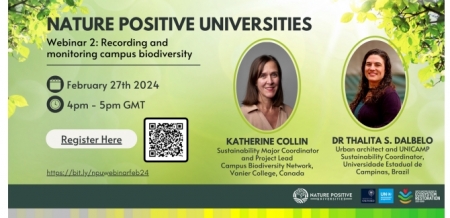 The 2024 Nature Positive Universities webinar series is a new series
of six webinars for members of the NPU network to learn more about the wor
k member institutions have been undertaking in several key areas of biodive
rsity action\, and take inspiration from their work. The series will cover
action for biodiversity on our campuses\, and in our supply chains\, and fo
cus on approaches in cities\, food on campus\, and how to set up biodiversi
ty strategies.
The 2024 Nature Positive Universities webinar series is a new series
of six webinars for members of the NPU network to learn more about the wor
k member institutions have been undertaking in several key areas of biodive
rsity action\, and take inspiration from their work. The series will cover
action for biodiversity on our campuses\, and in our supply chains\, and fo
cus on approaches in cities\, food on campus\, and how to set up biodiversi
ty strategies.
PROGRAMME
4pm | Welcome by the Vice C
hancellor\, Prof Irene Tracey
Update on the Oxford Networks for the E
nvironment\,
Prof Jim Hall\, Environmental Change Institute
Upda
te on the University Environmental Sustainability Strategy\,
Harriet W
aters\, Head of Environmental Sustainability
ONE Annual Lecture\, Pro f John Schellnhuber
Panel discussion: How to survive the Anthropocene
Prof Michael Obersteiner\, Environmental Change Institute
Alice
Evatt\, Oxford Net Zero
Prof Sam Fankhauser\, Smith School for Enterpr
ise and the Environment
Audrey Wagner\, Nature-Based Solutions Initiat
ive
Chaired by Prof Helen Johnson\, Earth Sciences
6pm | Close a nd drinks reception
LOCATION:Natural History Museum Oxford GEO:51.759379;-1.259145 ORGANIZER;CN="Nature Admin":MAILTO:letsrecord@gmail.com URL;VALUE=URI:https://nature.ox.ac.uk/events/event/how-to-survive-the-anthr opocene-flat-overshoot-deep-restoration/ END:VEVENT BEGIN:VEVENT UID:20260112T1002Z-1768212151.1-EO-10133-1@127.0.0.1 STATUS:CONFIRMED DTSTAMP:20260412T145451Z CREATED:20240201T170135Z LAST-MODIFIED:20240311T120452Z DTSTART;TZID=Europe/London:20240308T161500 DTEND;TZID=Europe/London:20240308T171500 SUMMARY: Soil Ecology from the microbe’s eye view – Edith Hammer DESCRIPTION: Abstract: Soil is arguably the most complicated biomaterial on the planet. It is the largest terrestrial carbon sink\, and the most speci es rich habitat on earth. Microorganisms driving biogeochemical cycles live and interact in the soil’s intricate pore space labyrinth\, but they diffi cult to study in realistic settings because of its opaqueness. We recently developed […] X-ALT-DESC;FMTTYPE=text/html:Abstract:
Soil is ar
guably the most complicated biomaterial on the planet. It is the largest te
rrestrial carbon sink\, and the most species rich habitat on earth. Microor
ganisms driving biogeochemical cycles live and interact in the soil’s intri
cate pore space labyrinth\, but they difficult to study in realistic settin
gs because of its opaqueness. We recently developed microfluidic model syst
ems that simulate the spatial microstructure of soil microbial habitats in
a transparent material\, which we call Soil Chips. They allow us to study t
he impact of soil physical microstructures on microbes\, microbial behavior
and realistic microbial interactions\, live and at the scale of their cell
s.
Using microbial model strains\, we could show the partly opposing influence of the pore space geometry on the growth and degradation activity of the two microbial groups bacteria and fungi in synthetic communities. D ifferent fungi\, including litter decomposers and mycorrhizal\, showed cont rasting space exploring strategies when studied at their hyphal level. Inoc ulating the chips with soil brings a large proportion of the natural microb ial community into our chips to study natural communities including their c omplex food webs\, and self-organizing interactions with soil minerals in e arly aggregation processes. Chemical imaging of microbe-mineral interaction s at nanoscale at synchrotrons reveal aggregate development and microbial g luing agents.
The soil chips enable us to study the influence of trop hic interactions such as the presence of predators on bacterial and fungal nutrient cycling\, and various predation strategies of protists otherwise d ifficult to culture. Beyond the scientific potential\, the chips can also b ring soils closer to people aiming to make more to appreciate their beauty and increase engagement in soil health conservation.
Biograph
y:
Edith is a Senior Lecturer/Assoc Professor in Soil Microbi
al Ecology at Lund University. Her research focusses on microbial processes
that drive the nutrient cycles in soils and are the base for healthy soil
functions\, such as its enormous carbon storage. She has developed so-calle
d soil chips\, microfluidic micromodels that mimic soil pore space structur
e to study organisms and processes embedded in their spatial settings. Thos
e enable the study of microbial processes and interactions at cellular scal
e\, including organic matter degradation and physical occlusion\, trophic n
etworks and microbial behavior.
With a strong background in fungal an d mycorrhizal ecology\, she has recently been broadening her projects to co mplex communities also including the often-overlooked protist. With help of imaging from the soil chips she also wishes to increase awareness of the f ragile ecosystem with its intricate biodiversity. She leads the branch for climate and C-cycle science of the Swedish strategic research environment B ECC\, the Section Soil Biology at the European Geosciences Union and a rece nt initiative for soil microbe outreach (“soilwatching”).
The Leverhu lme Centre for Nature Recovery and Biodiversity Network are interested in p romoting a wide variety of views and opinions on nature recovery from resea rchers and practitioners.
The views\, opinions and positions expresse d within this lecture are those of the author alone\, they do not purport t o reflect the opinions or views of the Leverhulme Centre for Nature Recover y/Biodiversity Network\, or its researchers.
LOCATION:School of Geography and Environment Lecture theatre GEO:51.758549;-1.253182 ORGANIZER;CN="Nature Admin":MAILTO:letsrecord@gmail.com URL;VALUE=URI:https://nature.ox.ac.uk/events/event/tbc/ END:VEVENT BEGIN:VEVENT UID:20260112T1002Z-1768212151.1-EO-10236-1@127.0.0.1 STATUS:CONFIRMED DTSTAMP:20260412T145451Z CREATED:20240221T162834Z LAST-MODIFIED:20240311T094625Z DTSTART;TZID=Europe/London:20240312T170000 DTEND;TZID=Europe/London:20240312T180000 SUMMARY: AmazonFlux: disentangling biodiversity-ecosystem function relation ship through an energy flux perspective DESCRIPTION: Human-made disturbances have triggered multiple changes in bio diversity\, with unexpected consequences for ecosystem functioning. Yet\, w e still miss a mechanistic comprehension of the relationship between biodiv ersity change and ecosystem function. Considering that species’ response to disturbances will depend on\, or are mediated by\, their interaction with other species\, this information gap might lead to erroneous […] X-ALT-DESC;FMTTYPE=text/html:Human-made disturbances have triggered mul tiple changes in biodiversity\, with unexpected consequences for ecosystem functioning. Yet\, we still miss a mechanistic comprehension of the relatio nship between biodiversity change and ecosystem function. Considering that species' response to disturbances will depend on\, or are mediated by\, the ir interaction with other species\, this information gap might lead to erro neous projections of how human-induced changes impact biodiversity and ecos ystem functioning. By merging biodiversity models and energy flux approach we can integrate biotic and abiotic factors into assessing ecosystem functi ons at macroecological scales. After a collaborative work to compile an ext ensive biodiversity dataset of camera trap information for the Amazon fores t (Amazonia Camtrap)\, I aim to disentangle the impact of different forest disturbances on bird and mammal communities and use an energy flux approach to investigate how these disturbances and changes in biodiversity affect e cosystem functions.
Biography
I am a Brazilian ecologist workin g as a postdoctoral researcher at the Synthesis Centre for Biodiversity Sci ences (sDiv)\, iDiv. My current research focuses on understanding how fores t disturbances\, associated with biodiversity changes\, affect ecosystem fu nctions in animal communities across the Amazon forest.
Prior to join ing sDiv\, I completed my PhD in 2023 in the Theory in Biodiversity group a t iDiv where I proposed a framework based on ecological energetics to link biodiversity-ecosystem functions and nature’s contributions to people acros s macroecological scales\, while accounting for ecological interactions bet ween species. In 2016\, I obtained my MSc from the National Institute of Am azonian Research (INPA) in Manaus\, Brazil\, where I specialized in ecology and started my passion for the Amazon forest.
The Biodiversity Netwo rk is interested in promoting a wide variety of views and opinions on natur e recovery from researchers and practitioners.
The views\, opinions a nd positions expressed within this lecture are those of the author alone\, they do not purport to reflect the opinions or views of the Biodiversity Ne twork\, or its researchers.
LOCATION:School of Geography and the Envionment - Atmosphere room GEO:51.758549;-1.253182 ORGANIZER;CN="Nature Admin":MAILTO:letsrecord@gmail.com URL;VALUE=URI:https://nature.ox.ac.uk/events/event/amazonflux-disentangling -biodiversity-ecosystem-function-relationship-through-an-energy-flux-perspe ctive/ END:VEVENT BEGIN:VEVENT UID:20260112T1002Z-1768212151.11-EO-10231-1@127.0.0.1 STATUS:CONFIRMED DTSTAMP:20260412T145451Z CREATED:20240220T183145Z LAST-MODIFIED:20240318T110811Z DTSTART;TZID=Europe/London:20240315T161500 DTEND;TZID=Europe/London:20240315T171500 SUMMARY: Building collaborations with Indigenous and Local Communities usin g Extreme Citizen Science DESCRIPTION: This talk will describe the work of the Extreme Citizen Scienc e Research Group designing and testing solutions for building effective col laborations with Indigenous People and local communities in the context of local conservation initiatives\, extractive industry\, human rights abuses\ , or to address the impacts of climate and environmental change on local li velihoods. Jerome Lewis works […] X-ALT-DESC;FMTTYPE=text/html:This talk will describe the work of the Ex treme Citizen Science Research Group designing and testing solutions for bu ilding effective collaborations with Indigenous People and local communitie s in the context of local conservation initiatives\, extractive industry\, human rights abuses\, or to address the impacts of climate and environmenta l change on local livelihoods.
Jerome Lewis works with BaYaka forest hunter-gatherers in Congo-Brazzaville since 1993 on egalitarianism and the role of ritual\, music and dance in society. Jerome’s applied research supp orts forest people to secure their land and better represent themselves to outsiders using new technologies (Extreme Citizen Science). He is director of the Centre for the Anthropology of Sustainability\, and co-founder of Fl ourishing Diversity.
The Biodiversity Network is interested in promot ing a wide variety of views and opinions on nature recovery from researcher s and practitioners.
The views\, opinions and positions expressed wit hin this lecture are those of the author alone\, they do not purport to ref lect the opinions or views of the Biodiversity Network\, or its researchers .
LOCATION:Main Lecture Theatre GEO:51.759076;-1.252735 ORGANIZER;CN="Nature Admin":MAILTO:letsrecord@gmail.com URL;VALUE=URI:https://nature.ox.ac.uk/events/event/building-collaborations- with-indigenous-and-local-communities-using-extreme-citizen-science/ END:VEVENT BEGIN:VEVENT UID:20260112T1002Z-1768212151.12-EO-10261-1@127.0.0.1 STATUS:CONFIRMED DTSTAMP:20260412T145451Z CREATED:20240307T153817Z LAST-MODIFIED:20240307T161800Z DTSTART;TZID=Europe/London:20240319T090000 DTEND;TZID=Europe/London:20240319T100000 SUMMARY: Webinar 3: Actions for biodiversity on campus DESCRIPTION: 🌱 Welcome to the next instalment of our new 2024 Nature Positi ve Universities (NPU) webinar series. In this opportunity\, we will be lear ning from two NPU member institutions about biodiversity initiatives on the ir respective campuses including the Familial Forestry approach for habitat restoration in Rajasthan and biodiversity uplift projects such as native p lanting\, green roofs […] X-ALT-DESC;FMTTYPE=text/html:🌱 Welcome to the next instalment of our ne w 2024 Nature Positive Universities (NPU) webinar series. In this opportuni ty\, we will be learning from two NPU member institutions about biodiversit y initiatives on their respective campuses including the Familial Forestry approach for habitat restoration in Rajasthan and biodiversity uplift proje cts such as native planting\, green roofs and habitat creation for birds\, bats and insects in Konstanz.
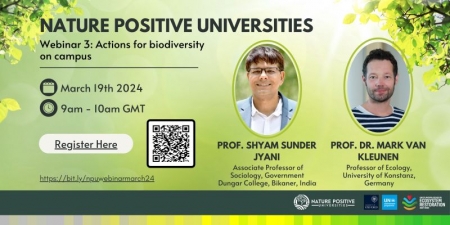
The 2024 Nature P ositive Universities webinar series is a new series of six webinars for mem bers of the NPU network to learn more about the work member institutions ha ve been undertaking in several key areas of biodiversity action\, and take inspiration from their work. The series will cover action for biodiversity on our campuses\, and in our supply chains\, and focus on approaches in cit ies\, food on campus\, and how to set up biodiversity strategies.
ORGANIZER;CN="Nature Admin":MAILTO:letsrecord@gmail.com URL;VALUE=URI:https://nature.ox.ac.uk/events/event/webinar-3-actions-for-bi odiversity-on-campus/ END:VEVENT BEGIN:VEVENT UID:20260112T1002Z-1768212151.12-EO-10269-1@127.0.0.1 STATUS:CONFIRMED DTSTAMP:20260412T145451Z CREATED:20240325T151228Z LAST-MODIFIED:20240325T151228Z DTSTART;TZID=Europe/London:20240412T161500 DTEND;TZID=Europe/London:20240412T173000 SUMMARY: Bending the curves – balancing nature\, economy and society\, from the bottom up DESCRIPTION: Abstract: Bending the curve of biodiversity decline\, ie. halt ing and reversing loss\, has been adopted as the mission for the Global Bio diversity Framework. While conservation and restoration are necessary to ac hieve this\, they are not sufficient and this talk focuses on the two sets of actions that need far greater attention – a) bending and […] X-ALT-DESC;FMTTYPE=text/html:Abstract: Bending the curve of biodiversit y decline\, ie. halting and reversing loss\, has been adopted as the missio n for the Global Biodiversity Framework. While conservation and restoration are necessary to achieve this\, they are not sufficient and this talk focu ses on the two sets of actions that need far greater attention - a) bending and reversing the drivers of biodiversity decline\, which requires primary focus on indirect drivers\, in particular overconsumption\, and b) redress ing equity imbalances. Both entail specific responsibilities and actions\, by those who over-consume\, and for those who under-consume. Focusing on he althy and sufficient nature at square kilometre scales provides a direct ap proach to address these issues\, providing tangible opportunities to revert financial capital into natural capital to nature\, economy and society for a sustainable future.
Biography - David Obura chairs the Intergovern mental Platform on Biodiversity and Ecosystem Services (IPBES)\, is on the Earth Commission and is a Founding Director of the coral reef research and conservation organization CORDIO East Africa. With 30 years of experience a ddressing ecological and climatic challenges in Africa and tropical coastal regions\, he is developing a new focus on sustainability and equity\, link ing challenges and solutions from local to global scales\, and working with diverse teams to identify pathways to a safe and just world for present an d future generations.
The Biodiversity Network is interested in promo ting a wide variety of views and opinions on nature recovery from researche rs and practitioners.
The views\, opinions and positions expressed wi thin this lecture are those of the author alone\, they do not purport to re flect the opinions or views of the Biodiversity Network\, or its researcher s.
LOCATION:School of Geography and Environment Lecture theatre GEO:51.758549;-1.253182 ORGANIZER;CN="Nature Admin":MAILTO:letsrecord@gmail.com URL;VALUE=URI:https://nature.ox.ac.uk/events/event/bending-the-curves-balan cing-nature-economy-and-society-from-the-bottom-up/ END:VEVENT BEGIN:VEVENT UID:20260112T1002Z-1768212151.13-EO-10289-1@127.0.0.1 STATUS:CONFIRMED DTSTAMP:20260412T145451Z CREATED:20240422T161025Z LAST-MODIFIED:20240422T161025Z DTSTART;TZID=Europe/London:20240426T161500 DTEND;TZID=Europe/London:20240426T171500 SUMMARY: Restoration Social Science: Understanding how and why people resto re landscapes\, and what the impacts of that restoration is on human well b eing. DESCRIPTION: Restoration is emerging as a global priority\, as exemplified in the UN Decade on Ecosystem Restoration\, the Bonn Challenge to restore 3 50 Mha by 2030\, and a wide variety of regional\, national\, and private ef forts. As described in these documents\, restoration is primarily conceived as an ecological process\, in which ecosystems are restored to a […] X-ALT-DESC;FMTTYPE=text/html:Restoration is emerging as a global priori ty\, as exemplified in the UN Decade on Ecosystem Restoration\, the Bonn Ch allenge to restore 350 Mha by 2030\, and a wide variety of regional\, natio nal\, and private efforts. As described in these documents\, restoration is primarily conceived as an ecological process\, in which ecosystems are res tored to a more functional or desirable state through ecological processes\ , and there is a well developed science of restoration ecology to inform th ese efforts. However most restoration seeks to undo damage to ecosystems ca used by people\, most restoration efforts involve people doing things\, and restoration is often sold as being beneficial to people. Thus a social sci ence of restoration is needed to make sure restoration achieves its goals\, however\, no such collected body of knowledge exists.
In this talk I will propose 3 key questions which restoration social science must answer: (1) What are the impacts of restoration on people? (2) How do human action s influence restoration outcomes? (3) Why has restoration emerged as a glob al priority now? I will provide preliminary answers to these questions whic h draw on my field research in India. These results suggest that the outcom es of restoration depend on who makes decisions about the restoration progr am\, and as such can vary from beneficial to harmful to people. They also s uggest that a major impetus for the popularity of restoration today is that restoration can be an effective way to greenwash environmentally harmful a ctivities.
Biography
Forrest Fleischman is an associate professo
r at the University of Minnesota\, Department of Forest Resources\, and a v
isiting researcher at the Institute of Environmental Science and Technology
at the Autonomous University of Barcelona (ICTA-UAB). His research examine
s the intersection of scientific knowledge\, government expertise\, and civ
ic engagement in policy-making and implementation\, as well as the outcomes
of resulting policies\, particularly in human-created ecosystems\, such as
restored\, planted\, and urban forests.
The Leverhulme Centre for Na ture Recovery and Biodiversity Network are interested in promoting a wide v ariety of views and opinions on nature recovery from researchers and practi tioners.
The views\, opinions and positions expressed within this lec ture are those of the author alone\, they do not purport to reflect the opi nions or views of the Leverhulme Centre for Nature Recovery/Biodiversity Ne twork\, or its researchers.
ORGANIZER;CN="Nature Admin":MAILTO:letsrecord@gmail.com URL;VALUE=URI:https://nature.ox.ac.uk/events/event/restoration-social-scien ce-understanding-how-and-why-people-restore-landscapes-and-what-the-impacts -of-that-restoration-is-on-human-well-being/ END:VEVENT BEGIN:VEVENT UID:20260112T1002Z-1768212151.13-EO-10285-1@127.0.0.1 STATUS:CONFIRMED DTSTAMP:20260412T145451Z CREATED:20240422T144626Z LAST-MODIFIED:20240422T144626Z DTSTART;TZID=Europe/London:20240430T160000 DTEND;TZID=Europe/London:20240430T170000 SUMMARY: Webinar 4: Procurement and suppliers DESCRIPTION: 🌱 Welcome to the next instalment of our new 2024 Nature Positi ve Universities (NPU) webinar series. In this opportunity\, we will be lear ning from two NPU member institutions about procurement and suppliers. Our speakers are Stéphanie H. Leclerc\, Program Manager\, Sustainable Procureme nt\, McGill University\, Canada who will talk about their supplier code of conduct and […] X-ALT-DESC;FMTTYPE=text/html:🌱 Welcome to the next instalment of our ne w 2024 Nature Positive Universities (NPU) webinar series. In this opportuni ty\, we will be learning from two NPU member institutions about procurement and suppliers. Our speakers are Stéphanie H. Leclerc\, Program Manager\, S ustainable Procurement\, McGill University\, Canada who will talk about the ir supplier code of conduct and how McGill University and other regional un iversities and colleges have been working with suppliers to address their e nvironmental impacts\, and Sami El Geneidy\, Doctoral Researcher and Biodiv ersity Footprint Team Lead\, University of Jyväskylä\, Finland who will pre sent the work done at the University of Jyväskylä regarding the biodiversit y footprint of their procurement activities.

The 2024 Nature Positive Universities webinar series is a n ew series of six webinars for members of the NPU network to learn more abou t the work member institutions have been undertaking in several key areas o f biodiversity action\, and take inspiration from their work. The series wi ll cover action for biodiversity on our campuses\, and in our supply chains \, and focus on approaches in cities\, food on campus\, and how to set up b iodiversity strategies.
ORGANIZER;CN="Nature Admin":MAILTO:letsrecord@gmail.com URL;VALUE=URI:https://nature.ox.ac.uk/events/event/webinar-4-procurement-an d-suppliers/ END:VEVENT BEGIN:VEVENT UID:20260112T1002Z-1768212151.14-EO-10266-1@127.0.0.1 STATUS:CONFIRMED DTSTAMP:20260412T145451Z CREATED:20240318T120748Z LAST-MODIFIED:20240318T123309Z DTSTART;TZID=Europe/London:20240430T163000 DTEND;TZID=Europe/London:20240430T173000 SUMMARY: Africa – Oxford Nature Networking Event X-ALT-DESC;FMTTYPE=text/html:
Abstract: Ecologist Thomas Crowther unders cores the vital role of nature conservation and restoration in combating bi odiversity loss and climate change. In his talk\, Crowther will highlight r ecent scientific advancements\, such as the groundbreaking evaluation of gl obal forest carbon potential\, and the launch of the SEED\, a biocomplexity index\, which enables us to understand the variation in biological health across the globe. These initiatives aim to enhance our commitment to nature and empower individuals\, companies and governments to make positive contr ibutions towards biodiversity conservation. Through collective action and i nformed stewardship\, Crowther inspires hope for a sustainable future where nature thrives alongside humanity.
Biography:
Thomas Ward Crowt
her is a professor of ecology at ETH Zürich and co-chair of the advisory bo
ard for the United Nations Decade on Ecosystem Restoration. At ETH Zürich\,
he started Crowther Lab\, an interdisciplinary group of scientists explori
ng the role of biodiversity in regulating the Earth’s climate. Crowther is
the founder of Restor\, an online platform that provides connectivity\, and
transparency to thousands of conservation and restoration projects around
the world. He also founded SEED\, a biodiversity monitoring tool to help me
asure the health of nature across the globe. He was selected in the final c
ohort for Prince William’s Earthshot Prize\, and was selected by World Econ
omic Forum as a Young Global Leader for his work to promote nature
Th e Leverhulme Centre for Nature Recovery and Biodiversity Network are intere sted in promoting a wide variety of views and opinions on nature recovery f rom researchers and practitioners.
The views\, opinions and positions expressed within this lecture are those of the author alone\, they do not purport to reflect the opinions or views of the Leverhulme Centre for Natur e Recovery/Biodiversity Network\, or its researchers.
LOCATION:School of Geography and Environment Lecture theatre GEO:51.758549;-1.253182 ORGANIZER;CN="Nature Admin":MAILTO:letsrecord@gmail.com URL;VALUE=URI:https://nature.ox.ac.uk/events/event/global-ecological-shift- for-the-protection-and-restoration-of-biodiversity-thomas-crowther/ END:VEVENT BEGIN:VEVENT UID:20260112T1002Z-1768212151.15-EO-10297-1@127.0.0.1 STATUS:CONFIRMED DTSTAMP:20260412T145451Z CREATED:20240424T160156Z LAST-MODIFIED:20240507T084557Z DTSTART;TZID=Europe/London:20240503T161500 DTEND;TZID=Europe/London:20240503T171500 SUMMARY: Does science impact nature conservation policy? Stories of success and failure.- Hugh Possingham DESCRIPTION: Hugh in semi-retirement has 3 jobs: Biodiversity Council’s Co- chief Councillor\, Chief Scientist of Accounting for Nature and The Univers ity of Queensland. He was the founding Director of The Australian Research Council Centre of Excellence for Environmental Decisions\, the National Env ironmental Science Program Threatened Species hub and an Australian Researc h Council Professorial\, Laureate and Federation Fellow. […] X-ALT-DESC;FMTTYPE=text/html:Hugh in semi-retirement has 3 jobs: Biodiv ersity Council's Co-chief Councillor\, Chief Scientist of Accounting for Na ture and The University of Queensland. He was the founding Director of The Australian Research Council Centre of Excellence for Environmental Decision s\, the National Environmental Science Program Threatened Species hub and a n Australian Research Council Professorial\, Laureate and Federation Fellow .
Hugh also has a variety of broader public roles advising policy mak ers and managers\, and sits on c30 boards and advisory committees – from th e Friends of Oxley Creek Common to Conservation International.
Alongs ide Dr Barry Traill\, Hugh wrote “The Brigalow Declaration”. This open lett er was used by the Queensland Premier Peter Beattie to stop land clearing i n the state\, thereby stopping c10% of Australia’s greenhouse gas emissions per annum and saving an area the size of Portugal from conversion into far mland.
The Possingham lab developed Marxan\, the most widely used con servation planning software in the world. Marxan was used to underpin the r ezoning of the Great Barrier Reef and is currently employed by more than 70 00 users in over 180 countries to build most of the world’s marine and terr estrial protected area systems from the Amazon and British Columbia to the Sunda Sea and South Africa.
Hugh has co-authored over 740 peer-review ed papers\, including 35 in Science and Nature\, and has been the privilege d mentor of over 200 PhD candidates\, honours students and postdoctoral res earchers. His google scholar h-index is 164. Hugh has honorary doctorates f rom the University of British Columbia and Adelaide University.
He ha s one known psychological disorder - a compulsive desire to watch birds.
The Leverhulme Centre for Nature Recovery and Biodiversity Network are interested in promoting a wide variety of views and opinions on nature reco very from researchers and practitioners.
The views\, opinions and pos itions expressed within this lecture are those of the author alone\, they d o not purport to reflect the opinions or views of the Leverhulme Centre for Nature Recovery/Biodiversity Network\, or its researchers.
LOCATION:Main Lecture Theatre GEO:51.759076;-1.252735 ORGANIZER;CN="Nature Admin":MAILTO:letsrecord@gmail.com URL;VALUE=URI:https://nature.ox.ac.uk/events/event/does-science-impact-natu re-conservation-policy-stories-of-success-and-failure-hugh-possingham/ END:VEVENT BEGIN:VEVENT UID:20260112T1002Z-1768212151.16-EO-10310-1@127.0.0.1 STATUS:CONFIRMED DTSTAMP:20260412T145451Z CREATED:20240510T095043Z LAST-MODIFIED:20240510T095043Z DTSTART;TZID=Europe/London:20240510T110000 DTEND;TZID=Europe/London:20240510T120000 SUMMARY: Biodiversity coffee morning seminars X-ALT-DESC;FMTTYPE=text/html: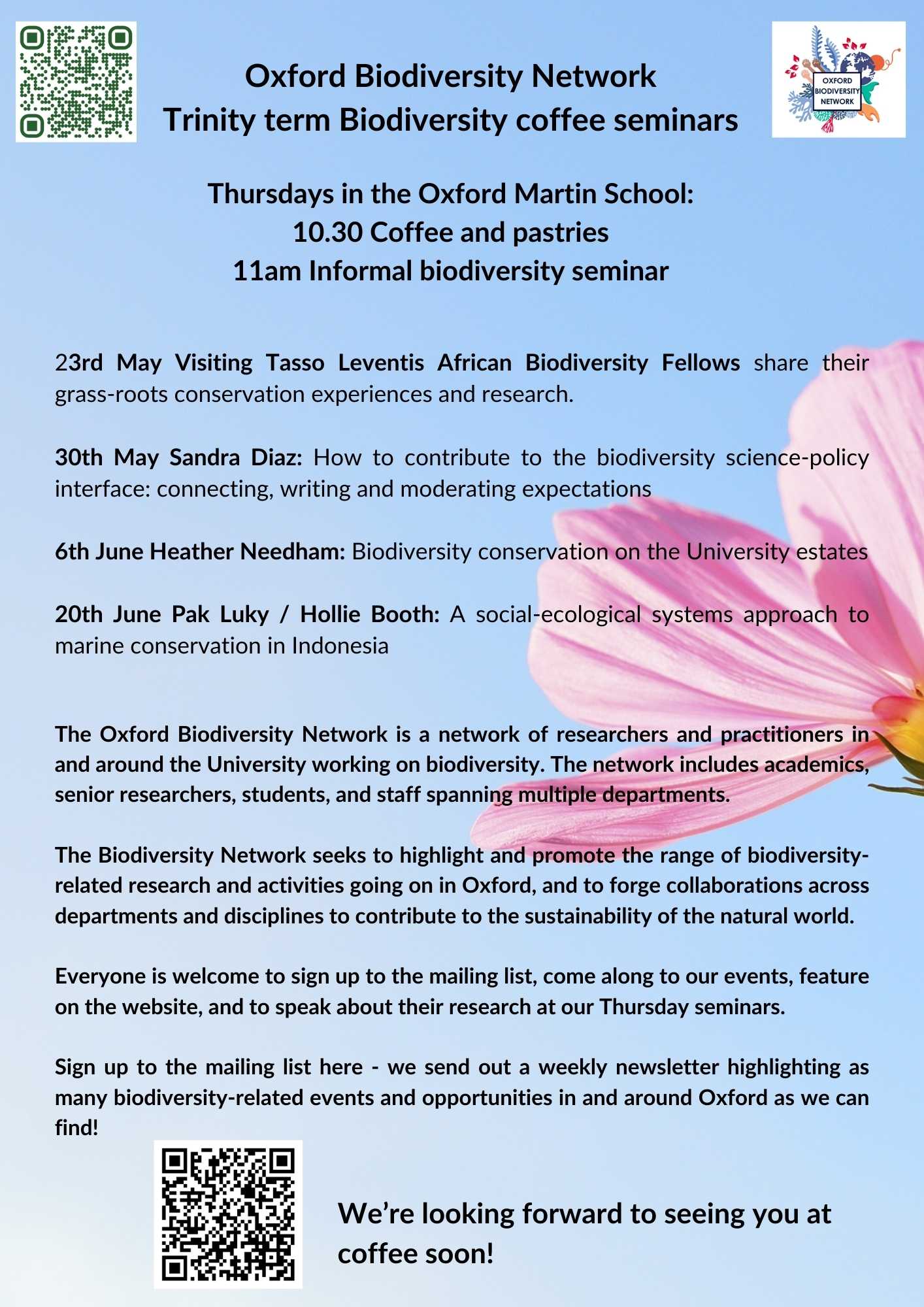
In this provocative talk Justin will argue that while the increased awareness and understanding of the decline of bio diversity is to be welcomed. Our current approaches and responses at both t he global and local levels are woefully inadequate. We are stuck in a cycle of incremental gains that are failing to address the roots causes of the ‘ nature crisis’. Moving forward we will need to be much bolder in reimaginin g the future we want to help build.
Justin will draw on his diverse e xperience to highlight the inadequacies of incremental approaches and the u rgent need for transformative change. From addressing commodity-driven defo restation\, to the ongoing challenges and controversies of the carbon marke t\, to his experience of implementing Biodiversity Net Gain locally\, Justi n will share insights gained from more than 15 years working on nature reco very.
He will take a step back to explore what we can learn from all these examples and then offer some perspectives on how we might collectivel y reimagine our approaches to nature recovery.
This interactive discu ssion will provide a platform for attendees to challenge assumptions and en gage in dialogue on the future of nature recovery. Come prepared to explore bold solutions and contribute to the conversation.
Biography:
J
ustin is a seasoned expert in nature and food systems. He has held senior r
oles in both the private sector and civil society and was a Senior Advisor
to the UK Government to deliver COP26 for which he was awarded an OBE by th
e late Queen in 2022. Most recently he led the strategy development of Gene
ration Investment Management’s new multi hundred-million-dollar nature and
food investment fund.
He stepped down from this role in August 2023 t o create space for a much deeper exploration of how to unlock transformatio nal change at both the individual and system levels. His latest endeavour\, the Ostara Collective\, launches in June and aims to create intentional di alogue and space for restoring our relationship with ourselves\, our commun ities\, and the Earth. He also serves on the Advisory Board for the Leverhu lme Centre for Nature Recovery\, is a Visiting Fellow at the Oxford Martin School and is Chair of the Trust for Oxfordshire’s Environment focused on l ocal nature recovery.
The Leverhulme Centre for Nature Recove ry and Biodiversity Network are interested in promoting a wide variety of v iews and opinions on nature recovery from researchers and practitioners.
The views\, opinions and positions expressed within this lecture are th ose of the author alone\, they do not purport to reflect the opinions or vi ews of the Leverhulme Centre for Nature Recovery/Biodiversity Network\, or its researchers.
LOCATION:Main Lecture Theatre GEO:51.759076;-1.252735 ORGANIZER;CN="Nature Admin":MAILTO:letsrecord@gmail.com URL;VALUE=URI:https://nature.ox.ac.uk/events/event/boldly-reimagining-our-a pproaches-to-nature-recovery-justin-adams/ END:VEVENT BEGIN:VEVENT UID:20260112T1002Z-1768212151.17-EO-10291-1@127.0.0.1 STATUS:CONFIRMED DTSTAMP:20260412T145451Z CREATED:20240422T162342Z LAST-MODIFIED:20240520T111722Z DTSTART;TZID=Europe/London:20240517T161500 DTEND;TZID=Europe/London:20240517T171500 SUMMARY: Climate Change and Rural Livelihoods in Ghana: the impacts\, adapt ations and barriers DESCRIPTION: Climate change poses considerable threats to socioeconomic dev elopment and ecological systems across Africa. This is particularly critica l for smallholder farming communities in dryland agroecosystems where clima te change interact with non-climatic stressors and shocks to exacerbate the vulnerability of rural livelihoods. Ghana is already suffering from signif icant climate change impacts and is projected to experience increased […] X-ALT-DESC;FMTTYPE=text/html:Climate change poses considerable threats to socioeconomic development and ecological systems across Africa. This is particularly critical for smallholder farming communities in dryland agroec osystems where climate change interact with non-climatic stressors and shoc ks to exacerbate the vulnerability of rural livelihoods. Ghana is already s uffering from significant climate change impacts and is projected to experi ence increased temperatures and erratic rainfall patterns in the coming yea rs and decades. This threatens the attainment of the Sustainable Developmen t Goals\, especially those relating to poverty reduction (SDG 1)\, food sec urity (SDG 2) and climate action (SDG 13).
This talk focuses on provi ding an understanding of the adverse impacts of climate change and variabil ity on rural livelihoods in northern Ghana and how these perpetuate existin g vulnerability among rural households and communities. Drawing on personal research from across rural Ghana\, this talk spotlights the various practi ces employed by rural communities to moderate the adverse impacts of climat e risks. The talk also highlights the key barriers confronting rural commun ities in their attempt to address the impacts of climate change. The talk c oncludes by proposing a number of recommendations such as increased use of climate services\, climate-smart agriculture interventions and changing cro pping choices\, aimed at making rural livelihoods in northern Ghana more re silient in the face of climate change and variability.
Biography
Prof. Philip Antwi-Agyei is the Director of the Office of Grants and Resea
rch at the Kwame Nkrumah University of Science and Technology\, Ghana. Phil
ip is a former Commonwealth Scholar\, who obtained his PhD from the Univers
ity of Leeds\, United Kingdom in 2013. Philip is an interdisciplinary clima
te change scientist whose research involves developing innovative multi-sca
le methodologies for assessing vulnerability and adaptations to climate cha
nge across the local\, regional and national scales. Specifically\, his res
earch uses spatial databases\, ecological studies and field-based participa
tory approaches aimed at broadening understanding of how climate change and
variability affect food security and livelihoods.
Prof. Antwi-Agyei was a Lead Author for the Intergovernmental Panel on Climate Change (IPCC) Special Report on Global Warming of 1.5 oC\, and a Contributing Author on t he Sixth Assessment Report of the IPCC. He has consulted for leading intern ational organisations including the United Nations Development Programme (U NDP\, Accra)\, the International Institute for Sustainable Development\, Ca nada\, and Ghana’s Environmental Protection Agency\, to mention but a few. Philip developed the National Adaptation Plan (NAP) Framework for Ghana and the National Adaptation Strategy and Action Plan for the Infrastructure Se ctor (Water\, Energy\, and Transport Sectors). Prof. Antwi-Agyei was the Co nsultant for the adaptation component of Ghana’s Updated Nationally Determi ned Contributions under the Paris Climate Agreement.
Prof. Antwi-Agye i is a recipient of several prestigious international grants including the International Foundation for Science (2010–2013)\, Climate Impacts Research Capacity and Leadership Enhancement Fellowship (2015–2016) funded by the U K’s Department for International Development\, Innovation Grant from the Lo ndon School of Economics and University of Leeds\, United Kingdom (2016–201 8)\, and Science for Weather Information and Forecasting Techniques (2016–2 021) funded by the Global Challenge Research Fund. He has also won grants u nder the Climate Research for Development (2019–2021)\, an initiative of th e African Climate Policy Centre in partnership with the United Kingdom’s De partment for International Development. Philip was a Fellow under the Futur e Leaders–Africa Independent Research (FLAIR) (2020–2022) and Collaboration Grants (2021–2022) funded by the Royal Society\, London.
He has publ ished extensively in reputable international peer reviewed journals on clim ate change issues and presented his research outputs in several internation al conferences and workshops. Philip serves as an Associate Editor for the Journal of Climate and Development (published by Taylor and Francis). He al so serves on the Editorial Board of Journal of Environmental Policy and Gov ernance and is a regular reviewer for several leading high impact factor jo urnals on climate change related matters.
The Leverhulme Centre for N ature Recovery and Biodiversity Network are interested in promoting a wide variety of views and opinions on nature recovery from researchers and pract itioners.
The views\, opinions and positions expressed within this le cture are those of the author alone\, they do not purport to reflect the op inions or views of the Leverhulme Centre for Nature Recovery/Biodiversity N etwork\, or its researchers.
LOCATION:School of Geography and Environment Lecture theatre GEO:51.758549;-1.253182 ORGANIZER;CN="Nature Admin":MAILTO:letsrecord@gmail.com URL;VALUE=URI:https://nature.ox.ac.uk/events/event/climate-change-and-rural -livelihoods-in-ghana-the-impacts-adaptations-and-barriers/ END:VEVENT BEGIN:VEVENT UID:20260112T1002Z-1768212151.18-EO-10320-1@127.0.0.1 STATUS:CONFIRMED DTSTAMP:20260412T145451Z CREATED:20240516T091150Z LAST-MODIFIED:20240516T091215Z DTSTART;TZID=Europe/London:20240523T160000 DTEND;TZID=Europe/London:20240523T173000 SUMMARY: The planetary boundaries framework: helpful for shaping human futu res? DESCRIPTION: The framework of planetary boundaries is widely applied to enc apsulate the idea that human transformation of the planet is in danger of b reaching multiple thresholds in planetary function\, leading to dangerous c onsequences for human futures and for wider life on Earth. It has inspired further concepts\, including the “doughnut” model of a safe operating space […] X-ALT-DESC;FMTTYPE=text/html:The framework of planetary boundaries is w idely applied to encapsulate the idea that human transformation of the plan et is in danger of breaching multiple thresholds in planetary function\, le ading to dangerous consequences for human futures and for wider life on Ear th. It has inspired further concepts\, including the “doughnut” model of a safe operating space for humanity. However\, specific boundaries are diffic ult to identify and practically action\, and some have argued that a such a boundaries framework hinders developing positive narratives for human and planetary flourishing.
Join us as we discuss this planetary topic\, w ith ecological economist Kate Raworth\, Erle Ellis\, Professor of Geography and Environmental Systems and Yadvinder Malhi\, Director of Oxford’s Lever hulme Centre for Nature Recovery.
Kate Raworth is an ecological econo mist and creator of the Doughnut of social and planetary boundaries. Her in ternationally best-selling book\, Doughnut Economics: Seven Ways to Think l ike a 21st Century Economist\, has been translated into more than 20 langua ges. In 2019 she co-founded Doughnut Economics Action Lab to collaborate wi th changemakers worldwide – from mayors and entrepreneurs to teachers and c ommunity activists – who are turning the book’s ideas into practice. She te aches at Oxford University’s Environmental Change Institute and is Professo r of Practice at the Amsterdam University of Applied Sciences.
Erle E llis is Professor of Geography and Environmental Systems at the University of Maryland\, Baltimore County (UMBC) where he directs the Anthroecology La boratory. His research investigates the ecology of human landscapes at loca l to global scales to inform sustainable stewardship of the biosphere in th e Anthropocene. His recent work examines long-term changes in Earth’s ecolo gy produced by human societies through the concept of anthropogenic biomes\ , or anthromes\, a term he introduced in 2008. He is author of Anthropocene : A Very Short Introduction.
Yadvinder Malhi is an ecosystem ecologis t\, Professor of Ecosystem Science at Oxford and Director of the Leverhulme Centre for Nature Recovery. His work focuses on understanding the function ing of the biosphere and its interactions with global change\, and on how n ature recovery can be developed and enabled to support a thriving future fo r life on Earth.
ORGANIZER;CN="Nature Admin":MAILTO:letsrecord@gmail.com URL;VALUE=URI:https://nature.ox.ac.uk/events/event/the-planetary-boundaries -framework-helpful-for-shaping-human-futures/ END:VEVENT BEGIN:VEVENT UID:20260112T1002Z-1768212151.18-EO-10305-1@127.0.0.1 STATUS:CONFIRMED DTSTAMP:20260412T145451Z CREATED:20240503T085514Z LAST-MODIFIED:20240503T091631Z DTSTART;TZID=Europe/London:20240524T161500 DTEND;TZID=Europe/London:20240524T171500 SUMMARY: Spirit of the Amazon\, Indigenous Peoples of the Xingu. DESCRIPTION: Sue is a photojournalist and Patrick is a writer. They have be en documenting environmental and social issues in Brazil since 1985\, with a focus on indigenous issues. It all started one day in the 1980s when Sue met Cacique Raoni Metuktire and her life changed\; he anchored her soul to the forest. Since then Sue […] X-ALT-DESC;FMTTYPE=text/html:Sue is a photojournalist and Patrick is a writer. They have been documenting environmental and social issues in Brazi l since 1985\, with a focus on indigenous issues.
It all started one day in the 1980s when Sue met Cacique Raoni Metuktire and her life changed\ ; he anchored her soul to the forest. Since then Sue and Patrick have produ ced many features for magazines and books\, based on frequent visits\, most ly to the Xingu River basin.
The Kayapo warriors\, men and women\, an d all of the 18 different Indigenous peoples of the Xingu taught them so mu ch about the forest and how to live. For them it was a re-birth. Witnessing the rapacious destruction they felt they had to do something!
They b ecame more and more involved - and invested - in the Amazon and the people who live there. They gained a greater understanding of the social and envir onmental importance of the forest and neighbouring cerrado\, for Brazil and the rest of the World.
In 2007 they spent six months travelling thro ugh the states of Mato Grosso and Pará\, navigating the 2\,500 kms of the X ingu River. They listened to their indigenous hosts as they told of their s truggles and hopes. They shared dreams\, they made lifelong friends. Each o f the 48 villages they visited asked them to take their message to the worl d\, to tell the kuben (non-indigenous people) about the strong indigenous c ultures and the threats they are facing\, from farmers\, from illegal fires \, from mining and from climate change.
That voyage is documented in their award-winning book "Spirit of the Amazon”. This illustrated talk brin gs that message from the heart of Brasil to Oxford!
"Our incredible f riends from Xingu fed us\, body and soul\,” said Sue. "They showed us that they are one entity with the forest\, the river\, the rocks and the sky. Th ey want non-Indigenous people to understand that Indigenous people are peop le\, women and men\, with aspirations and dreams. They are proud to fight w ith hope for a better future for their children and grandchildren\, in fact for all of us wherever we are."
Through their charity Tribes Alive t hey have been supporting Indigenous Peoples who are adapting to change. As their understanding of non-indigenous cultures has grown they have become b ridges of knowledge. For Sue and Patrick they are very much part of their d aily lives. When Cacique Raoni Metuktire comes to the UK he always insist o n staying with Sue and Patrick because he is at home in their house\, espec ially in their suburban garden!
Now more than ever it is important to give prominence to these resilient original peoples of the Amazon\, to the indigenous guardians who protect and defend the forest in Brazil\, who ele vate the spirit of Amazon for the benefit of humanity!
Our book Spirit of the Ama zon
The Leverhulme Centre for Nature Recovery and Biodi versity Network are interested in promoting a wide variety of views and opi nions on nature recovery from researchers and practitioners.
The view s\, opinions and positions expressed within this lecture are those of the a uthor alone\, they do not purport to reflect the opinions or views of the L everhulme Centre for Nature Recovery/Biodiversity Network\, or its research ers.
LOCATION:School of Geography and Environment Lecture theatre GEO:51.758549;-1.253182 ORGANIZER;CN="Nature Admin":MAILTO:letsrecord@gmail.com URL;VALUE=URI:https://nature.ox.ac.uk/events/event/spirit-of-the-amazon-ind igenous-peoples-of-the-xingu/ END:VEVENT BEGIN:VEVENT UID:20260112T1002Z-1768212151.19-EO-10301-1@127.0.0.1 STATUS:CONFIRMED DTSTAMP:20260412T145451Z CREATED:20240424T160659Z LAST-MODIFIED:20240604T125233Z DTSTART;TZID=Europe/London:20240531T161500 DTEND;TZID=Europe/London:20240531T171500 SUMMARY: Wildlife\, Warriors\, and Women: Large Carnivore Conservation in T anzania and beyond. Amy Dickman DESCRIPTION: Professor Amy Dickman established is the joint CEO of Lion Lan dscapes\, which works to help conserve wildlife in some of the most importa nt biodiversity areas of Africa. These areas include some of the most impor tant areas in the world for big cats\, but also have an extremely high leve l of lion killing\, as lions and […] X-ALT-DESC;FMTTYPE=text/html:Professor Amy Dickman established is the j oint CEO of Lion Landscapes\, which works to help conserve wildlife in some of the most important biodiversity areas of Africa. These areas include so me of the most important areas in the world for big cats\, but also have an extremely high level of lion killing\, as lions and other carnivores impos e high costs on poverty-stricken local people. Amy and her team are working with local communities to reduce carnivore attacks\, providing villagers w ith real benefits from carnivore presence\, engaging warriors in conservati on and training the next generation of local conservation leaders. It has b een a challenging endeavour\, given the remote location and secretive and h ostile nature of the tribe responsible for most lion-killing. In her talk\, Amy will discuss the significance of this project\, the difficulties of wo rking in an area where witchcraft and mythology abound\, and the conservati on successes that are already emerging from this important work.
Biog
raphy
Amy is the Kaplan Senior Research Fellow in Felid Conservation a
nd Professor of Wildlife Conservation at Oxford University\, and has over 2
5 years experience working on large carnivores in Africa\, specialising in
human-carnivore conflict. She has an MSc from Oxford University and a PhD f
rom University College London\, and has published over 80 scientific papers
and book chapters on large carnivore ecology and conservation. She is a me
mber of the IUCN Cat Specialist Group\, the Human-Wildlife Conflict Collabo
ration\, the African Lion Working Group\, the IUCN Human-Wildlife Conflict
task Force\, and is a National Geographic Explorer. She has received multip
le awards for her work\, including the Rabinowitz-Kaplan Prize for the Next
Generation in Wild Cat Conservation and the St Louis Zoo Conservation Awar
d.
The Leverhulme Centre for Nature Recovery and Biodiversity Network are interested in promoting a wide variety of views and opinions on nature recovery from researchers and practitioners.
The views\, opinions an d positions expressed within this lecture are those of the author alone\, t hey do not purport to reflect the opinions or views of the Leverhulme Centr e for Nature Recovery/Biodiversity Network\, or its researchers.
ORGANIZER;CN="Nature Admin":MAILTO:letsrecord@gmail.com URL;VALUE=URI:https://nature.ox.ac.uk/events/event/wildlife-warriors-and-wo men-large-carnivore-conservation-in-tanzania-and-beyond-amy-dickman/ END:VEVENT BEGIN:VEVENT UID:20260112T1002Z-1768212151.2-EO-10313-1@127.0.0.1 STATUS:CONFIRMED DTSTAMP:20260412T145451Z CREATED:20240514T131929Z LAST-MODIFIED:20240514T132112Z DTSTART;TZID=Europe/London:20240607T161500 DTEND;TZID=Europe/London:20240607T171500 SUMMARY: In praise of the phenotype: Stock-taking and perspectives in plant functional trait ecology DESCRIPTION: The plant functional trait diversity research programme has ex panded dramatically in the past two decades\, as a result of the combinatio n of a long-standing interest in fundamental syndromes of adaptive speciali zation behind the vast variety of form and function observed in nature on t he one hand\, and the pressing need to inform biodiversity policy in […] X-ALT-DESC;FMTTYPE=text/html:The plant functional trait diversity resea rch programme has expanded dramatically in the past two decades\, as a resu lt of the combination of a long-standing interest in fundamental syndromes of adaptive specialization behind the vast variety of form and function obs erved in nature on the one hand\, and the pressing need to inform biodivers ity policy in the face of rapid environmental change\, on the other. Its fi rst stages\, focused on interspecific variability of traits assumed essenti al for plant growth\, survival and reproduction\, led to an unprecedented d egree of collaboration in tools and communal data\, and resulted in importa nt stylized facts. From there\, different paths branched out towards intras pecific variability\, genomics\, demography\, biogeography\, cascading into other trophic levels\, and social perception and values.
The paths h ave achieved different degrees of progress\, with some opening up whole new fields of inquiry and some others at risk of becoming blind alleys. A comm on denominator\, however\, is the need to recover the idea of integrated ph enotype\, as a keystone concept in the interface between functional ecology \, evolutionary biology and ecosystem science.
Biography
Sandra
Díaz is a Senior Principal Investigator of the Argentine National Research
Council\, a Professor of Ecology at Córdoba National University (Argentina)
\, and a Visiting Professor at the School of Geography and the Environment\
, Oxford University (United Kingdom). She is interested in plant functional
traits and syndromes\, their effects on ecosystem properties\, their contr
ibutions to human quality of life\, and their interactions with global chan
ge drivers.
She constructed the first global quantitative picture of essential functional diversity of vascular plants –the global spectrum of p lant form and function. She has advanced theory and practical implementatio n of the concept of functional diversity and its effects on ecosystem prope rties and benefits to people. She combines her ecology studies with interdi sciplinary work on how different societies value and reconfigure nature\, h aving spearheaded transformative conceptual frameworks favouring pluralisti c collaborations in environmental knowledge and action\, including the infl uential notion of nature’s contributions to people. She co-founded the Glob al Communal Plant Trait Initiative TRY.
She co-chaired the Global Ass essment of the Intergovernmental Platform on Biodiversity and Ecosystem Ser vices and played a major role in the expert scientific advice to the Kunmin g-Montreal Global Biodiversity Framework. She is a Foreign Fellow of the Br itish Royal Society\, a member of the American Philosophical Society and a member of the Academies of Sciences of Argentina\, USA\, France\, Norway\, Latin America and the Developing World\, and the American Academy of Arts a nd Sciences. She has received several international scientific awards\, inc luding the Margalef Prize in Ecology (2017)\, the BBVA Frontiers of Knowled ge in Ecology and Conservation Award (2021)\, and the Royal Botanic Garden Edinburgh Medal (2022).
The Leverhulme Centre for Nature Recovery and Biodiversity Network are interested in promoting a wide variety of views a nd opinions on nature recovery from researchers and practitioners.
Th e views\, opinions and positions expressed within this lecture are those of the author alone\, they do not purport to reflect the opinions or views of the Leverhulme Centre for Nature Recovery/Biodiversity Network\, or its re searchers.
LOCATION:Main Lecture Theatre GEO:51.759076;-1.252735 ORGANIZER;CN="Nature Admin":MAILTO:letsrecord@gmail.com URL;VALUE=URI:https://nature.ox.ac.uk/events/event/in-praise-of-the-phenoty pe-stock-taking-and-perspectives-in-plant-functional-trait-ecology/ END:VEVENT BEGIN:VEVENT UID:20260112T1002Z-1768212151.21-EO-10308-1@127.0.0.1 STATUS:CONFIRMED DTSTAMP:20260412T145451Z CREATED:20240507T150124Z LAST-MODIFIED:20240617T093551Z DTSTART;TZID=Europe/London:20240614T161500 DTEND;TZID=Europe/London:20240614T171500 SUMMARY: The role of secondary forests in mitigating fragmentation-related extinctions DESCRIPTION: Abstract: Secondary forests are the predominant type of forest cover across the tropics. They provide myriad services and natural product s to human populations worldwide and key habitat for countless forest-dwell ing species. Although some fragmentation-related extinctions can be averted by forest regeneration\, the role of second growth in biodiversity conserv ation remains controversial. Central to the debate […] X-ALT-DESC;FMTTYPE=text/html:Abstract:
Secondary forests are the predominant type of forest cover across the tropics. They provide myriad services and natural products to human populations worldwide and key habitat for countless forest-dwelling species. Although some fragm entation-related extinctions can be averted by forest regeneration\, the ro le of second growth in biodiversity conservation remains controversial. Cen tral to the debate is the capacity of secondary forests to preserve old-gro wth specialist species and to buffer the impacts of fragmentation on assemb lages living in forest remnants. The Biological Dynamics of Forest Fragment s Project (BDFFP) is one of the world's largest and longest-running experim ental investigations. Spanning an area of ∼1000 km2 in the Central Brazilia n Amazon\, the BDFFP was initially designed to assess how fragment size inf luences biodiversity and ecological processes within rainforests. However\, it has transcended its initial objectives\, offering a wealth of insights into the long-term ecological dynamics of fragmented landscapes and their i ntricate relationship with forest regeneration. This talk will provide an o verview of the research conducted over the last decades at the Biological D ynamics of Forest Fragments Project (BDFFP)\, examining with particular det ail the taxonomic\, functional\, and phylogenetic responses of bats\, one o f the richest Amazonian mammalian groups\, to forest regeneration. I will e xplore area\, edge\, and matrix effects and investigate time-related comple xities related to both short- and long-term responses to changes in matrix structure and composition. Finally\, taking the BDFFP as an illustrative ex ample\, we will discuss the conservation implications of these findings for tropical biodiversity and propose avenues for future research in temporal ecology.
Biography:
Ricardo Rocha is a conserv ation biologist from Portugal\, with a specialization in tropical forests a nd island ecosystems. His research is aimed at providing the evidence requi red to support conservation decision-making in the face of contemporary glo bal change. Ricardo's particular focus lies in identifying ways to restore biodiversity in the aftermath of habitat loss and fragmentation\, as well a s managing human-modified landscapes to retain biodiversity and maximize ec osystem services. During his Ph.D.\, Ricardo spent over two and a half year s studying bat communities at the Biological Dynamics of Forest Fragments P roject in the Central Amazon region of Brazil. He then joined the Conservat ion Science Group of the Department of Zoology at the University of Cambrid ge\, where he worked on the Conservation Evidence project. Simultaneously\, he served as a scientific adviser for Lonely Planet\, contributing to non- fiction wildlife books for children. For his second postdoctoral research p osition\, Ricardo investigated the role of bats as suppressors of agricultu ral insect pests and human disease vectors in Macaronesia\, West Africa and Madagascar. Rocha received the European Early Career Conservation Award fr om the SCB Europe Section in 2020 became a National Geographic Explorer in the same year. Ricardo is currently an Associate Professor in Conservation Science at the Department of Biology\, University of Oxford and a Tutorial Fellow at Jesus College.
The Leverhulme Centre for Nature Recovery an d Biodiversity Network are interested in promoting a wide variety of views and opinions on nature recovery from researchers and practitioners.
T he views\, opinions and positions expressed within this lecture are those o f the author alone\, they do not purport to reflect the opinions or views o f the Leverhulme Centre for Nature Recovery/Biodiversity Network\, or its r esearchers.
LOCATION:School of Geography and Environment Lecture theatre GEO:51.758549;-1.253182 ORGANIZER;CN="Nature Admin":MAILTO:letsrecord@gmail.com URL;VALUE=URI:https://nature.ox.ac.uk/events/event/the-role-of-secondary-fo rests-in-mitigating-fragmentation-related-extinctions/ END:VEVENT BEGIN:VEVENT UID:20260112T1002Z-1768212151.22-EO-10344-1@127.0.0.1 STATUS:CONFIRMED DTSTAMP:20260412T145451Z CREATED:20240614T143210Z LAST-MODIFIED:20240624T105000Z DTSTART;TZID=Europe/London:20240621T161500 DTEND;TZID=Europe/London:20240621T173000 SUMMARY: The Return of the Mermaid: Revitilizing the Lerma Wetlands in the highlands of Central Mexico with the guidance of the Mother of the Waters DESCRIPTION: Abstract The Lerma Wetlands in the highlands of Central Mexico have been home to Otomian peoples for at least ten thousand years. In thei r belief system\, the rich biodiversity in the sweet water wetlands and the valley was the fruit of the generosity of Creation Mother\, the Tlanchana\ , who would show in her favorite springs\, […] X-ALT-DESC;FMTTYPE=text/html:Abstract
The Lerma Wetlands in the h ighlands of Central Mexico have been home to Otomian peoples for at least t en thousand years. In their belief system\, the rich biodiversity in the sw eet water wetlands and the valley was the fruit of the generosity of Creati on Mother\, the Tlanchana\, who would show in her favorite springs\, at the feet of the Sierra Mountains that separate the Toluca Valley from the vall ey of Mexico to the east. When in the 1940s hundreds of springs were destro yed with dynamite as per instructions of an international water consultant\ , the Tlanchana abandoned her people and the waters were swallowed into the aquifer\, with fish and all: the 20\,000 ha wetland shrank to a few scatte red ponds.
What Mindahi and his wife Geraldine bring is his biographi c accounting of what has happened in the time of his grandfather\, his fath er\, himself\, and their children\, at a time when Tlanchana seems to be an nouncing her return. Will they be ready to receive her?
Bios
Mi ndahi Bastida Muñoz was born in San Pedro Tultepec\, an island in the Lerma Wetland in Mexico State. He has a PhD in Rural Development and is member o f the Otomi National Council of Mexico. He served for eight years as head o f the Sustainable Development Division of the Intercultural University of M exico State\, and has promoted the rights of indigenous peoples to self-det ermine the future of their ecoregions for decades. He is a traditional cere monialist and member of the Grand Council of the Eagle and Condor\, also kn own as Earth Elders. He is the main author of the renowned book Ancestors\, and is the co-producer of an online educational curriculum on the subject. He is also a proud contributor of Rooted in Ethics. Honoring life through a biocultural rights-based approach to care for trees and communities. He c ontinues to support his community to protect the Wetlands and carries out y early ceremonies in reverence to the Mother of the Waters.
Geraldine Patrick Encina is fourth generation Scottish\, and she acknowledges both he r Celtic and Mapuche ancestors. She is an Ethnoecologist and a Mesoamerican Cultural Astronomer\, who has specialized on ancestral conceptions of time -space. She has recovered the original Otomi\, Maya and Mexica-Aztec calend ar systems and is currently working on a book to shift the paradigm of Meso american conceptions of time-space. (Her scientific breakthrough implies ch anging every single Olmec\, Maya\, Toltec\, Otomi and Aztec historical reco rd that has been published in the last century). Her work sheds new light n ot only about the way that ancient civilizations conceived their place in t he world\, but also of why their inheritors today are so resilient and stub bornly connected to Mother Nature and lifecycles. She is author of Wetland Ecology and Culture in Almoloya del Río\, and was a professor of Ethnoecolo gy at the Intercultural University of Mexico State while raising her two ch ildren. She is currently an Indigenous Relations Advisor for One Earth\, an d is supporting the community members of the Lerma Wetlands to defend their rights as a socioecological unit.
The Leverhulme Centre for Nature R ecovery and Biodiversity Network are interested in promoting a wide variety of views and opinions on nature recovery from researchers and practitioner s.
The views\, opinions and positions expressed within this lecture a re those of the author alone\, they do not purport to reflect the opinions or views of the Leverhulme Centre for Nature Recovery/Biodiversity Network\ , or its researchers.
LOCATION:School of Geography and Environment Lecture theatre GEO:51.758549;-1.253182 ORGANIZER;CN="Nature Admin":MAILTO:letsrecord@gmail.com URL;VALUE=URI:https://nature.ox.ac.uk/events/event/the-return-of-the-mermai d-revitilizing-the-lerma-wetlands-in-the-highlands-of-central-mexico-with-t he-guidance-of-the-mother-of-the-waters/ END:VEVENT BEGIN:VEVENT UID:20260112T1002Z-1768212151.23-EO-10302-1@127.0.0.1 STATUS:CONFIRMED DTSTAMP:20260412T145451Z CREATED:20240424T161129Z LAST-MODIFIED:20240424T161129Z DTSTART;TZID=Europe/London:20240628T161500 DTEND;TZID=Europe/London:20240628T171500 SUMMARY: The ecology and conservation of atolls – Sebastian Steibl DESCRIPTION: Over one third of Indo-Pacific islands are atolls. Nevertheles s\, atolls remain largely unrecognised as a distinct ecosystem type\, beyon d being recognised for their smallness and perceived depauperate floras and faunas. However\, atolls are systems with a remarkable and unique biogeogr aphy and ecology that transcend classic boundary thinking of marine\, fresh water\, and terrestrial realms. Recognising atolls […] X-ALT-DESC;FMTTYPE=text/html:Over one third of Indo-Pacific islands are atolls. Nevertheless\, atolls remain largely unrecognised as a distinct ec osystem type\, beyond being recognised for their smallness and perceived de pauperate floras and faunas. However\, atolls are systems with a remarkable and unique biogeography and ecology that transcend classic boundary thinki ng of marine\, freshwater\, and terrestrial realms. Recognising atolls as d ynamic and integrated systems of geologic\, marine\, and terrestrial proces ses may hold the key for unlocking conservation opportunities and place-bas ed solutions to build resilience to climate change and preserve their uniqu e cultural and ecological values beyond the Anthropocene.
Biography: Sebastian is an early-career postdoctoral researcher at the University of A uckland\, New Zealand. He has been researching atoll systems since his grad uate studies\, working and living on atolls across the Indo-Pacific. His re search takes a system’s thinking approach to atolls\, aimed at identifying the unique properties and processes of their biogeography and ecology that can contribute to establishing a rethinking of atolls in conservation and e cological restoration.
The Leverhulme Centre for Nature Recovery and Biodiversity Network are interested in promoting a wide variety of views an d opinions on nature recovery from researchers and practitioners.
The views\, opinions and positions expressed within this lecture are those of the author alone\, they do not purport to reflect the opinions or views of the Leverhulme Centre for Nature Recovery/Biodiversity Network\, or its res earchers.
LOCATION:School of Geography and Environment Lecture theatre GEO:51.758549;-1.253182 ORGANIZER;CN="Nature Admin":MAILTO:letsrecord@gmail.com URL;VALUE=URI:https://nature.ox.ac.uk/events/event/the-ecology-and-conserva tion-of-atolls-sebastian-steibl/ END:VEVENT BEGIN:VEVENT UID:20260112T1002Z-1768212151.24-EO-10346-1@127.0.0.1 STATUS:CONFIRMED DTSTAMP:20260412T145451Z CREATED:20240618T161951Z LAST-MODIFIED:20240708T100107Z DTSTART;TZID=Europe/London:20240709T160000 DTEND;TZID=Europe/London:20240709T180000 SUMMARY: Rolling out into the world : An ‘Art x science’ workshop DESCRIPTION: Producing conventional knowledge in the academic sense does no t automatically inspire action or change. Art\, as a revolutionary connecti on tool\, can unite science and society to create change because it articul ates these diverse types of knowledge visually\, immersively and deliberate ly. Eco-art or ecological art\, is often described as experimental explorat ory inquiries that drive change rather […] X-ALT-DESC;FMTTYPE=text/html:Producing conventional knowledge in the ac ademic sense does not automatically inspire action or change.
Art\, a s a revolutionary connection tool\, can unite science and society to create change because it articulates these diverse types of knowledge visually\, immersively and deliberately. Eco-art or ecological art\, is often describe d as experimental exploratory inquiries that drive change rather than art a s seen as merely a tool to communicate science to assembled audiences. Ther e is a real potential for scientists to partner with artists and actively e xperiment and engage with local communities\, public\, and other stakeholde rs of their work so that they can benefit from it when the study concludes.
This workshop aims to use participatory actions to engage scientists in eco-art theory and practice to find new ways to co-design research goal s and disseminate work within communities and landscapes.
Hannelie Warrington-Coetzee (she/her) is a Johannesburg-based visual artist and honorary research f ellow at the Global Change Institute (University of the Witwatersrand). Her relational practice regularly centres on public spaces\, where she produce s interventions that range from ephemeral to permanent. Originating out of her respect and concern for the environment\, Coetzee employs public experi ments on nature-based solutions\, most often built out of reclaimed industr ial waste\, to form unlikely partnerships\, including with the surrounding land.
Tanaya Nair (she/her) is an early career tropi cal ecologist and artist from India. She is a visiting researcher at Univer sity of Witwatersrand and beginning her DPhil in Geography and Environment at University of Oxford. Her research interests in biodiversity\, nature re covery\, and climate change expand across scale (from fine scale to macro s cale) and across various biomes (savannas\, grasslands\, forests). In addit ion to ecology\, she also has a professional and educational background in performing arts and yoga and is interested in finding ways to bring togethe r art and science in meaningful\, inclusive\, and collaborative settings.
LOCATION:School of Geography and the Environment GEO:0.000000;0.000000 ORGANIZER;CN="Nature Admin":MAILTO:letsrecord@gmail.com URL;VALUE=URI:https://nature.ox.ac.uk/events/event/rolling-out-into-the-wor ld-an-art-x-science-workshop/ END:VEVENT BEGIN:VEVENT UID:20260112T1002Z-1768212151.24-EO-10412-1@127.0.0.1 STATUS:CONFIRMED DTSTAMP:20260412T145451Z CREATED:20240920T170818Z LAST-MODIFIED:20240920T170818Z DTSTART;TZID=Europe/London:20240925T160000 DTEND;TZID=Europe/London:20240925T173000 SUMMARY: Opportunities and challenges of the Kunming-Montreal Global Biodiv ersity Framework. DESCRIPTION: A discussion with David Cooper – Convention on Biological Dive rsity. Deputy Executive Secretary. David played a leadership role in finali sing the Kunming Montreal Global Biodiversity Framework at COP-15 in Montre al\, and will once again be Secretary of the COP. After a short talk about the prospects and priorities for COP16\, which takes place in Cali\, […] X-ALT-DESC;FMTTYPE=text/html:A discussion with David Cooper - Conventio n on Biological Diversity. Deputy Executive Secretary.
David played a leadership role in finalising the Kunming Montreal Global Biodiversity Fra mework at COP-15 in Montreal\, and will once again be Secretary of the COP.
After a short talk about the prospects and priorities for COP16\, wh ich takes place in Cali\, from 21 Oct to 1 Nov 2024\, David will hold an in formal discussion on the how the Oxford research agenda can contribute.
ORGANIZER;CN="Nature Admin":MAILTO:letsrecord@gmail.com URL;VALUE=URI:https://nature.ox.ac.uk/events/event/opportunities-and-challe nges-of-the-kunming-montreal-global-biodiversity-framework/ END:VEVENT BEGIN:VEVENT UID:20260112T1002Z-1768212151.25-EO-10408-1@127.0.0.1 STATUS:CONFIRMED DTSTAMP:20260412T145451Z CREATED:20240916T160845Z LAST-MODIFIED:20241015T110716Z DTSTART;TZID=Europe/London:20241011T161500 DTEND;TZID=Europe/London:20241011T171500 SUMMARY: Toward a General Theory Predicting Biodiversity and Ecosystem Resp onses to Global Change DESCRIPTION: Professor. Brian Enquist. University of Arizona Developing a p redictive science of the Biosphere and more powerful tests of biodiversity theories need to move beyond species richness\, data driven approaches\, an d overly parameterized models to explicitly focus on mechanisms generating diversity via size and trait composition. The rise of scaling based theory and trait-based ecology has […] X-ALT-DESC;FMTTYPE=text/html:Professor. Brian Enquist. University of Ar izona
Developing a predictive science of the Biosphere and more power ful tests of biodiversity theories need to move beyond species richness\, d ata driven approaches\, and overly parameterized models to explicitly focus on mechanisms generating diversity via size and trait composition. The ris e of scaling based theory and trait-based ecology has led to an increased f ocus on the distribution and dynamics of traits across broad geographic and climatic gradients and how these distributions influence ecosystem functio n. In this talk I will present a synthesis of trait-based and metabolic sca ling approaches into a framework that we term ‘Trait Driver Theory’ or TDT. It shows that biodiversity response to climate change can be best the shap e and dynamics of trait and size distributions can be linked to fundamental drivers of community assembly and how the community will respond to future drivers. I review several theoretical studies and recent empirical studies spanning local and biogeographic gradients using long-term ecological moni toring\, ecological experiments\, and remote sensing. The talk will cover t hat TDT provides a baseline for (i) recasting the predictions of ecological theories based on species richness in terms of the shape of trait distribu tions and (ii) integrating how specific traits\, including body size\, and functional diversity then ‘scale up’ to influence ecosystem functioning and the dynamics of species assemblages across climate gradients. Further\, TD T offers a novel framework to integrate trait\, metabolic/allometric\, and species-richness-based approaches to better predict functional biogeography and how assemblages of species have and may respond to climate change.
Dr. Enquist is a broadly trained ecologist and botanist whose research p rogram investigates the origin and maintenance of biological diversity and the functioning of the biosphere. He and his collaborators have proposed an d advanced\, Metabolic Scaling Theory a predictive trait-based framework fo r biology to scale biological processes across space and time. Applications of this research is used to show how changes in climate then ramifies to i nfluence biodiversity and ecosystem functioning. His lab strives to develop a more integrative\, quantitative\, and predictive framework for biology\, community ecology\, and global ecology.
He has published over 300 sc ientific papers. He is recipient of a Fulbright Scholarship to study in Cos ta Rica\, the Ecological Society of America’s Mercer Award\, a National Sci ence Foundation CAREER Award\, and he was named one of Popular Science’s Br illiant 10 young scientists. He has been awarded fellowships for advanced s tudies at (i) Charles University/ The Center for Theoretical Study in Pragu e\, Czech Republic\, (ii) the CNRS in Montpellier\, France\, and (iii) the Oxford Martin School at Oxford University in the United Kingdom. Dr. Enquis t was elected a fellow of the Ecological Society of America and the America n Association for the Advancement of Science (AAAS).
Dr. Enquist rece ived his PhD (Biology) in 1998 at the University of New Mexico with James H . Brown. After graduating Dr. Enquist was a NSF postdoctoral fellow at the Santa Fe Institute\, and the National Center for Ecological Analysis and Sy nthesis (NCEAS) at UC Santa Barbara. He is currently a Professor in the Dep artment of Ecology and Evolutionary Biology at the University of Arizona. H e is an external faculty member of the Santa Fe Institute\, an independent\ , nonprofit theoretical research institute located in Santa Fe\, New Mexico \, dedicated to the multidisciplinary study of the fundamental principles o f complex adaptive systems.
The Leverhulme Centre for Nature Recovery and Biodiversity Network are interested in promoting a wide variety of vie ws and opinions on nature recovery from researchers and practitioners.
< p>The views\, opinions and positions expressed within this lecture are thos e of the author alone\, they do not purport to reflect the opinions or view s of the Leverhulme Centre for Nature Recovery/Biodiversity Network\, or it s researchers.LOCATION:School of Geography and Environment Lecture theatre GEO:51.758549;-1.253182 ORGANIZER;CN="Nature Admin":MAILTO:letsrecord@gmail.com URL;VALUE=URI:https://nature.ox.ac.uk/events/event/toward-a-general-theory- predicting-biodiversity-and-ecosystem-responses-to-global-change/ END:VEVENT BEGIN:VEVENT UID:20260112T1002Z-1768212151.26-EO-10507-1@127.0.0.1 STATUS:CONFIRMED DTSTAMP:20260412T145451Z CREATED:20241011T160429Z LAST-MODIFIED:20241011T160429Z DTSTART;TZID=Europe/London:20241016T123000 DTEND;TZID=Europe/London:20241016T130000 SUMMARY: A Dose of Nature sessions DESCRIPTION: Pause during the fast-paced day and enhance your wellbeing by connecting with the natural world in the University College grounds. The mo nthly\, lunchtime sessions will include three pathways to nature connection : 🌱 Noticing Nature – Engage your senses and ground yourself by observing t he beauty of the natural world. 🌱 Seasonal Poetry – Find peace and inspirat ion […] X-ALT-DESC;FMTTYPE=text/html:
Pause during the fast-paced day and enhanc e your wellbeing by connecting with the natural world in the University Col lege grounds. The monthly\, lunchtime sessions will include three pathways to nature connection:
🌱 Noticing Nature – Engage your senses and grou
nd yourself by observing the beauty of the natural world.
🌱 Seasonal P
oetry – Find peace and inspiration in the rhythm of nature through seasonal
poetry.
🌱 Communal Reflection (fully optional) – Integrate your exper
ience and connect with other colleagues from across the University by shari
ng insights and reflections.
Open to all University staff and no need to book\; just meet at the College’s Porters’ Lodge.
The first sessi
on will take place on Wednesday 16 October at St Peter’s College\, 12:30-1p
m.
If you have any questions or would like to suggest a poem (or would
indeed like to read one)\, please contact Elisha Ward elisha.ward@socsci.o
x.ac.uk or Genista Astell genista.astell@spc.ox.ac.uk. We hope you can join
us!
In this lively talk\, Tom Oliver argues th at our current fixes for the environmental crisis are often ineffective and even make things worse. Genuine solutions need to go beyond economic and t echnological ‘sticking plasters’ and require inner change. This goes right down the level of self-identity- overcoming the illusion of separation from each other and nature\, and our human exceptionalism. Scaled up\, this req uires a cultural shift to catalyse meaningful sustainability transformation . In the face of growing polycrisis\, the challenge is stark\; but Oliver g ives examples of various bright spots of progressive change in governance a nd practice that provide some hope.
Biography
T
om Oliver is Professor of Applied Ecology and Associate Pro-Vice-Chancellor
for Research (Environment)\, at the University of Reading. He has advised
Defra in the UK government\, helping them to set up a ‘Systems Research Pro
gramme’\, and the Cabinet Office on ‘chronic risks’ to complement the UK Na
tional Security Risk Assessment. He currently sits on the Food Standards Ag
ency science council and expert college for the Office for Environmental Pr
otection. He regularly advises the European Commission and was previously a
member of the European Environment Agency scientific committee\, working o
n sustainability transitions. His writing has appeared in the Guardian\, In
dependent and BBC Science Focus and he is author of the critically acclaime
d book : ‘The Self Delusion: The Surprising Science of Our Connection to Ea
ch Other and the Natural World’)
The Leverhulme Centre for Nature Rec overy and Biodiversity Network are interested in promoting a wide variety o f views and opinions on nature recovery from researchers and practitioners.
The views\, opinions and positions expressed within this lecture are those of the author alone\, they do not purport to reflect the opinions or views of the Leverhulme Centre for Nature Recovery/Biodiversity Network\, or its researchers.
LOCATION:School of Geography and Environment Lecture theatre GEO:51.758549;-1.253182 ORGANIZER;CN="Nature Admin":MAILTO:letsrecord@gmail.com URL;VALUE=URI:https://nature.ox.ac.uk/events/event/fixing-ourselves-to-fix- nature-inner-change-as-a-neglected-lever-to-tackle-environmental-crisis/ END:VEVENT BEGIN:VEVENT UID:20260112T1002Z-1768212151.27-EO-10462-1@127.0.0.1 STATUS:CONFIRMED DTSTAMP:20260412T145451Z CREATED:20241004T120704Z LAST-MODIFIED:20241004T132002Z DTSTART;TZID=Europe/London:20241025T161500 DTEND;TZID=Europe/London:20241025T171500 SUMMARY: Conservation Optimism film festival DESCRIPTION: Join us for the Good Natured Conservation Optimism Short Film Festival\, an evening of inspiring and empowering stories from across the n atural world. Conservation Optimism presents an evening of inspiring and em powering stories from across the natural world In the face of environmental erosion and human negligence\, it is all too easy to regard our […] X-ALT-DESC;FMTTYPE=text/html:Join us for the Good Natured Conservation
Optimism Short Film Festival\, an evening of inspiring and empowering stori
es from across the natural world.
Conservation Optimism presents an ev
ening of inspiring and empowering stories from across the natural world
In the face of environmental erosion and human negligence\, it is all to o easy to regard our planet with despair. But nestled amongst the prevailin g stories of loss and destruction\, there are inspiring stories of regenera tion — of communities who nurture the planet\, and who benefit from it in t urn.
We will be screening short films under the following categories:
Student
Animation
People & Nature
Life on Earth
There is a global biodiversity funding gap \, and rapid efforts to mobilise private funding to fill this gap. Attempts to commodify biodiversity to create markets and harness return-seeking inv estment into conservation have now been practiced for half a century. What have we learned about how or whether private finance can become part of the solution\, rather than a systemic driver\, of biodiversity loss? In this t alk I’ll give a tour of a few biodiversity markets we’ve studied in England and Australia and highlight what we’ve learned about how to make nature-ma rkets work for nature. Then I’ll present work from an ongoing project inter viewing high-level biodiversity finance professionals to work out how to sc ale up private investment in biodiversity in Europe whilst safeguarding its ecological and social outcomes. What is needed for private finance to cont ribute to\, rather than undermine\, the creation of an economy that thrives within the capacity of the living world?
A short biography
I’m
an ecological economist based at Oxford University’s Nature-positive Hub\,
specialising in biodiversity market-based instruments\, infrastructure sust
ainability\, biodiversity finance\, biodiversity offsetting and ecological
economics. I hold three ongoing expert advisory roles for the UK government
: on Natural England’s Biodiversity Net Gain Monitoring and Evaluation expe
rt advisory group\; the UK Treasury’s Biodiversity Economics working group\
; and the International Advisory Panel on Biodiversity Credits. I was an ex
pert contributor to the UK Environmental Audit Committee report on Biodiver
sity and Ecosystems\, and frequently contribute to policy reports by the Pa
rliamentary Office for Science and Technology. I’m co-host of the European
Society for Ecological Economics podcast “Economics for Rebels”\, in 2022 I
was listed as one of the 100 most influential environmental professionals
in the UK by newspaper the ENDS Report\, in 2023 was awarded the early care
er impact award by the UK’s Natural Environment Research Council\, and in 2
024 I won and led a team that came runner up in two research impact awards
within the University.
The Leverhulme Centre for Nature Recovery and Biodiversity Network are interested in promoting a wide variety of views an d opinions on nature recovery from researchers and practitioners.
The views\, opinions and positions expressed within this lecture are those of the author alone\, they do not purport to reflect the opinions or views of the Leverhulme Centre for Nature Recovery/Biodiversity Network\, or its res earchers.
LOCATION:School of Geography and Environment Lecture theatre GEO:51.758549;-1.253182 ORGANIZER;CN="Nature Admin":MAILTO:letsrecord@gmail.com URL;VALUE=URI:https://nature.ox.ac.uk/events/event/making-nature-markets-wo rk-in-the-21st-century-evidence-from-england-australia-and-the-eu/ END:VEVENT BEGIN:VEVENT UID:20260112T1002Z-1768212151.29-EO-10434-1@127.0.0.1 STATUS:CONFIRMED DTSTAMP:20260412T145451Z CREATED:20240927T143643Z LAST-MODIFIED:20241115T141921Z DTSTART;TZID=Europe/London:20241108T161500 DTEND;TZID=Europe/London:20241108T171500 SUMMARY: Why we need transformative scenarios for people and nature: Buildi ng capacities to imagine safe and just futures for all life on Earth DESCRIPTION: There is general scientific agreement on the need for transfor mative change in order to address the systemic poly-crisis of climate chang e\, biodiversity loss and growing inequalities globally. However\, what thi s transformative change is and what the future looks like if we are able to achieve it remains opaque. It is important to recognise that there […] X-ALT-DESC;FMTTYPE=text/html:There is general scientific agreement on t he need for transformative change in order to address the systemic poly-cri sis of climate change\, biodiversity loss and growing inequalities globally . However\, what this transformative change is and what the future looks li ke if we are able to achieve it remains opaque. It is important to recognis e that there is a plurality of desirable futures that could emerge from tra nsformative interventions\; these aspirational futures will look different in different contexts and from different people’s perspectives and knowledg e systems. When it comes to detailing how to achieve these outcomes\, there is a dearth of scenarios detailing preferable futures for people and natur e. In this talk\, I will unpack some of the thinking that has gone into try ing to address this gap through the development of the Nature Futures Frame work. I will also outline some of the capacities that are needed in order t o expand and further develop the framework\, especially in the context of m odelling how to achieve a safe and just future for all life on Earth- a tas k currently being undertaken by the Transformation Pathways workstream of t he Earth Commission.
Laura Pereira is a Professor in Sustainability T ransformations and Futures at the Global Change Institute\, Wits University and a researcher at the Stockholm Resilience Centre\, Stockholm University . She is an interdisciplinary sustainability scientist\, having been traine d in ecology\, law\, zoology and human geography. She completed her DPhil i n Geography at St Hilda’s College\, Oxford in 2012\, before working interna tionally at various institutions including the Harvard Kennedy School of Go vernment\, the University of Cape Town\, Stellenbosch University\, City Uni versity of London and Utrecht University. She is interested in the role of futures thinking in enabling transformative change and in developing innova tive methods for knowledge co-production in Global South contexts\, especia lly around issues of equity and justice in the construction of pathways to live within Earth System Boundaries. Laura is currently an Earth Commission er and an expert in the IPBES Task Force on scenarios and models.
The Leverhulme Centre for Nature Recovery and Biodiversity Network are interested in promoting a wide variety of views and opinions on nature rec overy from researchers and practitioners.
The views\, opinions and po sitions expressed within this lecture are those of the author alone\, they do not purport to reflect the opinions or views of the Leverhulme Centre fo r Nature Recovery/Biodiversity Network\, or its researchers.
LOCATION:School of Geography and Environment Lecture theatre GEO:51.758549;-1.253182 ORGANIZER;CN="Nature Admin":MAILTO:letsrecord@gmail.com URL;VALUE=URI:https://nature.ox.ac.uk/events/event/why-we-need-transformati ve-scenarios-for-people-and-nature-building-capacities-to-imagine-safe-and- just-futures-for-all-life-on-earth/ END:VEVENT BEGIN:VEVENT UID:20260112T1002Z-1768212151.3-EO-10464-1@127.0.0.1 STATUS:CONFIRMED DTSTAMP:20260412T145451Z CREATED:20241004T121028Z LAST-MODIFIED:20241118T152025Z DTSTART;TZID=Europe/London:20241115T161500 DTEND;TZID=Europe/London:20241115T171500 SUMMARY: Reimagining Bretton Woods: placing nature at the heart of global f inance and governance DESCRIPTION: Dr. Nicola Ranger\, University of Oxford Abstract: Eighty year s ago in 1944\, on the eve of the end of World War II\, world leaders came together in Bretton Woods USA with the shared ambition to shape a new globa l financial and monetary system that would ensure the economic stability an d development necessary to avoid future […] X-ALT-DESC;FMTTYPE=text/html:Dr. Nicola Ranger\, University of Oxford
Abstract:
Eighty years ago in 1944\, on the eve of the end of Wor
ld War II\, world leaders came together in Bretton Woods USA with the share
d ambition to shape a new global financial and monetary system that would e
nsure the economic stability and development necessary to avoid future cris
es and wars. The systems and institutions that emerged - including the Worl
d Bank and the IMF - helped shape economic history from then on and preside
d over an unprecedented period of growth and poverty alleviation around the
world. Arguably however\, they also presided (and some authors would argue
contributed to) a period of unprecedented environmental damage and biodive
rsity loss. Nature was not on the agenda in 1944. It is today. In this talk
- almost exactly two years after the signing of the Global Biodiversity Fr
amework and with only six years to go to meet its 2030 targets - I will dis
cuss how the global financial system needs to evolve to address the combine
d global challenges of biodiversity loss and climate change. I will particu
larly focus on the role of the World Bank\, IMF and Central Banks. I will p
ropose that the World Bank - as the only global financial institution with
the explicit mandate\, financial firepower and convening power to address t
hese global challenges - has a particularly important role to play and draw
upon both research and my own experience to propose solutions. I'll argue
for why we need to power up our public financial institutions\, including r
eforming our development finance architecture. I'll also argue for why the
IMF and Central Banks need to do more to explicitly recognise the systemic
risks from biodiversity loss across their operations and policies. A theme
throughout the talk will be on the role of data\, analytics and modelling i
n underpinning and informing action\, giving examples from my own research\
, as well as discuss the new frontiers of research required in order to pla
ce nature at the heart of global finance and governance.
Biography
Dr Nicola Ranger is the Director of the Global Finance and Economy Group
at the ECI and of the Resilient Planet Finance Lab. She is also Executive
Director of the Oxford Martin Systemic Resilience Initiative\, co-Director
of the UKRI Integrating Finance and Biodiversity Programme and a Senior Res
earch Fellow at the Institute for New Economic Thinking of the Oxford Marti
n School.
Her research addresses the advancement of finance and polic y to address critical societal challenges across climate\, nature\, food\, water\, economic development and human well-being. She brings two decades o f experience working in senior roles across government\, research\, interna tional financial institutions and the private sector\, and holds multiple a dvisory roles\, with substantial experience in working to drive change both locally and globally and deep technical expertise in data\, risk\, analyti cs\, scenario analysis\, environmental sciences\, economics\, policy and de cision science.
The Leverhulme Centre for Nature Recovery and Biodive rsity Network are interested in promoting a wide variety of views and opini ons on nature recovery from researchers and practitioners.
The views\ , opinions and positions expressed within this lecture are those of the aut hor alone\, they do not purport to reflect the opinions or views of the Lev erhulme Centre for Nature Recovery/Biodiversity Network\, or its researcher s.
LOCATION:School of Geography and Environment Lecture theatre GEO:51.758549;-1.253182 ORGANIZER;CN="Nature Admin":MAILTO:letsrecord@gmail.com URL;VALUE=URI:https://nature.ox.ac.uk/events/event/reimagining-bretton-wood s-placing-nature-at-the-heart-of-global-finance-and-governance/ END:VEVENT BEGIN:VEVENT UID:20260112T1002Z-1768212151.3-EO-10680-1@127.0.0.1 STATUS:CONFIRMED DTSTAMP:20260412T145451Z CREATED:20241114T145749Z LAST-MODIFIED:20241121T170252Z DTSTART;TZID=Europe/London:20241120T150000 DTEND;TZID=Europe/London:20241120T160000 SUMMARY: The Oxford delegation’s COP 16 Debrief DESCRIPTION: The headlines and statements that come out of COP16 rarely pro vide the full picture of what has occurred. We are lucky enough to have our Oxford Delegation deeply involved in participation and observation of some key moments as well as having off the record conversations with ministers\ , senior environmental figures and heads of state. To […] X-ALT-DESC;FMTTYPE=text/html:The headlines and statements that come out of COP16 rarely provide the full picture of what has occurred. We are luck y enough to have our Oxford Delegation deeply involved in participation and observation of some key moments as well as having off the record conversat ions with ministers\, senior environmental figures and heads of state.
< p>To find out what really happened\, and understand more about the overall experience of attending\, while hearing an honest assessment of COP 16’s st rengths and failures\, you are invited to join us for our COP debrief.< p>Everyone is welcome to attend.In person and on line
Main lec ture theatre\, followed by a chance to network in the Atmosphere room SoGE< /p> LOCATION:School of Geography and Environment Lecture theatre GEO:51.758549;-1.253182 ORGANIZER;CN="Nature Admin":MAILTO:letsrecord@gmail.com URL;VALUE=URI:https://nature.ox.ac.uk/events/event/the-oxford-delegations-c op-16-debrief/ END:VEVENT BEGIN:VEVENT UID:20260112T1002Z-1768212151.31-EO-10465-1@127.0.0.1 STATUS:CONFIRMED DTSTAMP:20260412T145451Z CREATED:20241004T121318Z LAST-MODIFIED:20241125T110409Z DTSTART;TZID=Europe/London:20241122T161500 DTEND;TZID=Europe/London:20241122T171500 SUMMARY: Understanding human-nature relations: How can we foster more colla borative and integrated solutions for tackling climate and biodiversity iss ues? DESCRIPTION: Achieving pressing climate and biodiversity goals demands more than just technological and scientific innovation – it requires deep socia l\, cultural\, and political change. However\, environmental challenges are often framed as technological and scientific ‘fixes’ that overlook these c ritical social dimensions\, sidelining alternative knowledges and solutions . Ultimately\, strengthening connections between people and nature must be at […] X-ALT-DESC;FMTTYPE=text/html:
Achieving pressing climate and biodiversit y goals demands more than just technological and scientific innovation – it requires deep social\, cultural\, and political change. However\, environm ental challenges are often framed as technological and scientific ‘fixes’ t hat overlook these critical social dimensions\, sidelining alternative know ledges and solutions. Ultimately\, strengthening connections between people and nature must be at the heart of solutions to the biodiversity and clima te crisis. This makes the social sciences – including geography\, anthropol ogy\, history\, arts\, psychology\, sociology\, politics\, and economics – vital for opening up alternative perspectives\, pathways\, and possibilitie s that foster justice and well-being for both humans and nature. This semin ar will explore how integrating social sciences\, alongside ecological and technological approaches\, can stimulate new ways of understanding environm ental challenges and develop more genuinely transformative solutions and re al-world impact.
This panel brings together social science experts fr om a range of disciplines – Professor Patrick Devine-Wright (University of Exeter)\, Dr Beth Brockett (Forest Research)\, Professor Karen Jones (Unive rsity of Kent)\, and Dr Eric Kumeh (University of Oxford) – to explore how more impactful\, integrated and collaborative approaches are vital for tack ling the poly-crisis of climate change\, biodiversity decline\, inequality and well-being issues. Drawing on their UK-based and internationally signif icant research spanning academia\, policy\, and practice\, the panellists w ill discuss how the social sciences can open up new ways of thinking and in novative solutions to achieving transformative change in ways that are equi table and socially ‘just’. This includes championing inter- and transdiscip linary\, more-than-human\, and equitable approaches that embrace diverse fo rms of Indigenous\, community-led\, and place-based science and expertise.< /p>
Following a brief opening talk by Dr Constance McDermott\, the semina r will feature short presentations by each panelist before opening up to an interactive discussion between the panel and the audience\, led by Profess or Michael Winter OBE. The event is being organised and co-facilitated by D r Caitlin Hafferty.
Biographies
Profess
or Patrick Devine-Wright
Patrick Devine-Wright is Professor o
f Geography at the University of Exeter. An IPCC lead author in AR6\, his r
esearch addresses social dimensions of climate change mitigation\, includin
g acceptance and justice dimensions of low carbon energy transitions\, comm
unity engagement with infrastructure siting (e.g. wind energy\, power lines
\, shale gas) and place attachment. He is Director of the £6.25m ESRC-funde
d ACCESS Network (Advancing Capacity for Climate and Environment Social Sci
ence)\, which aims to increase the visibility\, impact and coordination of
social science to address environmental challenges\, through co-production
with researchers and policy makers across the UK.
Professor J amie Lorimer
Jamie Lorimer is Professor of Environmental Ge ography at the University of Oxford. His research explores public understan dings of nature and how these come to shape environmental governance. Past projects have explored the histories\, politics and cultures of wildlife co nservation ranging across scales from elephants to the microbiome. Jamie is the author of Wildlife in the Anthropocene: Conservation after Nature (Min nesota\, 2015)\, The Probiotic Planet: Using Life to Manage Life (Minnesota \, 2020) and More-than-Human (Routledge\, 2024). His current research explo res transitions in agriculture and conservation in the context of growing c oncerns about the relationships between farming\, biodiversity loss and glo bal heating.
Dr Beth Brockett
Beth Brockett wor
ks for Forest Research as a Senior Social Scientist. She is currently leadi
ng on research which includes developing a better understanding of communit
y benefits from new tree planting and public values relating to trees outsi
de of woodland. Beth previously worked for Natural England providing eviden
ce for the Environmental Land Management Schemes programme\, supporting Nat
ural England in embedding an evidence-led\, best-practice engagement organi
sational culture\, and she spent time as the social science lead for the na
tional People and Nature Survey. She has a particular interest in promoting
the role of social science within the environmental sector and is involved
in the multi-partner ACCESS project. Beth's background is in human geograp
hy\, ecology and soil science and she considers herself an interdisciplinar
y specialist. She has also previously worked as a farm conservation adviser
\, an academic researcher\, and as a community development practitioner.
Dr Eric Kumeh
Eric Kumeh is a postdoctoral resear
cher focused on power and equity in land-use governance. Passionate about l
and access in rural Africa\, questions how multi-level governance of nature
recovery influences land-use choices and decisions among marginalized and
underserved communities in mosaic landscapes\, characterized by diverse and
divergent interests\, in low-income countries.
Professor Mic
hael Winter OBE
Michael Winter OBE is the Glanely Professor o
f Agricultural Change at the University of Exeter based jointly in the Cent
re for Rural Policy Research and the Department of Geography. He was direct
or of the CRPR from 2002 to 2017 and his career as a rural social scientist
spans 45 years with numerous research reports\, academic publications\, an
d research grants. He has a long track record of policy engagement and has
held many board and committee positions and chairmanships at both local and
national levels\, including being a board member of Natural England for 7
years until 2023 and of Rothamsted Research for nine years until 2023. Curr
ently he chairs Devon Local Nature Partnership and Natural England Social S
cience Expert Panel.
Dr Constance McDermott
Con
stance L. McDermott is an Associate Professor and Jackson Senior Fellow at
Oriel College and the Environmental Change Institute (ECI)\, University of
Oxford. She is also leader of ECI's Land Society and Governance Programme.
Her work spans the Americas\, Europe\, Asia and Africa and addresses the li
nkages among diverse local\, regional and global priorities for land use\,
forests\, and climate mitigation and adaptation. She examines both new and
old institutions of land use governance\, from market-based initiatives suc
h as forest and carbon certification to sovereign state-based and tradition
al community-based approaches\, to better understand how dynamics of trust
and power shape environmental and social policies and facilitate or inhibit
desired outcomes. Recent research directions include the study of carbon a
nd natural capital markets\, and supply chain policies\, such as the EUDR\,
and their intersection with alternative and community-based approaches.
Dr Caitlin Hafferty
Caitlin Hafferty does researc
h on the governance\, politics\, and democratic participation aspects of na
ture recovery and Nature-based Solutions. She conducts transdisciplinary re
search that is theoretically-informed and has real-world impact\, working i
n collaboration with government\, private business\, charities\, social ent
erprises\, and community organisations\, primarily within a UK context. Her
current postdoctoral research\, funded by the Leverhulme Centre for Nature
Recovery\, explores how nature recovery initiatives can be governed in mor
e participatory and collaborative ways for transformative change towards mu
ltiple sustainability objectives\, and the impact of private carbon and nat
ure markets in shaping this.
The Leverhulme Centre for Nature Recover y and Biodiversity Network are interested in promoting a wide variety of vi ews and opinions on nature recovery from researchers and practitioners.
The views\, opinions and positions expressed within this lecture are tho se of the author alone\, they do not purport to reflect the opinions or vie ws of the Leverhulme Centre for Nature Recovery/Biodiversity Network\, or i ts researchers.
LOCATION:School of Geography and Environment Lecture theatre GEO:51.758549;-1.253182 ORGANIZER;CN="Nature Admin":MAILTO:letsrecord@gmail.com URL;VALUE=URI:https://nature.ox.ac.uk/events/event/understanding-human-natu re-relations-how-can-we-foster-more-collaborative-and-integrated-solutions- for-tackling-climate-and-biodiversity-issues/ END:VEVENT BEGIN:VEVENT UID:20260112T1002Z-1768212151.32-EO-10437-1@127.0.0.1 STATUS:CONFIRMED DTSTAMP:20260412T145451Z CREATED:20240927T145629Z LAST-MODIFIED:20241202T104941Z DTSTART;TZID=Europe/London:20241129T161500 DTEND;TZID=Europe/London:20241129T171500 SUMMARY: The inevitable loss of large mammals in Malaysia\, the lessons not learned\, & pointers for the recovery of the surviving species DESCRIPTION: After almost fifty years as a nature conservation practitioner in Malaysia\, I see little need for further studies or technical data. Oth er than the baleful influence of governmental bureaucracy\, “The problem is not to find the answer\, it’s to face the answer”. Habitat loss\, deforest ation\, fragmentation\, poaching\, lack of public awareness\, lack of funds and […] X-ALT-DESC;FMTTYPE=text/html:After almost fifty years as a nature conse rvation practitioner in Malaysia\, I see little need for further studies or technical data. Other than the baleful influence of governmental bureaucra cy\, “The problem is not to find the answer\, it's to face the answer”. Hab itat loss\, deforestation\, fragmentation\, poaching\, lack of public aware ness\, lack of funds and climate change are all “givens” that we have to li ve with. The answer to be faced is that all endangered species are on an in evitable trajectory to extinction\, so targeted\, species-specific manageme nt interventions will be needed to recover and sustain demographically viab le populations. For many reasons interventions do not happen\, not least b ecause the late twentieth century model of powerful governments\, IUCN and mainstream NGOs does not allow small groups of passionate\, experienced and competent people to self-organise and decide what to do based on objective analysis. But even small groups are subject to a quintet of human cognitiv e biases that can be summarised as shifting baseline\, risk aversion and us -and-them\, and subservience to fashions and to opinions. The Hairy rhinoce ros (Dicerorhinus sumatrensis) will represent the first large mammal genus extinction in the 21st century for those reasons. Poaching and habitat loss ceased to be relevant for this species more than a century ago.
The challenges faced and lessons after five years garnered by a small NGO in Ma laysia (Borneo Rhino Alliance\, BORA\; www.bringingbackourrareanimals.org) are presented. Despite a perception that endangered large animals are being taken care of by governments and mainstream NGOs\, that is not so\, becaus e prevailing interventions are based largely on cognitive biases. BORA’s ap proach to recovery of four endangered species and sub-species (Bornean oran gutan\, Bornean elephant\, Bornean banteng and Malayan seladang) is by boos ting the availability and productivity of key food plants and essential min erals in circumscribed sub-optimal areas\, thereby bringing local animal po pulation density and demography back to pre-Anthropocene\, optimum habitat levels.
JOHN PAYNE
U.K-born tropical biologist John Payne has r esided in Malaysia and Indonesia since 1975\, including 25\,000 hours livin g within tropical rain forest. He headed the nature conservation NGO WWF in Sabah from 1982 to 1998. Now\, as head of a small\, specialist NGO\, Borne o Rhino Alliance (www.bringingbackourrareanimals.org)\, his aim is to highl ight that knowledge of and actions to enhance demography\, spatial distribu tion and reproductive performance are the vital parameters required to prev ent extinctions. His current work involves the application of simple method s to increase carrying capacity of forest-plantation landscapes for endange red large mammals.
ORGANIZER;CN="Nature Admin":MAILTO:letsrecord@gmail.com URL;VALUE=URI:https://nature.ox.ac.uk/events/event/toward-a-general-theory- predicting-biodiversity-and-ecosystem-responses-to-global-change-2/ END:VEVENT BEGIN:VEVENT UID:20260112T1002Z-1768212151.33-EO-10467-1@127.0.0.1 STATUS:CONFIRMED DTSTAMP:20260412T145451Z CREATED:20241004T131516Z LAST-MODIFIED:20241209T105834Z DTSTART;TZID=Europe/London:20241206T130000 DTEND;TZID=Europe/London:20241206T140000 SUMMARY: Eat\, Poop\, Die: How Animals Make Our World DESCRIPTION: Dr. Joe Roman\, University of Vermont. If forests are the lung s of the planet\, then animals are its arteries\, transporting nutrients ac ross vast distances and from the deep sea to the ocean surface. During this seminar\, Joe Roman will discuss his book\, Eat Poop\, Die: How Animals Ma ke Our World\, exploring the role of animals […] X-ALT-DESC;FMTTYPE=text/html:
Dr. Joe Roman\, University of Vermont.
If forests are the lungs of the planet\, then animals are its arteries\, transporting nutrients across vast distances and from the deep sea to the ocean surface. During this seminar\, Joe Roman will discuss his book\, Eat Poop\, Die: How Animals Make Our World\, exploring the role of animals in t he nitrogen\, phosphorous\, and carbon cycles\, including seabirds that cat alyzed the formation of a grassland ecosystem on a young volcanic island of f Iceland and his research on the vertical and horizontal movement of nitro gen by feeding and fasting whales. With many wild animals at risk worldwide \, Roman will discuss efforts to conserve and rewild native animals and res tore ancient nutrient pathways.
Biography
Joe Roman is a conserv
ation biologist\, marine ecologist\, and writer at the University of Vermon
t. His research focuses on endangered species conservation\, whale ecology\
, and zoogeochemistry. He has received fellowships at the Harvard Radcliffe
Institute\, Duke University Marine Lab\, the University of Iceland\, and t
he Federal University of Santa Catarina in Brazil. Joe has worked extensive
ly in Latin America and is dedicated to transforming the Guantánamo Bay Nav
al Base in Cuba into an international peace park and biodiversity research
center. Born and raised in New York\, he considers King Kong as an early co
nservation influence. You can read more about his work at joeroman.com.
The Leverhulme Centre for Nature Recovery and Biodiversity Network are i nterested in promoting a wide variety of views and opinions on nature recov ery from researchers and practitioners.
The views\, opinions and posi tions expressed within this lecture are those of the author alone\, they do not purport to reflect the opinions or views of the Leverhulme Centre for Nature Recovery/Biodiversity Network\, or its researchers.
LOCATION:School of Geography and Environment Lecture theatre GEO:51.758549;-1.253182 ORGANIZER;CN="Nature Admin":MAILTO:letsrecord@gmail.com URL;VALUE=URI:https://nature.ox.ac.uk/events/event/eat-poop-die-how-animals -make-our-world/ END:VEVENT BEGIN:VEVENT UID:20260112T1002Z-1768212151.33-EO-10469-1@127.0.0.1 STATUS:CONFIRMED DTSTAMP:20260412T145451Z CREATED:20241004T131713Z LAST-MODIFIED:20241008T131220Z DTSTART;TZID=Europe/London:20241206T161500 DTEND;TZID=Europe/London:20241206T171500 SUMMARY: The Screaming Sky: The strange allure of swifts DESCRIPTION: Professor Charles Foster. University of Oxford Abstract Swifts inhabit the air as few other organisms do. This talk is an account of an a ttempt by an earthbound man to follow them there: on their migration routes to and from Africa\, their winter travels\, dodging African storms and hun ting insects that spring up with the rains\, […] X-ALT-DESC;FMTTYPE=text/html:Professor Charles Foster. University of Ox ford
Abstract
Swifts inhabit the air as few other organisms do.
This talk is an account of an attempt by an earthbound man to follow them t
here: on their migration routes to and from Africa\, their winter travels\,
dodging African storms and hunting insects that spring up with the rains\,
and in their brief summer stay in the skies and eaves of Oxford
Biog
raphy
Charles Foster is a Fellow of Exeter College\, Oxford. His books
include Being a Beast (2016)\, a New York Times Bestseller\, for which he
won the IgNobel Prize for Biology\, Being a Human (2019)\, The Screaming Sk
y (2022) and Cry of the Wild (2024).
The Leverhulme Centre for Nature Recovery and Biodiversity Network are interested in promoting a wide varie ty of views and opinions on nature recovery from researchers and practition ers.
The views\, opinions and positions expressed within this lecture are those of the author alone\, they do not purport to reflect the opinion s or views of the Leverhulme Centre for Nature Recovery/Biodiversity Networ k\, or its researchers.
LOCATION:School of Geography and Environment Lecture theatre GEO:51.758549;-1.253182 ORGANIZER;CN="Nature Admin":MAILTO:letsrecord@gmail.com URL;VALUE=URI:https://nature.ox.ac.uk/events/event/the-screaming-sky-the-st range-allure-of-swifts/ END:VEVENT BEGIN:VEVENT UID:20260112T1002Z-1768212151.34-EO-10801-1@127.0.0.1 STATUS:CONFIRMED DTSTAMP:20260412T145451Z CREATED:20250113T142529Z LAST-MODIFIED:20250113T142529Z DTSTART;TZID=Europe/London:20250123T173000 DTEND;TZID=Europe/London:20250123T181500 SUMMARY: Understanding pathways of knowledge to action in conservation DESCRIPTION: Conservation is a crisis discipline\, and one that is arguably failing. As we face an unprecedented rate of extinction\, how do we mainst ream biodiversity conservation into global decision-making and sustainable development? In this talk\, Professor Leah Gerber will describe a theory of change for addressing the biodiversity crisis by integrating innovation wi th boundary-spanning work. Providing […] X-ALT-DESC;FMTTYPE=text/html:In this talk\, Pr ofessor Leah Gerber will describe a theory of change for addressing the bio diversity crisis by integrating innovation with boundary-spanning work.
Providing examples from a decade of work in leading Arizona State Univer sity’s Center for Biodiversity Outcomes\, she will discuss ways to bring bi odiversity into global decision-making and to establish a replicable model for effective conservation.
Leah Gerber is a Professor of Conservation Science in the School of Life Sciences and Founding Direct or of the Center for Biodiversity Outcomes (CBO) at Arizona State Universit y. Gerber’s research\, teaching\, and leadership advance the integration of science in decision processes to achieve sustainable biodiversity outcomes .
Gerber is a senior sustainability scientist in Arizona State Univer sity’s Julie Ann Wrigley Global Institute of Sustainability\, a fellow in t he Institute for the Future of Innovation in Society\, an honours faculty i n the Barrett Honors College\, an affiliate faculty in Applied Mathematics for Social Sciences and an affiliate faculty in the School of Public Affair s.
As one of the world’s leading conservation scientists\, Gerber fre quently serves on globally significant bodies charting the future course of conservation. She served as lead author of the Global Assessment Report on Biodiversity and Ecosystem Services and regularly provides guidance to int ernational agencies and corporate bodies. Gerber has served on the Board of Governors for the Ecological Society of America\, the Society for Conserva tion Biology\, and the Society for Marine Mammalogy. She currently serves o n the International Union for Conservation of Nature Red List Committee and the Scientific Advisory Boards for Defenders of Wildlife and the Charles D arwin Foundation.
Gerber is passionately committed to communicating t he relevance of science in tackling the complex environmental challenges of the 21st century. She communicates regularly with the media as an expert s ource on global change and biodiversity. She also writes regularly for high -impact general audience platforms\, including Nature\, Pacific Standard\, The Christian Science Monitor\, and The Conversation. She has published mor e than 150 peer-reviewed articles and book chapters and has frequently publ ished in leading scientific journals such as Science\, Nature\, PNAS\, Amer ican Scientist and Ecology Letters. Her research has garnered a broad fundi ng base\, including a National Science Foundation CAREER Award and the Lenf est Ocean Program of the Pew Charitable Trusts.
LOCATION:Oxford Martin School GEO:51.754679;-1.254219 ORGANIZER;CN="Nature Admin":MAILTO:letsrecord@gmail.com URL;VALUE=URI:https://nature.ox.ac.uk/events/event/understanding-pathways-o f-knowledge-to-action-in-conservation/ END:VEVENT BEGIN:VEVENT UID:20260112T1002Z-1768212151.35-EO-10752-1@127.0.0.1 STATUS:CONFIRMED DTSTAMP:20260412T145451Z CREATED:20241218T161447Z LAST-MODIFIED:20250203T120856Z DTSTART;TZID=Europe/London:20250124T161500 DTEND;TZID=Europe/London:20250124T173000 SUMMARY: The Universal History of Us: The Science of Why We Exist. DESCRIPTION: Have you ever wondered why you exist? What had to happen for y ou – and all life on Earth – to come into being? In this talk I start at th e beginning of everything: the Big Bang 13.8 billion years ago. From there\ , I journey step by step along the path to the most astonishing […] X-ALT-DESC;FMTTYPE=text/html:Have you ever wondered why you exist? What had to happen for you – and all life on Earth – to come into being? In thi s talk I start at the beginning of everything: the Big Bang 13.8 billion ye ars ago. From there\, I journey step by step along the path to the most ast onishing thing we have yet encountered – the staggering complexity of the m odern human mind. I will explore what had to happen for you and me to exist . The talk is the history of you\, me and everything – of how we all came t o be. In short\, it is the greatest story ever told.
There will be a book signing after the talk during the drinks reception
A short biogr aphy
Tim Coulson is Professor of Zoology at the University of Oxford. He is a science junkie who chose biology as it is the hardest of all the s ciences. He is also a keen populariser of science\, and this talk tells the story in his recent book – The Universal History of Us.
The Leverhul me Centre for Nature Recovery and Biodiversity Network are interested in pr omoting a wide variety of views and opinions on nature recovery from resear chers and practitioners.
The views\, opinions and positions expressed within this lecture are those of the author alone\, they do not purport to reflect the opinions or views of the Leverhulme Centre for Nature Recovery /Biodiversity Network\, or its researchers.
LOCATION:School of Geography and Environment Lecture theatre GEO:51.758549;-1.253182 ORGANIZER;CN="Nature Admin":MAILTO:letsrecord@gmail.com URL;VALUE=URI:https://nature.ox.ac.uk/events/event/the-universal-history-of -us-the-science-of-why-we-exist/ END:VEVENT BEGIN:VEVENT UID:20260112T1002Z-1768212151.35-EO-10764-1@127.0.0.1 STATUS:CONFIRMED DTSTAMP:20260412T145451Z CREATED:20241218T161654Z LAST-MODIFIED:20250203T115133Z DTSTART;TZID=Europe/London:20250131T161500 DTEND;TZID=Europe/London:20250131T173000 SUMMARY: Nature\, health and wellbeing: evidence and action. DESCRIPTION: Abstract In this talk I will present and discuss the array of interdisciplinary evidence on nature and health developed by myself and col leagues at the European Centre for Environment and Human Health. I will con sider how green/blue spaces and natural environment features more generally can deliver population health benefits. There are clearly significant chal lenges to […] X-ALT-DESC;FMTTYPE=text/html:Abstract
In this talk I will present and discuss the array of interdisciplinary evidence on nature and health d eveloped by myself and colleagues at the European Centre for Environment an d Human Health. I will consider how green/blue spaces and natural environme nt features more generally can deliver population health benefits. There ar e clearly significant challenges to public health from the ‘triple crisis’ framed by WHO – climate breakdown\, global biodiversity loss and environmen tal pollution. In this context I will discuss how the evidence on nature an d health can inform policy and other interventions\, and the opportunities for delivery of mutual benefits for human health and the environments we ar e a part of.
Prof Ben Wheeler
Ben is Professor in Envir onment\, Health and Inequalities at the University of Exeter’s European Cen tre for Environment and Human Health. Ben is a health geographer and enviro nmental epidemiologist\, and his research focuses on the adverse and benefi cial impacts of the environment on public health and well-being. He has par ticular interests in nature based solutions to promote public mental health and physical activity\, and in the connections between natural environment s and health inequalities. Ben works with a wide range of partners to devel op and translate evidence to inform public health and environmental policy. He is co-director of the WHO Collaborating Centre on Natural Environments and Health\, and currently holds an NIHR Population Health Career Scientist Award. https://experts.exeter.ac.uk/4303-ben-wheeler
LOCATION:School of Geography and Environment Lecture theatre GEO:51.758549;-1.253182 ORGANIZER;CN="Nature Admin":MAILTO:letsrecord@gmail.com URL;VALUE=URI:https://nature.ox.ac.uk/events/event/nature-health-and-wellbe ing-evidence-and-action/ END:VEVENT BEGIN:VEVENT UID:20260112T1002Z-1768212151.36-EO-10765-1@127.0.0.1 STATUS:CONFIRMED DTSTAMP:20260412T145451Z CREATED:20241218T161916Z LAST-MODIFIED:20250220T151057Z DTSTART;TZID=Europe/London:20250207T161500 DTEND;TZID=Europe/London:20250207T173000 SUMMARY: The Amazon Forest Climate Solution DESCRIPTION: Abstract: The voluntary carbon market is an important near-ter m opportunity for funding nature-based climate solutions. It is shrinking j ust as states of the Amazon are preparing to sell large volumes of a new ty pe of high-integrity forest carbon credit from jurisdictional REDD+ (J-REDD +) programs to provide essential funding for their forest strategies. These strategies could […] X-ALT-DESC;FMTTYPE=text/html:Abstract:
The voluntary carbon market
is an important near-term opportunity for funding nature-based climate sol
utions. It is shrinking just as states of the Amazon are preparing to sell
large volumes of a new type of high-integrity forest carbon credit from jur
isdictional REDD+ (J-REDD+) programs to provide essential funding for their
forest strategies. These strategies could reduce net emissions of Amazon f
orest carbon by 5% of the current global total\, driving far more emissions
reductions than credits issued. Fossil fuel producers and other big GHG em
itters could rapidly increase demand through the purchase and retirement of
J-REDD+ credits through a polluter pay mechanism. J-REDD+ could also enhan
ce the effectiveness of agricultural commodity market strategies for protec
ting forests\, beginning with China.
Biography
Dan Nepstad\, Pre
sident and Founder of Earth Innovation Institute\, has worked in the Brazil
ian Amazon for 40 years studying the ecological processes\, frontier dynami
cs\, public policies\, and market initiatives that are shaping the region.
Beginning in 2010\, Earth Innovation has developed and implemented in Brazi
l\, Colombia\, Indonesia and Peru the “jurisdictional approach” to forest-p
ositive\, socially-inclusive development in tropical forest regions. He was
previously Senior Scientist at Woods Hole Research Center\, Chief Program
Officer of Environmental Conservation at the Gordon and Betty Moore Foundat
ion and a Lecturer at Yale University. Dan co-founded the Amazon Environmen
tal Research Institute (IPAM) in 1995\, Aliança da Terra in 2004\, and was
a founding board member of the Round Table for Responsible Soy (RTRS) in 20
05 and INOBU (Indonesia) in 2015. He was a Lead Author of IPCC 5th Assessme
nt (WG2\, Ch 4) and holds a PhD in Forest Ecology from Yale University.
The Leverhulme Centre for Nature Recovery and Biodiversity Network are i nterested in promoting a wide variety of views and opinions on nature recov ery from researchers and practitioners.
The views\, opinions and posi tions expressed within this lecture are those of the author alone\, they do not purport to reflect the opinions or views of the Leverhulme Centre for Nature Recovery/Biodiversity Network\, or its researchers.
LOCATION:School of Geography and the Envionment - Atmosphere room GEO:51.758549;-1.253182 ORGANIZER;CN="Nature Admin":MAILTO:letsrecord@gmail.com URL;VALUE=URI:https://nature.ox.ac.uk/events/event/the-amazon-forest-climat e-solution/ END:VEVENT BEGIN:VEVENT UID:20260112T1002Z-1768212151.37-EO-10766-1@127.0.0.1 STATUS:CONFIRMED DTSTAMP:20260412T145451Z CREATED:20241218T162249Z LAST-MODIFIED:20250217T152155Z DTSTART;TZID=Europe/London:20250214T161500 DTEND;TZID=Europe/London:20250214T173000 SUMMARY: From livelihoods to lifeways: Reflections on conservation justice from West Africa’s Upper Guinean forests and beyond DESCRIPTION: Abstract Forests and the people who live in and with them are under the global scientific\, policy and popular spotlight as never before. Forest-human interactions\, often framed as disturbance of natural forest\ , are blamed for climate change\, biodiversity loss and related planetary p redicaments\, whilst also celebrated for contributing to solutions. The imp ortance of engaging local […] X-ALT-DESC;FMTTYPE=text/html:Abstract
Forests and the people who live in and with them are under the global scientific\, policy and popular spotlight as never before. Forest-human interactions\, often framed as dist urbance of natural forest\, are blamed for climate change\, biodiversity lo ss and related planetary predicaments\, whilst also celebrated for contribu ting to solutions. The importance of engaging local communities and indigen ous people with forest conservation and management efforts is now well reco gnised\, and approaches that emphasise local livelihoods and related equity and governance concerns are now commonplace. Yet do they go far enough to promote conservation that is not only effective but also socially just? Dra wing on several decades of ethnographic and historical-ecological research in the Upper Guinea forest zone of West Africa\, and more briefly on perspe ctives from North America and the UK\, I will lay out a ‘lifeways’ approach that more fully recognises diverse ways of being and knowing in ‘more than human’ forest worlds\, and the ways that past events – including conservat ion interventions – leave layered legacies in landscapes\, shaping forest c omposition and claims in the present and hopes for the future. Lifeways hig hlight additional dimensions of equity that are missing or underplayed in l ivelihoods-focused approaches\, paving the way for a fuller\, multi-dimensi onal notion of conservation justice with important practical and political implications.
Biography
Melissa Leach is currently Profe
ssor of Social Anthropology\, University of Cambridge and Executive Directo
r of the Cambridge Conservation Initiative (CCI). She was Director of the I
nstitute of Development Studies (IDS)\, University of Sussex. She brings 35
years of ethnographic research experience in West Africa where she has wor
ked extensively with natural scientists and practitioners on forests\, soil
s and biodiversity\, with particular commitments to bringing local communit
ies’ knowledge and perspectives into science-policy processes and practical
conservation and restoration approaches. Relevant book publications includ
e Rainforest Relations: Gender and Resource Use among the Mende of Gola\, S
ierra Leone\; Dynamic Sustainabilities: Technology\, Environment\, Social J
ustice\, and with James Fairhead\, Misreading the African Landscape: Societ
y and Ecology in a Forest-savanna Mosaic\; Reframing Deforestation: Global
Analysis and Local Realities\; Science\, Society and Power: Environmental K
nowledge and Policy in West Africa and the Caribbean\; Green Grabbing: A Ne
w Appropriation of Nature\, and (in press) Naturekind: Language\, Culture a
nd Power Beyond the Human.
PHOTO CREDIT: ‘Gola Rainforest National Pa rk. Photo: Marten Voors’.
The Leverhulme Centre for Nature Recovery a nd Biodiversity Network are interested in promoting a wide variety of views and opinions on nature recovery from researchers and practitioners.
The views\, opinions and positions expressed within this lecture are those of the author alone\, they do not purport to reflect the opinions or views of the Leverhulme Centre for Nature Recovery/Biodiversity Network\, or its researchers.
LOCATION:School of Geography and Environment Lecture theatre GEO:51.758549;-1.253182 ORGANIZER;CN="Nature Admin":MAILTO:letsrecord@gmail.com URL;VALUE=URI:https://nature.ox.ac.uk/events/event/from-livelihoods-to-life ways-reflections-on-conservation-justice-from-west-africas-upper-guinean-fo rests-and-beyond/ END:VEVENT BEGIN:VEVENT UID:20260112T1002Z-1768212151.38-EO-10767-1@127.0.0.1 STATUS:CONFIRMED DTSTAMP:20260412T145451Z CREATED:20241218T162429Z LAST-MODIFIED:20250224T121153Z DTSTART;TZID=Europe/London:20250221T161500 DTEND;TZID=Europe/London:20250221T173000 SUMMARY: Biodiversity science for 2030 – knowledge needs to support action to reach the targets of the Global Biodiversity Framework DESCRIPTION: Brief abstract: There has never been more interest in allocati ng resources to reversing biodiversity loss. The Kunming-Montreal Global Bi odiversity Framework is a theory of change with an explicit focus on addres sing the causes of biodiversity loss and the action needed to reverse curre nt biodiversity trends. Bending the curve for biodiversity is possible\, bu t only if […] X-ALT-DESC;FMTTYPE=text/html:Brief abstract:
There has never been more interest in allocating resources to reversing biodiversity loss. The Kunming-Montreal Global Biodiversity Framework is a theory of change with a n explicit focus on addressing the causes of biodiversity loss and the acti on needed to reverse current biodiversity trends. Bending the curve for bio diversity is possible\, but only if actions are implemented urgently and in an integrated manner across all sectors of society. This requires knowledg e of where\, why\, and how fast biodiversity is changing. The implementatio n of the GBF is hindered because information about biodiversity change is g eographically patchy\, and our estimates of trends in biodiversity and ecos ystem metrics are highly uncertain. I will present an overview of our work addressing these challenges. First\, I will present a detection and attribu tion framework for biodiversity change needed to guide action\; I will incl ude examples that show the value of science to support targets for ecologic al connectivity and protected areas. Then I will present a proposal to esta blish a Global Biodiversity Observing System (GBiOS) to fill a large knowle dge gap at the science-policy interface. I will motivate the need for GBiOS through an assessment of our capability to detect changes in global biodiv ersity trends and how this capability can be improved over time.
Shor t Bio:
Andrew Gonzalez is Professor and Liber Ero Chair in Biodiversi ty Conservation in the Department of Biology\, McGill University. He is a F ellow of the Royal Society of Canada. He obtained his PhD from Imperial Col lege (Silwood Park)\, London. He has published more than 180 articles on th e causes and consequences of biodiversity and ecosystem change\, including ecological and evolutionary dimensions of human impacts. He is also the fou nding Director of the Quebec Centre for Biodiversity Science and a co-Chair of the international network the Group on Earth Observations Biodiversity Observation Network (GEO BON). He is co-chair of the IPBES assessment on mo nitoring biodiversity and nature's contributions to people. He provided sci ence input during the development of the Global Biodiversity Framework adop ted by the UN CBD in December 2022. He has spoken widely on biodiversity ch ange including at TEDx and the World Economic Forum in Davos. He is the cof ounder of Habitat\, a biodiversity consultancy company providing science ad vice and design principles for conserving and restoring biodiversity.
The Leverhulme Centre for Nature Recovery and Biodiversity Network are int erested in promoting a wide variety of views and opinions on nature recover y from researchers and practitioners.
The views\, opinions and positi ons expressed within this lecture are those of the author alone\, they do n ot purport to reflect the opinions or views of the Leverhulme Centre for Na ture Recovery/Biodiversity Network\, or its researchers.
LOCATION:School of Geography and Environment Lecture theatre GEO:51.758549;-1.253182 ORGANIZER;CN="Nature Admin":MAILTO:letsrecord@gmail.com URL;VALUE=URI:https://nature.ox.ac.uk/events/event/biodiversity-science-for -2030-knowledge-needs-to-support-action-to-reach-the-targets-of-the-global- biodiversity-framework/ END:VEVENT BEGIN:VEVENT UID:20260112T1002Z-1768212151.39-EO-10918-1@127.0.0.1 STATUS:CONFIRMED DTSTAMP:20260412T145451Z CREATED:20250221T170910Z LAST-MODIFIED:20250221T170938Z DTSTART;TZID=Europe/London:20250221T173000 DTEND;TZID=Europe/London:20250221T183000 SUMMARY: Latin American and Caribbean networking event X-ALT-DESC;FMTTYPE=text/html: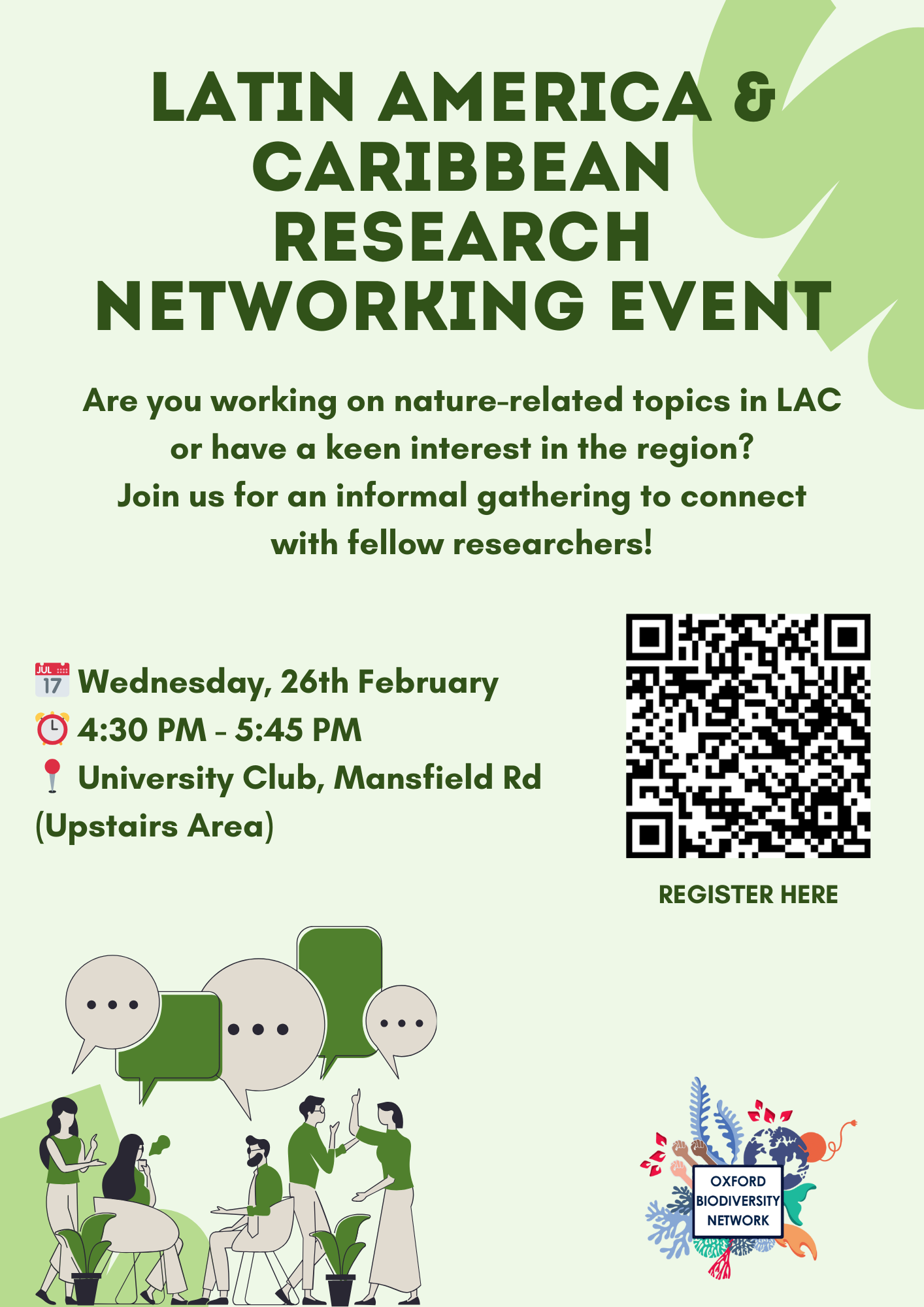
Abstract
Many of the most pressing i ssues in environmental and conservation sciences are caused by humans and o ur activities. Yet\, our well-intentioned efforts to address these issues o ften fail to critically engage with the simple fact that effective conserva tion ultimately relies on understanding and influencing people’s behaviours . This is not always a simple or straightforward task (e.g.\, educating or raising awareness does not change behaviour)\, but decades of work in the h uman behavioural sciences can inform\, guide\, and force multiply our effor ts to create meaningful changes in the ways humans interact with the enviro nment. In this talk\, I will debunk some of the most common myths around ch anging (environmental) behaviour\, discuss how our inherent social wiring c an be leveraged to create meaningful and rapidly scalable change\, distil t he most important takeaways from communication science\, and explore how we can further leverage cutting-edge insights from the behavioural sciences t o bolster conservation efforts.
A short biography
Dr Brock Berg seth has been working at the intersection of human behaviour and nature for more than two decades. Over the course of his career\, he’s worked in phil anthropic\, governmental\, consultant\, and academic research sectors\, com bining human behavioural sciences with natural sciences to address some of the most urgent and pervasive problems in conservation including water qual ity and pollution\, overfishing\, illegal fishing\, and poaching in protect ed areas. Brock’s most recent work has three themes: 1) strengthening the s ystems and approaches we use to manage human behaviours in protected areas\ ; 2) understanding and leveraging the inherent social nature of humans to i ncrease pro-conservation behaviours\; and 3) writing a popular science book to turn the tide of doom and gloom about the future of our planet and ours elves. Brock recently finished a prestigious DECRA Fellowship through the A ustralian Research Council at James Cook University and is currently a visi ting fellow at Oxford’s Interdisciplinary Centre for Conservation Science.< /p>
The Leverhulme Centre for Nature Recovery and Biodiversity Network ar e interested in promoting a wide variety of views and opinions on nature re covery from researchers and practitioners.
The views\, opinions and p ositions expressed within this lecture are those of the author alone\, they do not purport to reflect the opinions or views of the Leverhulme Centre f or Nature Recovery/Biodiversity Network\, or its researchers.
LOCATION:School of Geography and Environment Lecture theatre GEO:51.758549;-1.253182 ORGANIZER;CN="Nature Admin":MAILTO:letsrecord@gmail.com URL;VALUE=URI:https://nature.ox.ac.uk/events/event/tbc-2/ END:VEVENT BEGIN:VEVENT UID:20260112T1002Z-1768212151.4-EO-10769-1@127.0.0.1 STATUS:CONFIRMED DTSTAMP:20260412T145451Z CREATED:20241218T163141Z LAST-MODIFIED:20250310T104038Z DTSTART;TZID=Europe/London:20250307T161500 DTEND;TZID=Europe/London:20250307T173000 SUMMARY: Joining the blue dots – how our understanding of connectivity acro ss the seascape can inform nature restoration policy and practice DESCRIPTION: Abstract: Temperate coastal marine ecosystems have undergone s evere global loss and degradation. International goals to restore planetary resilience through climate mitigation\, reversing biodiversity loss and am eliorating pollution are set out by key international policy frameworks\, n amely: the United Nations Framework Convention on Climate Change\, Global B iodiversity Framework and the Sustainable Development Goals. We provide a [ …] X-ALT-DESC;FMTTYPE=text/html:Abstract:
Temperate coastal marine ec
osystems have undergone severe global loss and degradation. International g
oals to restore planetary resilience through climate mitigation\, reversing
biodiversity loss and ameliorating pollution are set out by key internatio
nal policy frameworks\, namely: the United Nations Framework Convention on
Climate Change\, Global Biodiversity Framework and the Sustainable Developm
ent Goals. We provide a logical framework for marine ecological connectivit
y and present evidence that connectivity plays a key role in achieving thes
e international policy targets through maintenance and delivery of ecosyste
m functions and services. Evidence of structural and functional connectivit
y across temperate seascapes is framed around nutrients\, carbon\, trophic
connectivity and biodiversity loss. Based on this evidence\, we define and
advocate for a seascape approach to restoration\, and consider the policy i
mplications\, rooted in the understanding that coastal ecosystems are dynam
ic and heterogeneous mosaics of habitats interconnected by a body of water
through which living things\, matter and energy flow.
Biography
Joanne Preston is a leading expert in coastal restoration ecology\, based a
t the Institute of Marine Sciences\, University of Portsmouth. Her research
group focuses on understanding the biodiversity\, function\, connectivity
and value of marine biogenic coastal habitats and applying this to effectiv
e practice and monitoring of ecological restoration at seascape scale. In 2
017 she founded the UK/Ireland Native Oyster Network with the Zoological So
ciety of London (ZSL)\, was a founding advisory board member for the Europe
an Native Oyster Restoration Alliance and currently leads its Monitoring Wo
rking Group. Working with a group of expert authors\, Joanne edited a serie
s of habitat restoration handbooks launched at COP26. Currently she is scie
ntific monitoring lead for the ELSP funded Solent Seascape Project and is w
orking on projects for DEFRA\, CEFAS and NERC to quantify and value the eco
system services provided by coastal habitats. In 2022\, Joanne co-led the f
irst UK conference on ecological connectivity across the temperate seascape
at the ZSL bringing habitat experts together to advocate a seascape approa
ch to ecosystem restoration. Since 2019 she has been awarded 8 grants\, sup
ervised 6 Phd students and authored over 30 scientific publications. She le
ads the University of Portsmouth Marine Ecology and Conservation degree mod
ule.
The Leverhulme Centre for Nature Recovery and Biodiversity Netwo rk are interested in promoting a wide variety of views and opinions on natu re recovery from researchers and practitioners.
The views\, opinions and positions expressed within this lecture are those of the author alone\, they do not purport to reflect the opinions or views of the Leverhulme Cen tre for Nature Recovery/Biodiversity Network\, or its researchers.
LOCATION:School of Geography and Environment Lecture theatre GEO:51.758549;-1.253182 ORGANIZER;CN="Nature Admin":MAILTO:letsrecord@gmail.com URL;VALUE=URI:https://nature.ox.ac.uk/events/event/joining-the-blue-dots-ho w-our-understanding-of-connectivity-across-the-seascape-can-inform-nature-r estoration-policy-and-practice/ END:VEVENT BEGIN:VEVENT UID:20260112T1002Z-1768212151.41-EO-10932-1@127.0.0.1 STATUS:CONFIRMED DTSTAMP:20260412T145451Z CREATED:20250306T110421Z LAST-MODIFIED:20250306T110706Z DTSTART;TZID=Europe/London:20250314T120000 DTEND;TZID=Europe/London:20250314T130000 SUMMARY: Returning Bernwood Otmoor Ray to Nature DESCRIPTION: Venue: City room\, School of Geography and the Environment\, a s well as online The Bernwood Otmoor Ray (BOR) landscape is a rich tapestry of diverse habitats\, characterised by its unique woodlands\, grasslands a nd floodplain meadows. This area is particularly well-suited for nature rec overy due to its varied ecosystems\, which provide essential resources for numerous rare […] X-ALT-DESC;FMTTYPE=text/html:Venue: City room\, School of Geography and the Environment\, as well as online
The Bernwood Otmoor Ray (BOR) la ndscape is a rich tapestry of diverse habitats\, characterised by its uniqu e woodlands\, grasslands and floodplain meadows. This area is particularly well-suited for nature recovery due to its varied ecosystems\, which provid e essential resources for numerous rare species\, underscoring the ecologic al significance of the region. The establishment of a Regional Nature Park in the BOR landscape is vital not only to protect these habitats\, but also to promote biodiversity\, enhance recreational opportunities\, and support community engagement in conservation efforts. Our vision for the Regional Nature Park involves creating a sanctuary for wildlife\, while fostering en vironmental education and sustainable local tourism. Join the talk and find out how you can get involved.
For more detailed information about ou r proposal\, please visit our website at www.reborn.org.uk.
ORGANIZER;CN="Nature Admin":MAILTO:letsrecord@gmail.com URL;VALUE=URI:https://nature.ox.ac.uk/events/event/returning-bernwood-otmoo r-ray-to-nature/ END:VEVENT BEGIN:VEVENT UID:20260112T1002Z-1768212151.41-EO-10772-1@127.0.0.1 STATUS:CONFIRMED DTSTAMP:20260412T145451Z CREATED:20241218T163333Z LAST-MODIFIED:20250116T161354Z DTSTART;TZID=Europe/London:20250314T161500 DTEND;TZID=Europe/London:20250314T173000 SUMMARY: Biodiversity Governance: past\, present and future: Reflections on COP-16\, and on 16 COPs. DESCRIPTION: Brief abstract The Convention on Biological Diversity is the w orld’s principal multilateral agreement to protect nature and the benefits it provides for people. It provided the forum for the development and adopt ion of the Kunming-Montreal Global Biodiversity Framework which sets out th e world’s plan to address the biodiversity crisis. In this talk\, David Coo per will […] X-ALT-DESC;FMTTYPE=text/html:Brief abstract
The Convention on Bio logical Diversity is the world’s principal multilateral agreement to protec t nature and the benefits it provides for people. It provided the forum for the development and adoption of the Kunming-Montreal Global Biodiversity F ramework which sets out the world’s plan to address the biodiversity crisis . In this talk\, David Cooper will examine the outcomes of the recent sixte enth meeting of the Conference of the Parties of the Convention\, held in C ali in October 2024 (and due to be completed in Rome in February 2025)\, an d prospects for achieving the goals and targets of the Kunming-Montreal Glo bal Biodiversity Framework. He will also look back at how the Convention ha s evolved since its adoption in 1992\, explore the opportunities and challe nges for the future of biodiversity governance\, and consider how multilate ralism\, science and popular initiatives can support effective policy and a ction.
Short Bio:
David Cooper is the former Acting Executive Se
cretary of the UN Convention on Biological Diversity. He played a pivotal r
ole in the adoption of the Kunming-Montreal Global Biodiversity Framework a
t COP-15\, and was instrumental in establishing its support mechanisms\, in
cluding the Global Biodiversity Framework Fund and the innovative Cali Fund
\, which aim to generate substantial financial resources from public and pr
ivate sources for biodiversity conservation and capacity building. David ha
s always championed the importance of science and traditional knowledge to
inform biodiversity policy. He has contributed to shaping major assessments
such as the 2019 IPBES Global Assessment as well as the Convention’s Globa
l Biodiversity Outlook. After 30 years working with the United Nations\, D
avid is returning to Oxford to work with colleagues here and globally to co
ntinue to explore ways to address the biodiversity crisis.
The Leverh ulme Centre for Nature Recovery and Biodiversity Network are interested in promoting a wide variety of views and opinions on nature recovery from rese archers and practitioners.
The views\, opinions and positions express ed within this lecture are those of the author alone\, they do not purport to reflect the opinions or views of the Leverhulme Centre for Nature Recove ry/Biodiversity Network\, or its researchers.
LOCATION:School of Geography and Environment Lecture theatre GEO:51.758549;-1.253182 ORGANIZER;CN="Nature Admin":MAILTO:letsrecord@gmail.com URL;VALUE=URI:https://nature.ox.ac.uk/events/event/biodiversity-governance- past-present-and-future-reflections-on-cop-16-and-on-16-cops/ END:VEVENT BEGIN:VEVENT UID:20260112T1002Z-1768212151.42-EO-10936-1@127.0.0.1 STATUS:CONFIRMED DTSTAMP:20260412T145451Z CREATED:20250320T151507Z LAST-MODIFIED:20250602T094820Z DTSTART;TZID=Europe/London:20250422T150000 DTEND;TZID=Europe/London:20250422T163000 SUMMARY: What is the role of academia in addressing the biodiversity crisis ? DESCRIPTION: Background and Objectives: The biodiversity crisis\, driven by human activity\, is one of the most pressing challenges of our time. Addre ssing this crisis requires urgent\, effective solutions informed by diverse perspectives. But can academia\, a community concerned with the pursuit of research\, education\, and scholarship meaningfully contribute to the prot ection of biodiversity? Conservation science—spanning both […] X-ALT-DESC;FMTTYPE=text/html:Background and Objectives:
The biodi versity crisis\, driven by human activity\, is one of the most pressing cha llenges of our time. Addressing this crisis requires urgent\, effective sol utions informed by diverse perspectives. But can academia\, a community con cerned with the pursuit of research\, education\, and scholarship meaningfu lly contribute to the protection of biodiversity? Conservation science—span ning both natural and social sciences—is argued by its advocates to play a central role in delivering applied solutions to slow and prevent biodiversi ty loss.
In this interactive session\, we will explore the interplay of theory\, engaged and action-oriented scholarship\, and practice in conse rvation conducted by academics\, with a focus on whether it has had much me aningful impact. Our discussion will include the principles and metrics tha t should underpin conservation practice\, alongside the academic values and practices that foster long-term\, less easily quantifiable impacts—such as building trust\, relationships\, and networks over time.
Join us for a special presentation on the outcomes of the Oxford Nature Conversations Citizens’ Jury . This project brought together a group of Oxford residents to harness loca l knowledge\, values\, and visions to generate practical proposals for maki ng Oxford a city where both people and nature can thrive.
Throughout four deliberative workshops held in February\, jury members explored the qu estion:
“How can we make Oxford a city where people and natur e thrive together?”
We will be presenting the 8 recommendati ons co-created during the process.
We will share:
Whe ther you are a policymaker\, researcher\, community member\, or simply curi ous about citizen-led approaches to environmental issues\, this talk is for you.
🎟 Free and open to all
☕ Refreshments provided
We lo ok forward to welcoming you!
ORGANIZER;CN="Nature Admin":MAILTO:letsrecord@gmail.com URL;VALUE=URI:https://nature.ox.ac.uk/events/event/oxford-nature-conversati ons-insights-from-oxfords-citizens-jury/ END:VEVENT BEGIN:VEVENT UID:20260112T1002Z-1768212151.43-EO-10946-1@127.0.0.1 STATUS:CONFIRMED DTSTAMP:20260412T145451Z CREATED:20250331T085841Z LAST-MODIFIED:20250331T085951Z DTSTART;TZID=Europe/London:20250430T190000 DTEND;TZID=Europe/London:20250430T201500 SUMMARY: Reimagining our Relationship with Nature DESCRIPTION: Leverhulme Centre for Nature Recovery researcher\, Tanaya Nair will be taking part in a discussion between an artist\, a scientist and a climate activist to explore our relationship with nature. Together\, they’l l delve into questions like how we can create new\, healthier ways of relat ing to non-human species. We’re part of the natural world. This […] X-ALT-DESC;FMTTYPE=text/html:Leverhulme Centre for Nature Recovery rese archer\, Tanaya Nair will be taking part in a discussion between an artist\, a scienti st and a climate activist to explore our relationship with nature. Together \, they’ll delve into questions like how we can create new\, healthier ways of relating to non-human species.
We’re part of the natural world. T his fact has become increasingly easy to forget as societies have evolved.< /p>
Over the last century particularly\, we’ve seen rapid advancements in technology and a relentless drive for growth and economic progress. Nature has become more commonly seen in terms of natural resources\, and the need for healthy levels of biodiversity has been forgotten. This has pushed us ever further into planetary crises.
Join creative director of the exp eriential artist collective Marshmallow Laser Feast\, Ersin Han Ersin\, eco logist and artist Tanaya Nair\, and climate justice activist Mitzi Tan\, in this wide-ranging discussion about our relationship with nature. How have we become so disconnected from the non-human species that we depend on for survival and that fascinate us? How can we create new ways to appreciate an d relate to the habitats and wildlife around us? In short\, how can we reim agine our relationship with nature?
LOCATION:Natural History Museum\, London GEO:0.000000;0.000000 ORGANIZER;CN="Nature Admin":MAILTO:letsrecord@gmail.com URL;VALUE=URI:https://nature.ox.ac.uk/events/event/reimagining-our-relation ship-with-nature/ END:VEVENT BEGIN:VEVENT UID:20260112T1002Z-1768212151.44-EO-10982-1@127.0.0.1 STATUS:CONFIRMED DTSTAMP:20260412T145451Z CREATED:20250425T160403Z LAST-MODIFIED:20250506T100914Z DTSTART;TZID=Europe/London:20250502T161500 DTEND;TZID=Europe/London:20250502T173000 SUMMARY: Economics of nature-based solutions for mitigating climate change DESCRIPTION: Seminar followed by Q&A and drinks – join in person or online – all welcome Abstract: Nature-based solutions (NbS) are actions to protect \, sustainably manage\, or restore natural ecosystems in ways that enhance their ability to reduce or remove carbon emissions. They are important to a chieving net-zero climate goals\, especially by reducing emissions from lan d […] X-ALT-DESC;FMTTYPE=text/html:Seminar followed by Q&A and drinks - join in person or online - all welcome
Abstract: Nature-b ased solutions (NbS) are actions to protect\, sustainably manage\, or resto re natural ecosystems in ways that enhance their ability to reduce or remov e carbon emissions. They are important to achieving net-zero climate goals\ , especially by reducing emissions from land use change. NbS credits featur e prominently in carbon offset markets. Economics has an important role in assessing the unique benefits\, costs\, and distributional impacts of NbS\; addressing the concerns raised over additionality\, leakage\, and permanen ce for the effectiveness of scaling up NbS\; and evaluating the integrity o f NbS offset credits. In addition\, the long-term potential of NbS for clim ate mitigation will depend on their cost-effectiveness compared to conventi onal energy and technology-based solutions. More analysis is needed of how NbS could be supported by economy-wide policies and financing sources other than carbon markets.
Biography: Edward B Barbier is
a University Distinguished Professor in the Department of Economics\, Colo
rado State University and a Senior Scholar in the School of Global Environm
ental Sustainability. His main expertise is environmental and resource econ
omics as well as international environmental policy. He has consulted for n
ational\, international and non-governmental agencies\, including many UN o
rganizations\, the World Bank and the OECD. Professor Barbier has published
widely in leading academic journals and is a highly cited scholar on globa
l environmental and sustainability issues. His latest book is the award-win
ning Economics for a Fragile Planet\, Cambridge University Press.
http
://www.edwardbbarbier.com/
The Leverhulme Centre for Nature Recovery and Biodiversity Network are interested in promoting a wide variety of view s and opinions on nature recovery from researchers and practitioners.
The views\, opinions and positions expressed within this lecture are those of the author alone\, they do not purport to reflect the opinions or views of the Leverhulme Centre for Nature Recovery/Biodiversity Network\, or its researchers.
LOCATION:School of Geography and Environment Lecture theatre GEO:51.758549;-1.253182 ORGANIZER;CN="Nature Admin":MAILTO:letsrecord@gmail.com URL;VALUE=URI:https://nature.ox.ac.uk/events/event/economics-of-nature-base d-solutions-for-mitigating-climate-change-edward-b-barbier-colorado-state-u niversity/ END:VEVENT BEGIN:VEVENT UID:20260112T1002Z-1768212151.45-EO-10962-1@127.0.0.1 STATUS:CONFIRMED DTSTAMP:20260412T145451Z CREATED:20250414T134500Z LAST-MODIFIED:20250416T144301Z DTSTART;TZID=Europe/London:20250507T170000 DTEND;TZID=Europe/London:20250507T180000 SUMMARY: Natural Connection: What Indigenous Wisdom & Marginalised People T each us about Environmental Action DESCRIPTION: Description: In this seminar\, University of Cambridge environ mental justice researcher\, Joycelyn Longdon will share her lyrical book Na tural Connection. Natural Connection celebrates the histories and extraordi nary acts of Indigenous and marginalised communities – from the US to the U K\, Brazil to Iran\, Ghana to Ethiopia – who have paved the way for today’s environmental movement […] X-ALT-DESC;FMTTYPE=text/html:Description:
In thi s seminar\, University of Cambridge environmental justice researcher\, Joyc elyn Longdon will share her lyrical book Natural Connection. Natural Connec tion celebrates the histories and extraordinary acts of Indigenous and marg inalised communities – from the US to the UK\, Brazil to Iran\, Ghana to Et hiopia – who have paved the way for today’s environmental movement and pres ents 6 key pillars\, RAGE\, IMAGINATION\, INNOVATION\, THEORY\, HEALING\, C ARE to root us in our intrinsic connection with the natural world\, celebra ting the power of community.
To join us in-person\, please con tinue to book using this page
To join us online please register here
Joycelyn Lo ngdon is an award-winning environmental justice researcher and educator. He r PhD research at the University of Cambridge centres on the design of just ice-led conservation technologies for monitoring biodiversity with local fo rest communities in Ghana.
Her work makes more accessible topics of c limate justice\, climate colonialism\, activism\, creativity and systems ch ange across a variety of forums on and offline and for platforms including Meta\, The United Nations Geneva Dialogues\, Channel 4\, Cheltenham Science Festival\, Oxford University\, The National Lottery\, The Design Council a nd The Wellcome Collection.
Joycelyn was 2022’s winner of the Emergin g Designer London Design Medal\, was featured in British Vogue’s December 2 023 ‘Forces for Change’ Issue\, and is a TEDx Alumni. Most recently\, she h as been listed as one of Pique Action and Harvard Chan C-CHANGE's 2024 Clim ate Creators to Watch and as one of Country and Town House’s Future Icons P ower People 2024.
The Nature-based Solutions Initiative\, Leverhulme Centre for Nature Recovery\, and Biodiver sity Network are interested in promoting a wide variety of views and opinio ns on nature recovery from researchers and practitioners.
The views\, opinions and positions expressed within this lecture are those of the auth or alone\, they do not purport to reflect the opinions or views of the Natu re-based Solutions Initiative\, Leverhulme Centre for Nature Recovery/Biodi versity Network\, or its researchers.
ORGANIZER;CN="Nature Admin":MAILTO:letsrecord@gmail.com URL;VALUE=URI:https://nature.ox.ac.uk/events/event/natural-connection-what- indigenous-wisdom-marginalised-people-teach-us-about-environmental-action/ END:VEVENT BEGIN:VEVENT UID:20260112T1002Z-1768212151.45-EO-10985-1@127.0.0.1 STATUS:CONFIRMED DTSTAMP:20260412T145451Z CREATED:20250425T161819Z LAST-MODIFIED:20250602T094626Z DTSTART;TZID=Europe/London:20250516T161500 DTEND;TZID=Europe/London:20250516T173000 SUMMARY: Transforming nature-based solutions DESCRIPTION: Seminar followed by Q&A and drinks – join in person or online – all welcome Abstract: Nature-based Solutions (NbS) are increasingly haile d as a means of tackling climate and biodiversity crises while benefiting s ociety. Yet they’re often reduced to carbon-offset schemes or narrowly focu sed projects\, overlooking their power for deeper systemic change. In this talk\, […] X-ALT-DESC;FMTTYPE=text/html:Seminar followed by Q&A and drinks - join in person or online - all welcome
Abstract: Nature-b ased Solutions (NbS) are increasingly hailed as a means of tackling climate and biodiversity crises while benefiting society. Yet they’re often reduce d to carbon-offset schemes or narrowly focused projects\, overlooking their power for deeper systemic change. In this talk\, I will explore how Wester n ecological science and Indigenous and Local Knowledge (ILK)—grounded in c ore values of relationality\, reciprocity\, responsibility\, and redistribu tion—can unlock NbS’ transformative potential. Drawing on these worldviews\ , I will discuss how holistic measures\, genuine community empowerment\, an d the reorientation of economic priorities toward stewardship can help NbS catalyse lasting social and ecological transformation rather than merely de livering incremental gains.
Biography: Nathalie Sedd on is Professor of Biodiversity and Founding Director of the Nature-based S olutions Initiative in the Departments of Biology and Geography (Smith Scho ol for Enterprise and the Environment) at the University of Oxford. She is also Director of the Agile Initiative\, member of the leadership team of th e Leverhulme Centre for Nature Recovery\, and is a Senior Research Fellow a t Wadham College.
In 2021\, she co-founded the Oxford University Soci al Venture\, Nature-based Insights Ltd\, of which she is non-executive Dire ctor.
Nathalie trained as an evolutionary ecologist at Cambridge Univ ersity and has over 25 years of research experience in a range of ecosystem s across the globe. As a University Research Fellow of the Royal Society\, she developed broad research interests in understanding the origins and mai ntenance of biodiversity and its relationship with global change. Her work now focuses on the role of nature-based solutions in social and ecological flourishing\, and how to increase the influence of robust biodiversity scie nce as well as traditional knowledge on the design and implementation of cl imate and development policy.
The Leverhulme Centre for Nature Recove ry and Biodiversity Network are interested in promoting a wide variety of v iews and opinions on nature recovery from researchers and practitioners.
The views\, opinions and positions expressed within this lecture are th ose of the author alone\, they do not purport to reflect the opinions or vi ews of the Leverhulme Centre for Nature Recovery/Biodiversity Network\, or its researchers.
LOCATION:School of Geography and Environment Lecture theatre GEO:51.758549;-1.253182 ORGANIZER;CN="Nature Admin":MAILTO:letsrecord@gmail.com URL;VALUE=URI:https://nature.ox.ac.uk/events/event/transforming-nature-base d-solutions/ END:VEVENT BEGIN:VEVENT UID:20260112T1002Z-1768212151.47-EO-10987-1@127.0.0.1 STATUS:CONFIRMED DTSTAMP:20260412T145451Z CREATED:20250425T162835Z LAST-MODIFIED:20250602T110842Z DTSTART;TZID=Europe/London:20250530T161500 DTEND;TZID=Europe/London:20250530T173000 SUMMARY: Megafauna recovery and relevance amidst people and poverty in Indi a DESCRIPTION: Seminar followed by Q&A and drinks – join in person or online – all welcome Abstract: Humans have historically extirpated large animals\, or megafauna\, on a global scale\, a trend that has only intensified with the Anthropocene. Contrary to this pattern\, some megafauna species are dem onstrating a remarkable comeback\, even amidst the densely populated landsc apes […] X-ALT-DESC;FMTTYPE=text/html:Seminar followed by Q&A and drinks - join in person or online - all welcome
Abstract: Humans h ave historically extirpated large animals\, or megafauna\, on a global scal e\, a trend that has only intensified with the Anthropocene. Contrary to th is pattern\, some megafauna species are demonstrating a remarkable comeback \, even amidst the densely populated landscapes of Earth. This talk demonst rates rare cases from India\, where the decline in some megafauna populatio ns has been effectively halted and examines factors contributing to megafau na recovery. Utilizing large-scale\, long-term population assessments\, our investigation focuses on the sustenance and recoveries of tigers\, megaher bivores\, and snow leopards. Beyond ecological factors such as habitat and food resources\, we show how the economics of coexistence\, political stabi lity\, and landscape sustainability have shaped megafauna trajectories. In an era of unprecedented novelty\, these species are not just surviving but are potentially becoming central to promoting biodiversity and ecosystem re silience. India’s ecosystems\, at crossroads of rapid global change and dee p cultural ties to nature\, offer valuable insights into the evolving model of megafauna conservation. It rekindles hope for a biodiverse Anthropocene .
Biography: Ninad Mungi is an ecologist with a rese arch focus on conservation biology\, functional ecology\, and biogeography. His collaborative work includes development of methodologies for monitorin g megafauna populations and contributing to their effective conservation pl ans. His PhD research at the Wildlife Institute of India examined the ecolo gy and adaptive potential of invasive plants\, aiding policies and manageme nt of invasive species. He currently leads multiple experiments on ecosyste m restoration designed to understand the role of trophic control\, trait sp ace\, and nutrient dynamics in emerging ecosystems. His research employs in tegrative and quantitative frameworks to understand metacommunity dynamics\ , while aiming to promote socioecological resilience notably in the Global South. He is presently an Assistant Professor at the Center for Ecological Dynamics in a Novel Biosphere at Aarhus University in Denmark.
The Le verhulme Centre for Nature Recovery and Biodiversity Network are interested in promoting a wide variety of views and opinions on nature recovery from researchers and practitioners.
The views\, opinions and positions exp ressed within this lecture are those of the author alone\, they do not purp ort to reflect the opinions or views of the Leverhulme Centre for Nature Re covery/Biodiversity Network\, or its researchers.
LOCATION:School of Geography and Environment Lecture theatre GEO:51.758549;-1.253182 ORGANIZER;CN="Nature Admin":MAILTO:letsrecord@gmail.com URL;VALUE=URI:https://nature.ox.ac.uk/events/event/megafauna-recovery-and-r elevance-amidst-people-and-poverty-in-india/ END:VEVENT BEGIN:VEVENT UID:20260112T1002Z-1768212151.48-EO-11026-1@127.0.0.1 STATUS:CONFIRMED DTSTAMP:20260412T145451Z CREATED:20250529T130958Z LAST-MODIFIED:20250709T133756Z DTSTART;TZID=Europe/London:20250704T161500 DTEND;TZID=Europe/London:20250704T173000 SUMMARY: Rethinking Human–Nature Relations Through Indigenous Epistemologie s DESCRIPTION: Speaker: Dr Helina Jolly\, Assistant Professor\, Rubenstein Sc hool of Environment and Natural Resources\, University of Vermont Abstract: What if wild animals were not managed\, but listened to? What if fires wer e not a threat to suppress but a presence to learn from? In many Indigenous cultures\, environmental stewardship is not about control but fostering co nnections […] X-ALT-DESC;FMTTYPE=text/html:Speaker: Dr Helina Jolly\ , Assistant Professor\, Rubenstein School of Environment and Natural Resour ces\, University of Vermont
Abstract: What if wild a nimals were not managed\, but listened to? What if fires were not a threat to suppress but a presence to learn from? In many Indigenous cultures\, env ironmental stewardship is not about control but fostering connections and r elationships. From cultural burning that renews ecosystems to tending plant s guided by ancestral protocols to seeing animals as kin\, these practices reflect a relational\, place-based understanding of the more-than-human wor ld. These perspectives contrast the dominant conservation and ecosystem man agement approaches rooted in separating humans from nature. While the contr ibution of Indigenous and local communities is widely acknowledged as neces sary for biodiversity conservation\, in practice\, they often remain margin alized or tokenized. Too often\, Indigenous knowledge is superficially refe renced or instrumentalized without an adequate understanding of what shapes them. We still lack clear ways to understand and engage with Indigenous pe oples and their knowledge respectfully and collaboratively. My research sit s at this critical interface and begins with this proposition: What if cons ervation began with conversations instead of instructions? Through ethnogra phic and collaborative research with communities in Asia and North America\ , my research asks – how people understand\, engage\, and value their local environment\, what knowledge systems\, histories\, and worldviews shape th eir relationships with it\, and how these support communities in responding to contemporary environmental challenges. In the talk\, I will discuss my long-term research with the Kattunayakan\, a hunter-gatherer community in t he Western Ghats of South India\, and their ways of living with wildlife. I will explain how their understanding of animals as rational\, conversing b eings\, gods\, teachers\, and kin with shared origins\, practicing dharmam (ethical conduct) shapes their behaviours and practices towards wildlife\, promoting coexistence. By citing these\, I explain that rethinking human-na ture relations through Indigenous epistemologies is a relational endeavour in which learning about people's history\, experiences\, and stories with a nimals is just as crucial as understanding animals and theirs. Finally\, I will talk about why it is important to combine Indigenous and Western knowl edge\, the challenges that come with it\, and how we can move forward.
< p>Biography: Dr Helina Jolly is an Assistant Professor at the Rubenstein School of Environment and Natural Resources at the Universit y of Vermont (UVM)\, where she leads research on traditional ecological kno wledge. She is an interdisciplinary environmental researcher\, National Geo graphic Explorer\, and documentarian whose work lies at the interface of pe ople and nature. Dr. Jolly uses ethnographic approaches\, qualitative inter views\, participatory mapping\, and other mixed-method approaches to unders tand how Indigenous knowledge systems and lived experiences shape their rel ationship with ecosystems and help them adapt to contemporary environmental changes. She has worked with diverse communities— hunter-gatherers in the Western Ghats in South India\, farmers in Sri Lanka\, and berry pickers of Miawpukek First Nation in Canada on topics ranging from wildlife coexistenc e\, cultural burning\, traditional livelihoods\, and biocultural food syste ms. Before UVM\, she was a postdoctoral research fellow at the University o f California San Diego and the University of Guelph. She earned her PhD fro m the University of British Columbia and an MSc from the London School of E conomics and Political Science as a Commonwealth Scholar. She is a podcast host of Biodiversity Speaks. She brings to her research extensive experienc e working in South Asia as an advisor and policy analyst to government agen cies and development banks.The Leverhulme Centre for Nature Recovery and Biodiversity Network are interested in promoting a wide variety of vie ws and opinions on nature recovery from researchers and practitioners.The v iews\, opinions and positions expressed within this lecture are those of th e author alone\, they do not purport to reflect the opinions or views of th e Leverhulme Centre for Nature Recovery/Biodiversity Network\, or its resea rchers.
LOCATION:School of Geography and the Envionment - Atmosphere room GEO:51.758549;-1.253182 ORGANIZER;CN="Nature Admin":MAILTO:letsrecord@gmail.com URL;VALUE=URI:https://nature.ox.ac.uk/events/event/rethinking-human-nature- relations-through-indigenous-epistemologies/ END:VEVENT BEGIN:VEVENT UID:20260112T1002Z-1768212151.49-EO-11049-1@127.0.0.1 STATUS:CONFIRMED DTSTAMP:20260412T145451Z CREATED:20250701T103734Z LAST-MODIFIED:20250701T103839Z DTSTART;TZID=Europe/London:20250708T160000 DTEND;TZID=Europe/London:20250708T180000 SUMMARY: Listening to the Earth: An Afternoon with Indigenous Wisdom Keeper s from Brazil DESCRIPTION: In early July\, a group of Indigenous Elders from Brazil are v isiting Oxford for a few days during a longer trip to the UK. During their stay\, the Skoll Centre alongside Global Canopy\, Ostara\, Smith School\, S aïd Business School and the Nature-Based Solutions Initiative are delighted to be co-hosting a public event to share their […] X-ALT-DESC;FMTTYPE=text/html:In early July\, a group of Indigenous Elde rs from Brazil are visiting Oxford for a few days during a longer trip to t he UK. During their stay\, the Skoll Centre alongside Global Canopy\, Ostar a\, Smith School\, Saïd Business School and the Nature-Based Solutions Init iative are delighted to be co-hosting a public event to share their wisdom and teachings.
The event will be a unique opportunity to hear from th ree of the most respected Indigenous leaders and guardians of ancestral wis dom from Brazil and the Amazon\, in dialogue with Oxford academics working on nature\, climate and our increasingly fragmented and fractious relations hip with the Earth.
This hybrid public event welcomes three Indigenou s leaders from Brazil and the Amazon: Davi Kopenawa Yanomami\, spiritual le ader and defender of the Yanomami people\; Ailton Krenak\, activist\, writ er\, and philosopher of the Krenak people\; Adana Omagua Kambeba\,healer an d wisdom carrier of the Kambeba people. They carry the voices of peoples ro oted in a continuous relationship with the Earth for millennia. Their visit offers a rare opportunity to hear reflections on restoring balance and rei magining humanity's path. The evening features dialogue between these Amazo nian wisdom keepers and Oxford academics working on nature\, climate and ou r wider\, and increasingly fractious\, relationship with the Earth. This op en gathering\, both online and in-person\, weaves many knowledge traditions seeking common ground for a more sustainable future.
LOCATION:Said Business School GEO:51.753285;-1.268360 ORGANIZER;CN="Nature Admin":MAILTO:letsrecord@gmail.com URL;VALUE=URI:https://nature.ox.ac.uk/events/event/listening-to-the-earth-a n-afternoon-with-indigenous-wisdom-keepers-from-brazil/ END:VEVENT BEGIN:VEVENT UID:20260112T1002Z-1768212151.5-EO-11083-1@127.0.0.1 STATUS:CONFIRMED DTSTAMP:20260412T145451Z CREATED:20250725T120621Z LAST-MODIFIED:20250725T120621Z DTSTART;VALUE=DATE:20250904 DTEND;VALUE=DATE:20250905 SUMMARY: NATURE Impacts Webinar DESCRIPTION: Webinar will run at two time to suit international attendees: 9am & 4pm BST X-ALT-DESC;FMTTYPE=text/html:
Join Us for an exciting webinar to explore the NATURE Impacts initiative!
Hosted by a team from the University of Oxford in collaboration with WWF-UK\, ‘NATURE Impacts’ is a new initiati ve designed to assess and accelerate national progress towards halting and reversing nature loss by 2030. As part of the global effort to achieve the Global Biodiversity Framework\, we are developing an innovative tool to eva luate how nations can enhance their efforts to restore biodiversity\, prior itise future actions\, and support nature recovery.
In this exclusive webinar\, you’ll get an opportunity to hear about the vision behind the to ol\, current plans for its development\, and have the chance to shape how i t can become a dynamic platform to identify new challenges\, opportunities\ , and solutions for positive change.

Abstract: For nearly four billion years\, l ife on Earth has found new ways to adapt\, reproduce and thrive\, taking on new forms to meet the environment of the moment. Human impacts on the plan et\, and the potentially devastating threat of climate change\, have stress ed that adaptability as never before. Yet life still finds a way. In the mi dst of an extinction crisis\, many animals\, plants and insects are still a dapting\, even in our rapidly transforming environment. In their example we may just find ways that we too can adapt\, ways to stop the destruction we 're causing to the planet. In Nature's Genius David Farrier explores what n ature's capacity to change can reveal about our own potential to live diffe rently. The ways animals adjust to the urban landscape can help us design s ustainable cities. Examining other intelligences can help us remake our eco nomies. Learning from PCB-resistant fish may help solve our waste problem. Synthetic biology could rescue animals from the brink of extinction. Thinki ng in timescales of the natural world could help us choose a better future.
Biography: David Farrier is Professor of Literature and the Environm ent at the University of Edinburgh. David’s first book\, Footprints: In Sea rch of Future Fossils\, looked at the marks we are leaving on the planet an d how these might appear in the fossil record in the deep future. It was na med by both The Times and Telegraph as a book of the year\, earned praise f rom Robert Macfarlane and Margaret Atwood\, and has been translated into te n other languages. He has had pieces published in the Atlantic\, BBC Future \, Emergence\, Prospect\, Daily Telegraph\, Orion and Washington Post. He h as spoken at numerous online events\, has given an invited lecture at the R oyal Geographical Society\, and has appeared on radio and podcasts such as BBC Free Thinking and Little Atoms. Nature's Genius is his second book and was shortlisted for the Wainwright Prize for Conservation Writing.
Th e Leverhulme Centre for Nature Recovery and Biodiversity Network are intere sted in promoting a wide variety of views and opinions on nature recovery f rom researchers and practitioners.
The views\, opinions and positions expressed within this lecture are those of the author alone\, they do not purport to reflect the opinions or views of the Leverhulme Centre for Natur e Recovery/Biodiversity Network\, or its researchers.
LOCATION:School of Geography and Environment Lecture theatre GEO:51.758549;-1.253182 ORGANIZER;CN="Nature Admin":MAILTO:letsrecord@gmail.com URL;VALUE=URI:https://nature.ox.ac.uk/events/event/natures-genius-evolution s-lessons-for-a-changing-planet/ END:VEVENT BEGIN:VEVENT UID:20260126T1012Z-1769422338.52-EO-11497-1@127.0.0.1 STATUS:CONFIRMED DTSTAMP:20260412T145451Z CREATED:20260126T093123Z LAST-MODIFIED:20260126T093443Z DTSTART;TZID=Europe/London:20251031T163000 DTEND;TZID=Europe/London:20251031T173000 SUMMARY: Cull of the wild: Killing in the name of conservation DESCRIPTION: Seminar followed by Q&A\, drinks and book signing – all welcom e Speaker: Hugh Warwick\, Ecologist and author Abstract: Killing for conser vation is contentious. Researching this book has been a challenge\, requiri ng me to dip toes into unfamiliar waters – speaking to people I do not norm ally spend time with\, such as philosophers and game keepers! The plot […] X-ALT-DESC;FMTTYPE=text/html:Abstract: Killing for conservation is contentious. Researching this book has been a challenge\, requiring me to dip toes into unfamiliar water s - speaking to people I do not normally spend time with\, such as philosop hers and game keepers! The plot spoiler is that there are no simple answers . But the process of writing this book has\, I hope\, encouraged me to thin k better … the talk will dig into some of that thinking\, illustrated by ca se studies.
Biography: Hugh Warwick is an author and ecologist with a particular passion for hedgehogs. Currently writing his 12th book\, he has tended to spend time either digging into conservation issues\, such as kil ling for conservation or habitat fragmentation\, or enjoying popular scienc e monographs on British mammals. He is the spokesperson for the British Hed gehog Preservation Society and a regular commentator on ecological issues.< /p>
The Leverhulme Centre for Nature Recovery and Biodiversity Network ar e interested in promoting a wide variety of views and opinions on nature re covery from researchers and practitioners.
The views\, opinions and p ositions expressed within this lecture are those of the author alone\, they do not purport to reflect the opinions or views of the Leverhulme Centre f or Nature Recovery/Biodiversity Network\, or its researchers.
LOCATION:School of Geography and Environment Lecture theatre GEO:51.758549;-1.253182 ORGANIZER;CN="Carlyn Samuel":MAILTO:carlyn.samuel@ouce.ox.ac.uk URL;VALUE=URI:https://nature.ox.ac.uk/events/event/cull-of-the-wild-killing -in-the-name-of-conservation/ END:VEVENT BEGIN:VEVENT UID:20260112T1002Z-1768212151.51-EO-11114-1@127.0.0.1 STATUS:CONFIRMED DTSTAMP:20260412T145451Z CREATED:20250821T141835Z LAST-MODIFIED:20260126T095115Z DTSTART;TZID=Europe/London:20251107T161500 DTEND;TZID=Europe/London:20251107T173000 SUMMARY: How Story Creates Agency for the Nature and Climate Crises DESCRIPTION: Seminar followed by Q&A and drinks – all welcome Speaker: Jul es Pretty\, Professor of Environment and Society\, University of Essex Abst ract: Story creates agency for the climate and nature crises. It is a comm on feeling for people to feel anxiety and fear\, helplessness too\, in the face of the global climate and nature crises. Yet […] X-ALT-DESC;FMTTYPE=text/html:Abstract: Story creates agency for the cli mate and nature crises. It is a common feeling for people to feel anxiety a nd fear\, helplessness too\, in the face of the global climate and nature c rises. Yet story can act like tricksters of old who set us on new paths thr ough the dark forest ahead. Organisations often find themselves facing thei r own crises\, sometimes existential. All have their own tried and tested w ays of talking about themselves: foundation myths\, measures of success\, m ission statements\, brand architecture and tales of enemy competitors. But these are not stories. Good story is always about engagement with the publi c: audiences\, readers\, listeners\, members\, students. An organisation su cceeds when it tells a story not about itself\, but how it is helping peopl e make the world a better place. It talks about how it is improving lives.< /p>
This talk is based on the 2025 paper by Pretty\, Milner-Gulland and 2 7 co-authors: “How the Concept of “Regenerative Good Growth” Could Help Inc rease Public and Policy Engagement and Speed Transitions to Net Zero and Na ture Recovery” (Sustainability 17(3)\, 849).
Jules Pretty is Emeritus Professor of Environment and Society at the University of Essex. His sole-authored books include The Low-Carbon Good Life (2023)\, Sea Sagas of the North (2022)\, The East Country (2017)\ , The Edge of Extinction (2014)\, This Luminous Coast (2011)\, The Earth On ly Endures (2007)\, Agri-Culture (2002)\, The Living Land (1998)\, and Rege nerating Agriculture (1995).
He is former Deputy-Chair of the UK gove rnment’s Advisory Committee on Releases to the Environment\, and has served on advisory committees for UK research councils and the Royal Society. He was appointed A D White Professor-at-Large by Cornell University from 2001\ , and was Founding Editor of the International Journal of Agricultural Sust ainability. He received an OBE in 2006 for services to sustainable agricult ure\, an honorary degree from Ohio State University\, and the British Scien ce Association Presidential Medal (Agriculture and Food) in 2015. He was ap pointed President of Essex Wildlife Trust in 2019\, is Chair of the Essex C limate Action Commission\, was also a trustee for WWF-UK\, and was appointe d a Deputy Lieutenant for Essex in 2023. This Luminous Coast was winner of New Angle Prize for Literature\, and The East Country was winner of the Eas t Anglian book of the year. He is host of 80 podcasts and films (in the ser ies Louder Than Words and Brighter Futures) and writes the series The Clima te Chronicles at www.julespretty.com.
LOCATION:Main Lecture Theatre GEO:51.759076;-1.252735 ORGANIZER;CN="Nature Admin":MAILTO:letsrecord@gmail.com URL;VALUE=URI:https://nature.ox.ac.uk/events/event/how-story-creates-agency -for-the-nature-and-climate-crises-jules-pretty-university-of-essex/ END:VEVENT BEGIN:VEVENT UID:20260126T1012Z-1769422338.53-EO-11495-1@127.0.0.1 STATUS:CONFIRMED DTSTAMP:20260412T145451Z CREATED:20260126T091454Z LAST-MODIFIED:20260126T102907Z DTSTART;TZID=Europe/London:20251114T161500 DTEND;TZID=Europe/London:20251114T173000 SUMMARY: What drives species sensitivity to deforestation? Clue: it’s not w hat you think DESCRIPTION: Discover what truly drives species sensitivity to deforestatio n — and why the answer challenges long-held assumptions in conservation sci ence\, biodiversity research\, and nature recovery policy. In this talk\, C ristina Banks-Leite (Imperial College London) explores the overlooked but p owerful role of intraspecific variability in shaping how species respond to habitat loss\, forest degradation\, and wider environmental […] X-ALT-DESC;FMTTYPE=text/html:Discover what truly drives species sensiti vity to deforestation — and why the answer challenges long-held assumptions in conservation science\, biodiversity research\, and nature recovery poli cy. In this talk\, Cristina Banks-Leite (Imperial College London) explores the overlooked but powerful role of intraspecific variability in shaping ho w species respond to habitat loss\, forest degradation\, and wider environm ental change. While most conservation studies prioritise species-level trai ts such as morphology\, behaviour\, or life-history characteristics\, this research reveals that variation within species can rival or even exceed dif ferences between species. This emerging evidence has transformative implica tions for biodiversity conservation strategies\, environmental economics\, and policy frameworks aimed at protecting ecosystems under accelerating pre ssures from deforestation. You’ll learn why understanding ecological driver s of intraspecific variation is essential for designing effective nature re covery interventions\, how these findings reshape our predictions of specie s vulnerability\, and what they mean for academics\, policymakers\, NGOs\, and practitioners working at the front line of conservation planning. If yo u're interested in nature recovery\, ecosystem resilience\, and cutting-edg e approaches to biodiversity protection\, this video will deepen your under standing of how species actually adapt — and why our current models may be missing a crucial part of the story. The Leverhulme Centre for Nature Recov ery and Nature Network are interested in promoting a wide variety of views and opinions on nature recovery from researchers and practitioners. The vie ws\, opinions and positions expressed within this lecture are those of the author alone\, they do not purport to reflect the opinions or views of the Leverhulme Centre for Nature Recovery/Biodiversity Network\, or its researc hers.
LOCATION:School of Geography and Environment Lecture theatre GEO:51.758549;-1.253182 ORGANIZER;CN="Carlyn Samuel":MAILTO:carlyn.samuel@ouce.ox.ac.uk URL;VALUE=URI:https://nature.ox.ac.uk/events/event/what-drives-species-sens itivity-to-deforestation-clue-its-not-what-you-think/ END:VEVENT BEGIN:VEVENT UID:20260126T1012Z-1769422338.55-EO-11499-1@127.0.0.1 STATUS:CONFIRMED DTSTAMP:20260412T145451Z CREATED:20260126T093843Z LAST-MODIFIED:20260126T102557Z DTSTART;TZID=Europe/London:20251121T161500 DTEND;TZID=Europe/London:20251121T173000 SUMMARY: Earth’s Biodiversity: Its Origins\, Impacts and Potential Fate DESCRIPTION: Speaker: David Tilman\, University of Minnesota\, Regents Prof essor\; McKnight Presidential Chair\, Ecology\, Evolution\, and Behavior Th e amazing diversity of life on Earth is the direct result of evolutionarily unavoidable tradeoffs that all life has faced since the Cambrian explosion . Because of such tradeoffs\, new species coexisted with\, and did not disp lace\, established species. These same […] X-ALT-DESC;FMTTYPE=text/html:The amazing diversity of life on Earth is the dir ect result of evolutionarily unavoidable tradeoffs that all life has faced since the Cambrian explosion. Because of such tradeoffs\, new species coexi sted with\, and did not displace\, established species. These same tradeoff s explain why greater diversity leads to increases in ecosystem productivit y and stability\, carbon capture and storage\, water quality\, soil fertili ty\, and resistance to invasive species. Humans\, the only species to escap e these tradeoffs\, caused waves of extinctions during the past 50K years. In this\, the final period of rapid increases in human population and incom e\, the prevention of further extinctions will require major changes to agr iculture\, diets and energy sources and usage.
Davi d Tilman is Regents Professor and McKnight Presidential Chair in Ecology at the University of Minnesota\, and Distinguished Professor in the Bren Scho ol of Environmental Science and Management at the University of California Santa Barbara. Tilman is an ecologist whose long-term experiments and relat ed mathematical theory were the first to show that biodiversity is a major determinant of ecosystem stability\, productivity\, carbon storage and susc eptibility to invasion. His recent work focuses on ways to protect and pres erve biodiversity by improving agriculture and diets.
He is a member of the National Academy of Science\, the American Academy of Arts and Scien ces\, and the Royal Society. Awards include the International Prize for Bio logy\, the Heineken Prize for Environmental Sciences\, the Balzan Prize\, t he BBVA Foundation’s Frontiers of Knowledge Award\, the Asahi Foundation’s Blue Planet Prize\, and in 2025\, the United States National Medal of Scien ce.
He is deeply interested in the interface of science\, society\, e thics and environmental policy\, and has communicated the benefits of scien tifically-based solutions to major environmental problems with the public\, politicians\, and media. He has given expert invited testimony to Congress ional committees and served on several White House scientific advisory comm ittees.
David Tilman\, whose Ph. D. was from the University of Michig an in 1976\, has written two books\, edited four books\, and published more than 375 scientific papers\, including more than 40 papers in Nature and S cience.
LOCATION:School of Geography and Environment Lecture theatre GEO:51.758549;-1.253182 ORGANIZER;CN="Carlyn Samuel":MAILTO:carlyn.samuel@ouce.ox.ac.uk URL;VALUE=URI:https://nature.ox.ac.uk/events/event/earths-biodiversity-its- origins-impacts-and-potential-fate/ END:VEVENT BEGIN:VEVENT UID:20260126T1012Z-1769422338.53-EO-11509-1@127.0.0.1 STATUS:CONFIRMED DTSTAMP:20260412T145451Z CREATED:20260126T095637Z LAST-MODIFIED:20260126T102737Z DTSTART;TZID=Europe/London:20251121T161500 DTEND;TZID=Europe/London:20251121T173000 SUMMARY: The Natural Capital of Wasps DESCRIPTION: Wasps are predators\, natural enemies\, pollinators and decomp osers. They are also sources of nutrition for humans\, potential pharmacolo gical treasure chests and hold cultural value for indigenous communities ar ound the world. Despite this\, wasps remain under-valued. Part of the probl em has been the lack of research on the importance of wasps. Whilst they ha ve been popular […] X-ALT-DESC;FMTTYPE=text/html:Wasps are predators\, natural enemies\, po llinators and decomposers. They are also sources of nutrition for humans\, potential pharmacological treasure chests and hold cultural value for indig enous communities around the world. Despite this\, wasps remain under-value d. Part of the problem has been the lack of research on the importance of w asps. Whilst they have been popular models for social evolution and behavio ural studies\, there has been relatively little focus on their ecological r oles and their utility and importance in supporting human health\, food\, c ulture and wellbeing. Seirian provides an interdisciplinary overview of the value of wasps using a holistic natural capital framework.
Seirian i s a behavioural ecologist. Her work research sits at the interface of behav ioural ecology\, biodiversity and conservation. She uses a combination of f ield ecology and genomic techniques to address questions about how and why animals live in societies. She is especially interested in social wasps\, a nd is working hard to raise the profile of these ecologically important ins ects\, among both scientific and lay communities. As part of these efforts\ , she co-founded the Big Wasp Survey in 2017 – a citizen science project de signed to engage the public with the diversity and importance of social was ps in their back yard\; and in 2022\, she published a popular science book\ , “Endless Forms: Why You Should Love Wasps”.
The Leverhulme Centre f or Nature Recovery and Biodiversity Network are interested in promoting a w ide variety of views and opinions on nature recovery from researchers and p ractitioners.
The views\, opinions and positions expressed within thi s lecture are those of the author alone\, they do not purport to reflect th e opinions or views of the Leverhulme Centre for Nature Recovery/Biodiversi ty Network\, or its researchers.
LOCATION:School of Geography and Environment Lecture theatre GEO:51.758549;-1.253182 ORGANIZER;CN="Carlyn Samuel":MAILTO:carlyn.samuel@ouce.ox.ac.uk URL;VALUE=URI:https://nature.ox.ac.uk/events/event/the-natural-capital-of-w asps/ END:VEVENT BEGIN:VEVENT UID:20260112T1002Z-1768212151.51-EO-11116-1@127.0.0.1 STATUS:CONFIRMED DTSTAMP:20260412T145451Z CREATED:20250826T112948Z LAST-MODIFIED:20260126T092000Z DTSTART;TZID=Europe/London:20251128T161500 DTEND;TZID=Europe/London:20251128T173000 SUMMARY: The Spirit of the Rainforest DESCRIPTION: Seminar followed by Q&A\, drinks and book signing – all welcom e Abstract: The Amazon Rainforest — vast\, mysterious\, and teeming with li fe — has long captured the imagination of explorers\, scientists\, and stor ytellers alike. Yet today\, it stands at a crossroads\, facing mounting thr eats from deforestation\, climate change\, and cultural erosion. In this ta lk\, Andean-Amazonian […] X-ALT-DESC;FMTTYPE=text/html:Seminar followed by Q&A\, drinks a nd book signing - all welcome
Abstract: The Amazon Rainforest — vast\, mysterious\, and teeming with life — has long c aptured the imagination of explorers\, scientists\, and storytellers alike. Yet today\, it stands at a crossroads\, facing mounting threats from defor estation\, climate change\, and cultural erosion. In this talk\, Andean-Ama zonian scientist and author Rosa Vásquez Espinoza takes us on a deeply pers onal journey into the heart of the Amazon. Blending indigenous wisdom with cutting-edge science\, she explores the rainforest not just as an ecosystem \, but as a living\, breathing entity — one that holds profound lessons for resilience\, healing\, and our connection to the natural world. Drawing fr om her book The Spirit of the Rainforest\, Rosa shares intimate encounters with Amazonian communities\, revealing how their ancestral knowledge offers a vital perspective in the face of environmental crises. She explores her own experiences navigating remote ecosystems\, discovering biodiversity kno wn to very few\, and rekindling our innate sense of wonder and the spirit o f exploration.
Biography: Dr Rosa Vásquez Espinoza i s a Peruvian chemical biologist with Andean-Amazonian indigenous roots\, Na tional Geographic Explorer\, and UN Harmony with Nature Scientist. She is f ounder of Amazon Research Internacional\, where she bridges ancestral knowl edge and modern science to protect Amazonian biodiversity\, with a focus on stingless bees\, medicinal plants\, and microbial life in extreme environm ents.
LOCATION:School of Geography and Environment Lecture theatre GEO:51.758549;-1.253182 ORGANIZER;CN="Nature Admin":MAILTO:letsrecord@gmail.com URL;VALUE=URI:https://nature.ox.ac.uk/events/event/the-spirit-of-the-rainfo rest/ END:VEVENT BEGIN:VEVENT UID:20260126T1012Z-1769422338.54-EO-11511-1@127.0.0.1 STATUS:CONFIRMED DTSTAMP:20260412T145451Z CREATED:20260126T100003Z LAST-MODIFIED:20260126T100003Z DTSTART;TZID=Europe/London:20251205T161500 DTEND;TZID=Europe/London:20251205T173000 SUMMARY: Advancing wildlife health in conservation translocations: a scalab le framework piloted in eastern black rhinos. DESCRIPTION: Conservation translocations are increasingly used to restore s pecies and strengthen ecosystem resilience\, yet health and welfare conside rations are often insufficiently integrated into planning and evaluation. T his seminar will present an ongoing project aimed at building a scalable fr amework to improve health monitoring in conservation translocations\, devel oped through applied research and piloted with eastern black rhinos […] X-ALT-DESC;FMTTYPE=text/html:Conservation translocations are increasing ly used to restore species and strengthen ecosystem resilience\, yet health and welfare considerations are often insufficiently integrated into planni ng and evaluation. This seminar will present an ongoing project aimed at bu ilding a scalable framework to improve health monitoring in conservation tr anslocations\, developed through applied research and piloted with eastern black rhinos in Kenya.
The talk will highlight ongoing work to simpli fy data collection through field-adapted indicators and digital tools\, str engthen interdisciplinary capacity across veterinary\, ecological\, and man agement sectors\, and build more coordinated research approaches among disc iplines. The discussion will also reflect on how integrating wildlife healt h into translocation practice aligns with emerging global biodiversity poli cy needs—particularly those related to restoration effectiveness\, species recovery\, and One Health integration
Biography: Dr Francesca Vitali\ , a wildlife veterinarian and research associate at the Smithsonian’s Globa l Health Program in Kenya\, is dedicated to advancing wildlife medicine wit hin the conservation and One Health framework. She leads a National Geograp hic Society project to improve health frameworks for translocated animals l ike the eastern black rhino\, focusing on multidisciplinary collaboration\, technological innovations\, and research initiatives.
As the Smithso nian’s Global Health Program Wildlife Health and Welfare Training Kenya Lea d\, Vitali mentors future conservation scientists\, providing theoretical a nd practical training to wildlife veterinarians. She holds a degree in Vete rinary Medicine from the University of Milan\, where she also completed her Ph.D. research on the effects of immobilization in African wildlife.
She serves as a visiting scientist at the International Livestock Research Institute\, collaborating with the Mpala Research Center\, Kenya Wildlife Service Veterinary Department\, and Wildlife Research and Training Institut e. As a principal investigator\, she has received several research grants a nd has been a National Geographic Society Explorer since 2018.
The Le verhulme Centre for Nature Recovery and Biodiversity Network are interested in promoting a wide variety of views and opinions on nature recovery from researchers and practitioners. The views\, opinions and positions expressed within this lecture are those of the author alone\, they do not purport to reflect the opinions or views of the Leverhulme Centre for Nature Recovery /Biodiversity Network\, or its researchers.
LOCATION:School of Geography and Environment Lecture theatre GEO:51.758549;-1.253182 ORGANIZER;CN="Carlyn Samuel":MAILTO:carlyn.samuel@ouce.ox.ac.uk URL;VALUE=URI:https://nature.ox.ac.uk/events/event/advancing-wildlife-healt h-in-conservation-translocations-a-scalable-framework-piloted-in-eastern-bl ack-rhinos/ END:VEVENT BEGIN:VEVENT UID:20260112T1002Z-1768212151.52-EO-11437-1@127.0.0.1 STATUS:CONFIRMED DTSTAMP:20260412T145451Z CREATED:20260109T145649Z LAST-MODIFIED:20260126T102217Z DTSTART;TZID=Europe/London:20260123T161500 DTEND;TZID=Europe/London:20260123T173000 SUMMARY: The Natural History of Nightshades DESCRIPTION: Seminar followed by Q&A and drinks – attend in person or join online – all welcome Abstract Systematics or taxonomy is often seen as an e nd in itself\, but like all science it is a key facilitator of downstream s tudies and innovations. The results of taxonomy (including systematics and phylogeny) are the foundational cornerstones for […] X-ALT-DESC;FMTTYPE=text/html:Seminar followed by Q&A and drinks - attend in person or join online - all welcome
Systematics or taxonomy is often seen as an end in itself\, but like all science it is a key facilitator of downstream studies and innovations. The results of taxonomy (including systematics and phylogeny) are the found ational cornerstones for our understanding of how the world works\, and for how we can best conserve and protect a dynamic set of ecosystems for the f uture. My taxonomic work has focused on Solanum\, one of the largest genera of flowering plants\, and has involved making sometimes difficult linkages to diverse communities of scientists across plant biology. The size of Sol anum\, with some 1\,250 currently recognised species means that assembling monophyletic groups of species and tackling these monographically has been thought to be too challenging\; big genera have been something for taxonomi sts to avoid. But the landscape is changing\, working with these large grou ps has significant advantages. Solanum also contains many species of agricu ltural importance\, often complicating primary taxonomy with a superfluity of names from the past. Of course\, this work has not been done alone\, but with a dynamic and exciting group all of whom have brought their skills an d perspectives to the task in hand. In this talk I will take you through th e journey we have made\, from a set of small taxonomically focused monograp hs and floras to studies involving genomes and advances in plant breeding. The path the Solanum group has taken is always centred in systematics – und erstanding species and their relationships. Large\, species-rich genera lik e Solanum are traditionally seen as problems\, but with a multidisciplinary approach that is broad-minded and open to new ideas and paths\, can reveal much about plant evolution. It can also bring systematics and taxonomy to the table as critical components of solutions to today’s societal and envir onmental problems.
Sandra Knapp is a botanist at th e Natural History Museum in London. Her research focuses on the taxonomy an d evolution of the paradoxical nightshade family\, whose members include so me of our favourite foods like potatoes and tomatoes and plants that are th e source of potent poisons like nicotine and atropine and has a long histor y of working in the field\, mostly in tropical forests. She is passionate a bout promoting the role of taxonomy and the importance of science for conse rvation and sustainable development worldwide and is committed to increasin g openness\, diversity\, and inclusion in science. Her work has been recogn ised by fellowships in the American Academy of Arts and Sciences\, Academia Nacional de Ciencias of Argentina and Academia Europeana. She was awarded the Engler Medal in Gold at the International Botanical Congress in 2024 fo r her lifetime achievements in plant systematics. Sandy was elected to as a Fellow of the Royal Society in 2022. She is the author of several books ab out natural history\, including Extraordinary orchids and Flora: an artisti c voyage through the world of plants.
LOCATION:Main Lecture Theatre GEO:51.759076;-1.252735 ORGANIZER;CN="Carlyn Samuel":MAILTO:carlyn.samuel@ouce.ox.ac.uk URL;VALUE=URI:https://nature.ox.ac.uk/events/event/tackling-the-impossible- the-mega-genus-solanum-solanaceae-as-a-model-for-understanding-diversity-an d-distribution/ END:VEVENT BEGIN:VEVENT UID:20260122T1157Z-1769083072.3-EO-11493-1@127.0.0.1 STATUS:CONFIRMED DTSTAMP:20260412T145451Z CREATED:20260122T113416Z LAST-MODIFIED:20260224T112832Z DTSTART;TZID=Europe/London:20260130T161500 DTEND;TZID=Europe/London:20260130T173000 SUMMARY: How can scientific insights inspire transformative change for biod iversity and nature conservation? DESCRIPTION: Seminar followed by Q&A and drinks – attend in person or join online – all welcome Abstract Despite a growing recognition of the triple c risis of biodiversity loss\, climate change and pollution\, we continue to fall short of delivering the change required. The awareness that increasing efforts in Multilateral Agreements\, national conservation action and sust ainable […] X-ALT-DESC;FMTTYPE=text/html:Seminar followed by Q&A and drinks - atten d in person or join online - all welcome
Despite a g rowing recognition of the triple crisis of biodiversity loss\, climate chan ge and pollution\, we continue to fall short of delivering the change requi red. The awareness that increasing efforts in Multilateral Agreements\, nat ional conservation action and sustainable finance have not translated into commensurate outcomes\, highlighting the need to rethink not the quantity b ut the quality of efforts addressing them. The global assessment by the Int ergovernmental Platform on Biodiversity and Ecosystem Services (IPBES) defi nes a deliberate transformative change as a system-wide shift in views\, st ructures and practices that are capable of addressing the underlying causes of biodiversity loss and nature’s decline. The report identifies five inte rdependent strategies and 22 associated actions\, which are (1) conserving and regenerating places of value\; (2) driving change in the sectors most r esponsible\; (3) transforming economic systems\; (4) transforming governanc e\; and (5) shifting societal views and values. In this seminar\, Dr Yves Z inngrebe will introduce the IPBES process\, provide an overview of the asse ssment’s conceptual framing and provide examples from his own research to i llustrate what these strategies imply for implementation and what is requir ed to operationalise them.
Dr Yves Zinngrebe is a s enior researcher and research group lead at the Helmholtz Centre for Enviro nmental Research (UFZ). His academic work focuses on the analysis of public policies and institutional frameworks that foster a more sustainable relat ionship between society and nature. He has conducted fieldwork in Peru\, Ge rmany\, Honduras\, Uganda\, Rwanda\, and Indonesia\, exploring issues such as agroforestry\, biodiversity\, and land use. He was a Coordinating Lead A uthor of the global IPBES Transformative Change Assessment\, has followed t he Convention on Biological Diversity (CBD) and its implementation for almo st two decades\, has served as the lead scientific advisor for the revision of Germany’s National Biodiversity Strategy\, and currently coordinates th e EU project RESPIN\, which aims to strengthen science-policy interfaces in the areas of climate change and biodiversity.
The seminar will explo re real-world strategies and actions to enable transformative change in bio diversity\, with a focus on case studies from Germany and Peru. Drawing on his experience\, Dr. Zinngrebe will share key insights into how to move tow ard more just\, sustainable\, and resilient systems and draw connections to the implementation of the CBD’s Global Biodiversity Framework.
LOCATION:Main Lecture Theatre GEO:51.759076;-1.252735 ORGANIZER;CN="Jane":MAILTO:jane.applegarth@eci.ox.ac.uk URL;VALUE=URI:https://nature.ox.ac.uk/events/event/how-can-scientific-insig hts-inspire-transformative-change-for-biodiversity-and-nature-conservation/ END:VEVENT BEGIN:VEVENT UID:20260116T1031Z-1768559480.62-EO-11457-1@127.0.0.1 STATUS:CONFIRMED DTSTAMP:20260412T145451Z CREATED:20260115T145213Z LAST-MODIFIED:20260210T124446Z DTSTART;TZID=Europe/London:20260206T161500 DTEND;TZID=Europe/London:20260206T173000 SUMMARY: The answer to tomorrow’s question may lie in the past: the value o f long-term records as illustrated by research at Wytham Woods DESCRIPTION: Seminar followed by Q&A and drinks – attend in person or join online – all welcome Abstract Landscapes are not static but changing. Howev er\, these changes may be on time-scales greater than that of the average r esearch grant\, of a researcher’s life span\, even of an institution’s exis tence. We often need to put observations we […] X-ALT-DESC;FMTTYPE=text/html:Seminar followed by Q&A and drinks - atten d in person or join online - all welcome
Landscapes are not static but changing. However\, these changes may be on time-scales greater than that of the average research grant\, of a researcher's life sp an\, even of an institution's existence. We often need to put observations we make now into their longer-term perspective\, if we are to understand th eir causes and hence\, make projections into the future. Wytham Woods is fa mous for some of its long-term studies both of the animals and the plants. Keith will use examples from these studies to show why conclusions from wha t we see now may need to be re-thought when viewed over a longer period.
Raised in rural Essex\, I decided to be a forester\; not really knowing what one was. My degree was in Agricultural and Forest S ciences (Oxford)\; becoming more interested in ecology than economics\, a D .Phil studying brambles in Wytham Woods followed. My first permanent job in 1979 was as 'apprentice' to George Peterken\,\, the woodland conservation guru\, in the Nature Conservancy Council (government conservation agency). With NCC\, through to Natural England in 2012\, I was involved with the dev elopment of the Ancient Woodland Inventory and1985 Broadleaves Policy\, the woodland section of the Habitats Directive and Biodiversity Action Plans\, various government reviews of forest policy\, and the emergence of ‘rewild ing’. plus a lot of individual site management advice. For the last 12 yrs I have returned to research on long-term vegetation change In Wytham Wood. I had 'inherited' the permanent plot records from my supervisor Colyear Daw kins in the 1980s and have tried to re-record them every 5-10 years. Throug hout my career I have tried to break down perceptions of binary splits betw een foresters and environment\, production vs conservation. We cannot affor d them.
LOCATION:Main Lecture Theatre GEO:51.759076;-1.252735 ORGANIZER;CN="Jane":MAILTO:jane.applegarth@eci.ox.ac.uk URL;VALUE=URI:https://nature.ox.ac.uk/events/event/the-answer-to-tomorrows- question-may-lie-in-the-past-the-value-of-long-term-records-as-illustrated- by-research-at-wytham-woods/ END:VEVENT BEGIN:VEVENT UID:20260116T1031Z-1768559480.63-EO-11459-1@127.0.0.1 STATUS:CONFIRMED DTSTAMP:20260412T145451Z CREATED:20260115T152622Z LAST-MODIFIED:20260224T113057Z DTSTART;TZID=Europe/London:20260213T161500 DTEND;TZID=Europe/London:20260213T173000 SUMMARY: Embracing the change: evaluating the evolving use of Green Infrast ructure in policy and practice in England and internationally DESCRIPTION: Seminar followed by Q&A and drinks – attend in person or join online – all welcome Abstract The mainstreaming of Green Infrastructure has grounded multi-functionality\, connectivity\, access to nature\, and the a lignment of people\, nature and place in praxis in both the UK and internat ionally. This is supported by a growing set of policy and […] X-ALT-DESC;FMTTYPE=text/html:Seminar followed by Q&A and drinks - atten d in person or join online - all welcome
The mainstr eaming of Green Infrastructure has grounded multi-functionality\, connectiv ity\, access to nature\, and the alignment of people\, nature and place in praxis in both the UK and internationally. This is supported by a growing s et of policy and evaluative approaches that provide a framework for planner s and the environment profession to deliver more resilient places. As “gree ning” efforts continue it remains critical to reflect on best practice to i dentify what types of investment are developed. Moreover\, by reflecting on how and why Green Infrastructure in geographically diverse places we are b etter able to assess the influence of scale\, time and disciplinary differe nces in what is delivered. The talk will draw on research from the UK and A sia to discuss how the politics of place shapes the form\, function and qua lity of investment in urban Green Infrastructure.
I an Mell is Professor in Environmental & Landscape Planning at the Universit y of Manchester. He has over twenty years of experience in academia and pra ctice examining the ways in which Green Infrastructure is designed\, planne d for\, and evaluated in both the UK and internationally. His work supporte d the development of the National Green Infrastructure Standards Framework (Defra/Natural England\, 2023) and he is the author of growing Green Infras tructure Green Infrastructure in Contemporary Asian Cities (Routledge\, 202 5) and co-author of Rural Planning Futures (Scott et al.\, 2025\, Routledge ).
LOCATION:Main Lecture Theatre GEO:51.759076;-1.252735 ORGANIZER;CN="Jane":MAILTO:jane.applegarth@eci.ox.ac.uk URL;VALUE=URI:https://nature.ox.ac.uk/events/event/embracing-the-change-eva luating-the-evolving-use-of-green-infrastructure-in-policy-and-practice-in- england-and-internationally/ END:VEVENT BEGIN:VEVENT UID:20260116T1031Z-1768559480.64-EO-11461-1@127.0.0.1 STATUS:CONFIRMED DTSTAMP:20260412T145451Z CREATED:20260115T153258Z LAST-MODIFIED:20260224T113200Z DTSTART;TZID=Europe/London:20260220T161500 DTEND;TZID=Europe/London:20260220T173000 SUMMARY: The Orphan Chimpanzee’s Brother: Who Speaks for Nature? DESCRIPTION: Seminar followed by Q&A and drinks – attend in person or join online – all welcome Abstract Lee will describe his journey from growing up as a young boy in Uganda\, whose brother was an orphan chimpanzee\, to bec oming the Minister of Water\, Forests\, Sea and Environment in Gabon and th e importance of science on […] X-ALT-DESC;FMTTYPE=text/html:Seminar followed by Q&A and drinks - atten d in person or join online - all welcome
Lee will de scribe his journey from growing up as a young boy in Uganda\, whose brother was an orphan chimpanzee\, to becoming the Minister of Water\, Forests\, S ea and Environment in Gabon and the importance of science on that journey. From meeting wild chimps in Budongo Forest aged 5\, taking his first steps into science and conservation in the Gola Forest in Sierra Leone aged 14\, to arriving in Gabon ten years later\, where his scientific journey began i n earnest. He will describe learning to know and read the forest\, piecing together the natural history of the wildlife\, understanding forest history and appreciating the global significance of the Congo Basin.
Lee White CBE is a scientist\, conservationist and politician wi th over 40 years experience in natural resource conservation and management in Equatorial Africa. He was director of the WCS Gabon programme (1992-200 8)\; head of Gabon’s National Parks Agency (2009-2019)\; and served as Gabo n’s Water\, Forests\, Sea and Environment Minister (2019-2023). He helped c reate over 50 protected areas\, including Gabon’s network of 13 national pa rks. As head of national parks in Gabon he led the fight against ivory poac hing\, protecting the biggest population of forest elephants in Africa and dismantled an illegal forestry network stealing $400 million per year from the Gabonese economy. He raised over 500 million US$ of donor funding\; reg istered 187 million tons of REDD+ results with the UNFCCC\; put in place a Blue Bond for $500 million\; and spoke on behalf of Africa at UNFCCC COP26 in Glasgow. He founded Pangea Nature Partners in 2024 to design and impleme nt a new financial mechanism to make forests more valuable alive than dead. He also acts as the Special Envoy of the Science Panel for the Congo Basin and is an honorary professor in the University of Stirling’s School of Nat ural Sciences.
LOCATION:Main Lecture Theatre GEO:51.759076;-1.252735 ORGANIZER;CN="Jane":MAILTO:jane.applegarth@eci.ox.ac.uk URL;VALUE=URI:https://nature.ox.ac.uk/events/event/the-orphan-chimpanzees-b rother-who-speaks-for-nature/ END:VEVENT BEGIN:VEVENT UID:20260116T1031Z-1768559480.64-EO-11464-1@127.0.0.1 STATUS:CONFIRMED DTSTAMP:20260412T145451Z CREATED:20260115T163611Z LAST-MODIFIED:20260302T121900Z DTSTART;TZID=Europe/London:20260227T161500 DTEND;TZID=Europe/London:20260227T173000 SUMMARY: AI for Nature Recovery – Improving the Journey from Data to Decisi ons DESCRIPTION: Seminar followed by Q&A and drinks – attend in person or join online – all welcome Abstract Nature recovery depends on turning ecological data into clear\, timely\, and actionable insights. This talk explores how sensing technologies\, automated acoustics\, and AI can strengthen that da ta-to-decision journey by improving how we monitor ecosystems and interpret change. Through […] X-ALT-DESC;FMTTYPE=text/html:
Seminar followed by Q&A and drinks - atten d in person or join online - all welcome
Nature reco very depends on turning ecological data into clear\, timely\, and actionabl e insights. This talk explores how sensing technologies\, automated acousti cs\, and AI can strengthen that data-to-decision journey by improving how w e monitor ecosystems and interpret change. Through examples from her resear ch\, Kate will outline the opportunities and limitations of applying AI to real-world ecological data\, and show how better tools can support more eff ective decisions for nature recovery.
Kate Jones is an ecologist whose interdisciplinary research investigates the interface o f ecological and human health. Her research understands the impact of globa l land use and climate change on ecological and human systems\, with a part icular focus on emerging infectious diseases from animals. Kate’s work also focuses on generating better tools for monitoring the status of wildlife p opulations\, developing some of the first applied artificial intelligence t ools for monitoring ecosystems\, and further understanding how citizen scie nce data can be used to understand biodiversity trends. Kate is the Directo r of The People and Nature Lab at UCL’s new cross-disciplinary campus in Lo ndon’s Queen Elizabeth Olympic Park (UCL East). Kate has held appointments at the Zoological Society of London\, University of Cambridge\, Columbia Un iversity\, University of Virginia\, and Imperial College London. She has wr itten over 150 articles and book chapters in prestigious journals\, is a UK government scientific advisor\, chaired The Bat Conservation Trust for 5 y ears\, and served as an expert advisor to the UK’s Climate Change Committee . Kate won the Leverhulme Prize for outstanding contributions to Zoology in 2008\, and in 2022 won both ZSL’s Marsh Award for Conservation Biology and British Ecology Society’s Marsh Award for Ecology.
LOCATION:Main Lecture Theatre GEO:51.759076;-1.252735 ORGANIZER;CN="Jane":MAILTO:jane.applegarth@eci.ox.ac.uk URL;VALUE=URI:https://nature.ox.ac.uk/events/event/ai-for-nature-recovery-i mproving-the-journey-from-data-to-decisions/ END:VEVENT BEGIN:VEVENT UID:20260116T1031Z-1768559480.65-EO-11465-1@127.0.0.1 STATUS:CONFIRMED DTSTAMP:20260412T145451Z CREATED:20260115T155252Z LAST-MODIFIED:20260309T104654Z DTSTART;TZID=Europe/London:20260306T161500 DTEND;TZID=Europe/London:20260306T173000 SUMMARY: Ill fares the land? Holding large landowners to account for nature destruction – and restoration DESCRIPTION: Seminar followed by Q&A and drinks – attend in person or join online – all welcome Abstract Nature is in crisis in England\; a country wh ere half the land is owned by less than 1% of the population. Landowners of ten like to style themselves as stewards of the earth\, but how can we ensu re this […] X-ALT-DESC;FMTTYPE=text/html:
Seminar followed by Q&A and drinks - atten d in person or join online - all welcome
Nature is i n crisis in England\; a country where half the land is owned by less than 1 % of the population. Landowners often like to style themselves as stewards of the earth\, but how can we ensure this isn't just greenwash? Can we desi gn better policies to hold the biggest landowners to account for how they t reat habitats and wildlife? This talk\, drawing on Guy Shrubsole's latest b ook The Lie of the Land\, will look at several proposals for making landown ership more accountable and transparent: from the forthcoming Land Use Stra tegy and the government's new National Estate for Nature group\, to Communi ty Right to Buy and other initiatives to democratise decision-making over l and use.
Guy Shrubsole is an environmental campaign er and author of The Lie of the Land (William Collins\, 2024)\, The Lost Ra inforests of Britain (2022)\, and Who Owns England? (2019). He has twice wo n the Wainwright Prize for writing on conservation\; worked for Friends of the Earth\, Rewilding Britain\, and DEFRA\; and co-founded the Right to Roa m campaign.
LOCATION:Main Lecture Theatre GEO:51.759076;-1.252735 ORGANIZER;CN="Jane":MAILTO:jane.applegarth@eci.ox.ac.uk URL;VALUE=URI:https://nature.ox.ac.uk/events/event/ill-fares-the-land-holdi ng-large-landowners-to-account-for-nature-destruction-and-restoration/ END:VEVENT BEGIN:VEVENT UID:20260116T1031Z-1768559480.65-EO-11472-1@127.0.0.1 STATUS:CONFIRMED DTSTAMP:20260412T145451Z CREATED:20260115T164319Z LAST-MODIFIED:20260316T145630Z DTSTART;TZID=Europe/London:20260313T161500 DTEND;TZID=Europe/London:20260313T173000 SUMMARY: Do forests make it rain? Harnessing the local climate benefits of tropical forests DESCRIPTION: Seminar followed by Q&A and drinks – join in person or online – all welcome Abstract The relationship between forests and rainfall has in trigued humankind for millennia and has been a focus of scientific inquiry for more than a century. Forests strongly influence land–atmosphere exchang es of energy\, water\, and trace gases\, giving rise to complex […] X-ALT-DESC;FMTTYPE=text/html:Seminar followed by Q&A and drinks - join in person or online - all welcome
The relationship b etween forests and rainfall has intrigued humankind for millennia and has b een a focus of scientific inquiry for more than a century. Forests strongly influence land–atmosphere exchanges of energy\, water\, and trace gases\, giving rise to complex climate interactions that are still not fully unders tood. In this talk\, I will present recent advances in our understanding of the mechanisms through which forests shape climate across local to regiona l scales. Rapid deforestation across the tropics is transforming land surfa ces\, altering regional temperature and rainfall patterns\, and affecting t he livelihoods of millions of people. By combining observational datasets w ith climate and Earth system models\, we quantify how tropical deforestatio n modifies local and regional climate. We then use this improved process-le vel understanding to assess the impacts of deforestation on human health\, agriculture\, and fire activity. Our results demonstrate that tropical defo restation has profound consequences for local climate and public health. Be yond its role in driving global climate change\, tropical deforestation eme rges as a major and immediate public health hazard. A clearer understanding of this hazard may help broaden societal consensus around the value of tro pical forest conservation.
Dominick Spracklen is Pr ofessor of Biosphere-Atmosphere Interactions at the University of Leeds. Hi s research focuses on understanding how land-use change\, particularly trop ical deforestation\, influences climate\, air quality\, and human health. U sing a combination of observations and Earth system modelling\, his work ha s helped quantify the impacts of forests on rainfall\, temperature\, fire\, and public health across the tropics. He works in partnership with organis ations worldwide to support evidence-based and community-led approaches to nature recovery. He serves on the Conservation Advisory Panel of the World Land Trust. In the UK\, he leads the Upper Duddon Landscape Recovery and Re storing Hardknott Forest projects\, sits on the steering group of Wild Ingl eborough\, and is a Trustee of the John Muir Trust.
LOCATION:Main Lecture Theatre GEO:51.759076;-1.252735 ORGANIZER;CN="Jane":MAILTO:jane.applegarth@eci.ox.ac.uk URL;VALUE=URI:https://nature.ox.ac.uk/events/event/do-forests-make-it-rain- harnessing-the-local-climate-benefits-of-tropical-forests/ END:VEVENT BEGIN:VEVENT UID:20260326T1613Z-1774541592.04-EO-11543-1@127.0.0.1 STATUS:CONFIRMED DTSTAMP:20260412T145451Z CREATED:20260326T121847Z LAST-MODIFIED:20260326T122309Z DTSTART;TZID=Europe/London:20260422T190000 DTEND;TZID=Europe/London:20260422T223000 SUMMARY: How to Save the Amazon – Solutions from the forest DESCRIPTION: An evening showcasing Indigenous wisdom\, culture\, cutting ed ge science and data from the Amazon. Join us for an evening exploring and c elebrating the world’s largest rainforest. We are bring together leading ex perts and voices from Amazonia and beyond showcasing the current reality in the biome\, but also focusing on the way forward and solutions that […] X-ALT-DESC;FMTTYPE=text/html:We are bring together leading experts and voices from Amazonia and beyo nd showcasing the current reality in the biome\, but also focusing on the w ay forward and solutions that can build change. Taking place on Earth Day\, the event will build on the key themes explored in Dom Phillips’ book – Ho w to Save the Amazon – which is being launched in paperback.
Dom Phi llips was working on the book\, alongside the Indigenous expert Bruno Perei ra\, when they were both ambushed. They are believed to have been assassina ted by one of the criminal networks whose illegal activities they were work ing to expose. Dom’s book was only a third finished when he died. Alongside his publisher and literary agent\, a group of journalists\, experts and fr iends worked tirelessly to complete it\, so that his account of the problem s facing the Amazon and the people intent on solving them would not be sile nced.
You’ll hear from a panel of of policy makers\, academics\, Indi genous Amazonian leaders and NGOs to discuss positive solutions in law\, bi oeconomy\, agriculture and Indigenous rights. After this\, wander the Museu m with a drink from our bar to explore stands with experts showcasing how v aried data is gathered and presented on deforestation to tell a more nuance d story about how to save the biome\, from journalism and photography to fi lm\, real-time trade mapping and digital scanning and art.
Seminar followed by Q&A and drinks - all welcome
Description: The Thousand Ye ar Trust is the only charity in the UK solely dedicated to the restoration of our temperate rainforest landscapes. Our name is inspired by the longevi ty of the Sessile oak\, a paramount species in our rainforests. These beaut iful trees can take 300 years to grow\, can live and thrive for over 400 ye ars and can take 300 years to slowly die\, rot and return their goodness to the soil. We believe that if we are truly to heal our natural habitats\, w e need to think like an oak tree – over a thousand-year timespan.
The Leverhul me Centre for Nature Recovery and the Nature Network are interested in prom oting a wide variety of views and opinions on nature recovery from research ers and practitioners.
The views\, opinions and positions expressed w ithin this lecture are those of the author alone\, they do not purport to r eflect the opinions or views of the Leverhulme Centre for Nature Recovery/N atureNetwork\, or its researchers.
LOCATION:School of Geography and Environment Lecture theatre GEO:51.758549;-1.253182 ORGANIZER;CN="Carlyn Samuel":MAILTO:carlyn.samuel@ouce.ox.ac.uk URL;VALUE=URI:https://nature.ox.ac.uk/events/event/a-thousand-year-project- saving-britains-rainforests/ END:VEVENT BEGIN:VEVENT UID:20260409T1844Z-1775760258.35-EO-11555-1@127.0.0.1 STATUS:CONFIRMED DTSTAMP:20260412T145451Z CREATED:20260407T140206Z LAST-MODIFIED:20260407T140308Z DTSTART;TZID=Europe/London:20260508T161500 DTEND;TZID=Europe/London:20260508T173000 SUMMARY: The Commonwealth of Breath: Climate and Mind on a Biodiverse Plane t DESCRIPTION: Seminar followed by Q&A and drinks – all welcome Description: Entangling environmental studies with philosophy\, anthropology\, and psych ology\, this seminar will counter the theoretical abstraction of much clima te-related discourse with a range of traditionally oral\, place-based\, ind igenous understandings of earth’s elemental atmosphere. We’ll ponder the an imistic quality of sensorial experience\, and draw upon some unnoticed sour ces […] X-ALT-DESC;FMTTYPE=text/html:Seminar followed by Q&A and drinks - all w elcome
Description: Entangling environmental studies with philosophy\ , anthropology\, and psychology\, this seminar will counter the theoretical abstraction of much climate-related discourse with a range of traditionall y oral\, place-based\, indigenous understandings of earth's elemental atmos phere. We’ll ponder the animistic quality of sensorial experience\, and dra w upon some unnoticed sources within the alphabetic tradition as well\, cat ching faint whiffs of a more-than-human story slowly shaping itself\, today \, through a wild plurality of tongues.
Biography: David Abram – cult ural ecologist and geophilosopher – is the author of The Spell of the Sensu ous: Perception and Language in a More-than-Human World and Becoming Animal : An Earthly Cosmology. Described as "revolutionary" by the Los Angeles Tim es\, as “daring” and “truly original” by the journal Science\, David's work engages the ecological depths of experience\, exploring the ways in which sensory perception\, language\, and imagination inform the relation between the human animal and the animate earth. In his first book David coined the phrase "the more-than-human world\," in order to speak of nature as a real m that thoroughly includes humankind\, yet also necessarily exceeds humanki nd\; the phrase has now been taken up worldwide within the broad movement f or ecological sanity. David was the first contemporary philosopher to advoc ate for a reappraisal of "animism" as a complexly nuanced and uniquely viab le worldview\, catalysing a thorough reassessment now underway in many disc iplines. The recipient of numerous fellowships and literary awards\, Dr. Ab ram has held the international Arne Naess Chair in Global Justice and the E nvironment at the University of Oslo\, and was recently the Senior Visiting Scholar in Ecology and Natural Philosophy at Harvard University. He makes his home in the foothills of the southern Rockies.
The Leverhulme Cen tre for Nature Recovery and the Nature Network are interested in promoting a wide variety of views and opinions on nature recovery from researchers an d practitioners.
The views\, opinions and positions expressed within this lecture are those of the author alone\, they do not purport to reflect the opinions or views of the Leverhulme Centre for Nature Recovery/NatureN etwork\, or its researchers.
LOCATION:School of Geography and Environment Lecture theatre GEO:51.758549;-1.253182 ORGANIZER;CN="Carlyn Samuel":MAILTO:carlyn.samuel@ouce.ox.ac.uk URL;VALUE=URI:https://nature.ox.ac.uk/events/event/11555/ END:VEVENT BEGIN:VEVENT UID:20260409T1844Z-1775760258.36-EO-11556-1@127.0.0.1 STATUS:CONFIRMED DTSTAMP:20260412T145451Z CREATED:20260407T140835Z LAST-MODIFIED:20260407T155742Z DTSTART;TZID=Europe/London:20260515T161500 DTEND;TZID=Europe/London:20260515T173000 SUMMARY: Fair and Equitable Benefit Sharing and the Common Heritage of Huma nkind in International Treaties for Nature DESCRIPTION: Description: TBC The Leverhulme Centre for Nature Recovery and the Nature Network are interested in promoting a wide variety of views and opinions on nature recovery from researchers and practitioners. The views\ , opinions and positions expressed within this lecture are those of the aut hor alone\, they do not purport to reflect the opinions or views of […] X-ALT-DESC;FMTTYPE=text/html:Description: TBC
Th e Leverhulme Centre for Nature Recovery and the Nature Network are interest ed in promoting a wide variety of views and opinions on nature recovery fro m researchers and practitioners.
The views\, opinions and positions e xpressed within this lecture are those of the author alone\, they do not pu rport to reflect the opinions or views of the Leverhulme Centre for Nature Recovery/NatureNetwork\, or its researchers.
ORGANIZER;CN="Carlyn Samuel":MAILTO:carlyn.samuel@ouce.ox.ac.uk URL;VALUE=URI:https://nature.ox.ac.uk/events/event/fair-and-equitable-benef it-sharing-and-the-common-heritage-of-humankind-in-biodiversity-treaties/ END:VEVENT BEGIN:VEVENT UID:20260409T1844Z-1775760258.36-EO-11558-1@127.0.0.1 STATUS:CONFIRMED DTSTAMP:20260412T145451Z CREATED:20260407T142715Z LAST-MODIFIED:20260407T142715Z DTSTART;TZID=Europe/London:20260522T161500 DTEND;TZID=Europe/London:20260522T173000 SUMMARY: Saving species takes more than science: an assessment of knowledge use in conservation practice DESCRIPTION: Seminar followed by Q&A and drinks – all welcome Description: TBC Biography: Leah Gerber is a professor of conservation science in the Sc hool of Life Sciences and founding director of the Center for Biodiversity Outcomes (CBO) at Arizona State University. Leah’s research\, teaching\, an d leadership advance the integration of science in decision processes to ac hieve sustainable […] X-ALT-DESC;FMTTYPE=text/html:Seminar followed by Q&A and drinks - all welcome
Description: TBC
The Leverhulme Centre for Nature Recovery and the Na ture Network are interested in promoting a wide variety of views and opinio ns on nature recovery from researchers and practitioners.
The views\, opinions and positions expressed within this lecture are those of the auth or alone\, they do not purport to reflect the opinions or views of the Leve rhulme Centre for Nature Recovery/NatureNetwork\, or its researchers.
LOCATION:School of Geography and Environment Lecture theatre GEO:51.758549;-1.253182 ORGANIZER;CN="Carlyn Samuel":MAILTO:carlyn.samuel@ouce.ox.ac.uk URL;VALUE=URI:https://nature.ox.ac.uk/events/event/saving-species-takes-mor e-than-science-an-assessment-of-knowledge-use-in-conservation-practice/ END:VEVENT BEGIN:VEVENT UID:20260409T1844Z-1775760258.37-EO-11560-1@127.0.0.1 STATUS:CONFIRMED DTSTAMP:20260412T145451Z CREATED:20260407T142909Z LAST-MODIFIED:20260407T143630Z DTSTART;TZID=Europe/London:20260529T161500 DTEND;TZID=Europe/London:20260529T173000 SUMMARY: Forest dynamics for a changing planet DESCRIPTION: Details Description:TBA Biography: Adriane Esquivel Muelbert i s an Associate Professor head of the Global Change Ecology group in the Dep artment of Plant Sciences and Conservation Research Institute. Her group in vestigates the impact of global change on forests\, their biodiversity\, an d the ecosystem services they provide focusing on two fundamental component s of forests: the composition of […] X-ALT-DESC;FMTTYPE=text/html:Details
Desc
ription:TBA
Biography: Adriane Esquivel Mue lbert is an Associate Professor head of the Global Change Ecology group in the Department of Plant Sciences and Conservation Research Institute. Her g roup investigates the impact of global change on forests\, their biodiversi ty\, and the ecosystem services they provide focusing on two fundamental co mponents of forests: the composition of tree species and the dynamics of th ese systems. Adriane has led several syntheses of forest ecology at large s cales\, working with colleagues from across the globe. She coordinated effo rts that brought together field biodiversity data on forests from across th e Tropical Americas and forest dynamics data globally\, and currently coord inates efforts integrating drone\, AI\, and field techniques to understand when\, where\, and why large trees die. Adriane works towards bringing solu tions to our environmental crisis through inclusive and fair science\, work ing with policymakers\, artists\, and practitioners across several projects and countries.
The Leverhulme Centre for Nature Recovery and the Nat ure Network are interested in promoting a wide variety of views and opinion s on nature recovery from researchers and practitioners.
The views\, opinions and positions expressed within this lecture are those of the autho r alone\, they do not purport to reflect the opinions or views of the Lever hulme Centre for Nature Recovery/NatureNetwork\, or its researchers.
LOCATION:School of Geography and Environment Lecture theatre GEO:51.758549;-1.253182 ORGANIZER;CN="Carlyn Samuel":MAILTO:carlyn.samuel@ouce.ox.ac.uk URL;VALUE=URI:https://nature.ox.ac.uk/events/event/forest-dynamics-for-a-ch anging-planet/ END:VEVENT BEGIN:VTIMEZONE TZID:Europe/London BEGIN:DAYLIGHT TZOFFSETFROM:+0000 TZOFFSETTO:+0100 DTSTART:20200329T010000 TZNAME:BST END:DAYLIGHT BEGIN:STANDARD TZOFFSETFROM:+0100 TZOFFSETTO:+0000 DTSTART:20201025T010000 TZNAME:GMT END:STANDARD BEGIN:DAYLIGHT TZOFFSETFROM:+0000 TZOFFSETTO:+0100 DTSTART:20210328T010000 TZNAME:BST END:DAYLIGHT BEGIN:STANDARD TZOFFSETFROM:+0100 TZOFFSETTO:+0000 DTSTART:20211031T010000 TZNAME:GMT END:STANDARD BEGIN:DAYLIGHT TZOFFSETFROM:+0000 TZOFFSETTO:+0100 DTSTART:20220327T010000 TZNAME:BST END:DAYLIGHT BEGIN:STANDARD TZOFFSETFROM:+0100 TZOFFSETTO:+0000 DTSTART:20221030T010000 TZNAME:GMT END:STANDARD BEGIN:DAYLIGHT TZOFFSETFROM:+0000 TZOFFSETTO:+0100 DTSTART:20230326T010000 TZNAME:BST END:DAYLIGHT BEGIN:STANDARD TZOFFSETFROM:+0100 TZOFFSETTO:+0000 DTSTART:20231029T010000 TZNAME:GMT END:STANDARD BEGIN:DAYLIGHT TZOFFSETFROM:+0000 TZOFFSETTO:+0100 DTSTART:20240331T010000 TZNAME:BST END:DAYLIGHT BEGIN:STANDARD TZOFFSETFROM:+0100 TZOFFSETTO:+0000 DTSTART:20241027T010000 TZNAME:GMT END:STANDARD BEGIN:DAYLIGHT TZOFFSETFROM:+0000 TZOFFSETTO:+0100 DTSTART:20250330T010000 TZNAME:BST END:DAYLIGHT BEGIN:STANDARD TZOFFSETFROM:+0100 TZOFFSETTO:+0000 DTSTART:20251026T010000 TZNAME:GMT END:STANDARD BEGIN:DAYLIGHT TZOFFSETFROM:+0000 TZOFFSETTO:+0100 DTSTART:20260329T010000 TZNAME:BST END:DAYLIGHT END:VTIMEZONE END:VCALENDAR